
Information checked: August 29, 2026. Airport security rules in Japan depend on whether your flight is domestic or international, the item itself, and sometimes the airline. The most common mistakes are packing a power bank in checked baggage, using an oversized container for international-flight liquids, and assuming a duty-free purchase will pass through every connecting airport.
This guide covers departure from Japanese airports. Your airline and connecting country may impose stricter rules, so verify them before packing.
Quick packing table
- Power bank or spare lithium battery: carry-on only; protect terminals and check the Wh label.
- Laptop, tablet and phone: usually carry-on; be ready to place larger electronics in a tray if instructed.
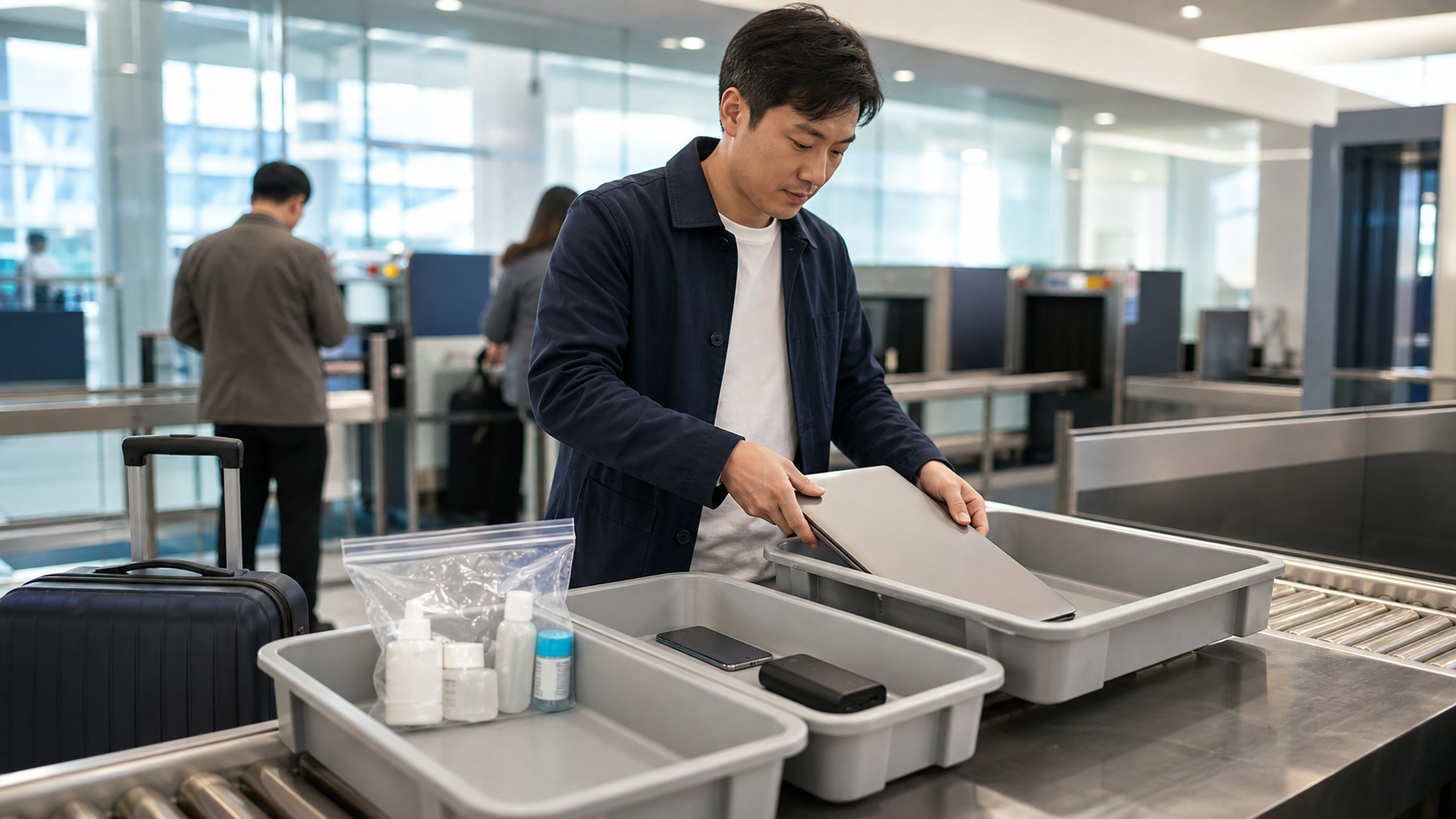
- International-flight liquids: containers of 100 ml/100 g or less inside one transparent, resealable bag of no more than one liter per passenger.
- Domestic-flight liquids: different limits apply; cosmetics and drinks are generally treated differently from international departures.
- Knives, scissors and tools: do not place prohibited sharp items in carry-on baggage; ask the airline about checked-baggage acceptance.
- Medicine and baby food: exceptions may apply, but declare them and carry supporting information when appropriate.
Power banks: the rule travelers most often miss
Haneda Airport’s April 2026 notice states that mobile batteries must not be placed in checked baggage and must be carried in the cabin. The notice limits passengers to two batteries, each rated at 160 Wh or less, and asks travelers to protect terminals with tape or separate bags to prevent short circuits. It also says not to charge the power bank from an onboard outlet or use it to charge another device during the flight.
Check the printed Wh rating. If only mAh and voltage are shown, the usual calculation is Wh = mAh × V ÷ 1,000. A missing or unreadable label can cause problems because staff cannot confirm capacity. Airline rules may be stricter, so the carrier’s dangerous-goods page remains the final check.
International-flight liquid rules
For an international departure from Japan, liquids, aerosols and gels in carry-on baggage must generally be in individual containers no larger than 100 ml or 100 g. All containers must fit comfortably inside one transparent, resealable plastic bag with a capacity of no more than one liter, and each passenger may carry one bag.
The container size matters, not the amount left inside. A 200 ml bottle containing only 20 ml is still oversized. Toothpaste, creams, gels, liquid cosmetics and many spreadable products count as liquids.
Prepare the bag before reaching the checkpoint and place it in the tray when instructed. Do not rely on receiving a suitable bag at the airport.
Domestic flights are different
Japan’s domestic-flight liquid rules are not identical to international rules. Haneda’s guidance says ordinary drinks may be carried, while cosmetics and toiletry liquids generally have per-container and per-passenger limits. Flammable or dangerous liquids remain prohibited regardless of size.
If a domestic flight connects to an international departure, pack for the international segment from the beginning unless you will check or repack the item between flights.
Medicine, baby food and special needs
Liquid medicine, dietary products required for a medical condition, and baby food needed during the journey can receive exceptions to standard liquid limits. Declare them to screening staff. Carry the original label, prescription copy or doctor’s information when practical, especially for an unusual quantity or injectable medicine.
Security permission does not replace customs or drug-import rules. A medicine can pass screening yet still require import approval, so check Japan’s medicine rules separately.
Duty-free liquids and connections
Liquids bought after security at a Japanese airport may be allowed on the departing flight, but a later checkpoint in another country can apply different rules. Security tamper-evident bags and proof of purchase may be required, and opening the sealed bag can invalidate the protection.
Tell the duty-free shop your full itinerary before buying a large liquid. When connecting, follow the rules of the transfer airport rather than assuming the Japanese receipt is sufficient.
Sharp objects, tools and souvenirs
Kitchen knives, craft blades and many tools are not suitable for carry-on baggage. If the airline accepts them in checked baggage, pack them securely so baggage handlers cannot be injured. Replica weapons and some sporting goods can also cause difficulties.
Japanese souvenir shops may offer knives or scissors, but retail sale does not mean cabin acceptance. Ask the airline before purchasing if you have no checked bag.
At the checkpoint
- Have your boarding pass ready and follow the lane signs.
- Remove metal items and outerwear when instructed.
- Place laptops, tablets and the liquid bag in trays as directed.
- Do not photograph security equipment or staff.
- If a bag is selected for inspection, answer calmly and do not touch it until permitted.
Procedures vary with equipment and current security requirements. Follow staff instructions even if they differ from your previous airport.
Frequently asked questions
Can a power bank go in my checked suitcase?
No. Carry it in the cabin, protect the terminals and confirm the capacity and airline limit.
Does a half-empty 150 ml bottle meet the international liquid rule?
No. The container itself must be 100 ml/100 g or smaller.
Can I carry bottled water on a domestic flight?
Ordinary drinks are generally permitted on Japanese domestic flights, but screening may be required. International departures use the stricter liquid rule before security.
Are duty-free liquids always safe for a connection?
No. The transfer airport’s rules apply. Ask the shop and airline before purchase.
Summary
Keep power banks and spare lithium batteries in carry-on baggage, pack international liquids in 100 ml containers inside one one-liter bag, and check special items with the airline. Domestic and international rules differ, while connecting airports may re-screen duty-free liquids.