

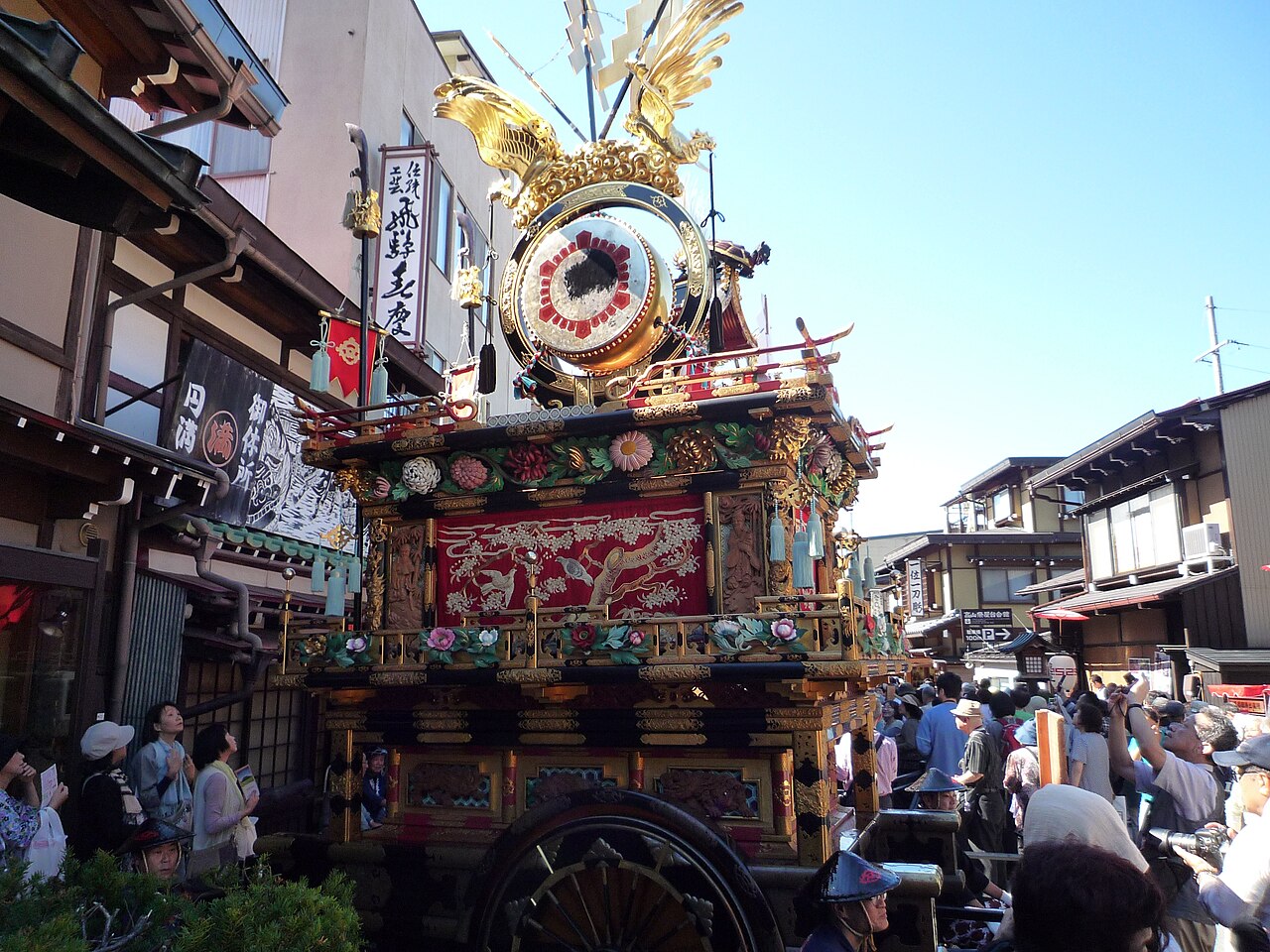
Information verified: August 28, 2026. The Chubu region spans a vast area from the mountains of Hida and the Hokuriku coast to the Tokai plains, and each area preserves its own distinctive traditional festivals. Among them, the Takayama Festival (Gifu), counted among “Japan’s Three Most Beautiful Festivals”; the Kanazawa Hyakumangoku Festival (Ishikawa), which celebrates the glory of the Kaga domain; and the Owari-Tsushima Tenno Festival (Aichi), one of Japan’s Three Great River Festivals, are must-see events representing the region. Dates are broadly consistent year to year, but please check each official website for the latest information before you travel.
Takayama Festival — Ornate Floats and Master Craftsmanship
Held twice a year, in spring and autumn, as the grand festival of Hie Shrine and Sakurayama Hachimangu Shrine in Hida-Takayama, this event is counted among “Japan’s Three Most Beautiful Festivals,” alongside Kyoto’s Gion Festival and Saitama’s Chichibu Night Festival. The magnificent float event is registered as UNESCO Intangible Cultural Heritage, and the floats, adorned with intricate mechanical dolls and carvings, are so beautiful they’ve been called a “moving Yomeimon Gate.”
| Item | Details |
|---|---|
| Dates | The Spring Festival (Sanno Matsuri) is held every April 14–15; the Autumn Festival (Hachiman Matsuri) every October 9–10 (October 9–10, 2026) |
| Main venue | Takayama City center, Gifu Prefecture (around Hie Shrine and the old government house in spring; around Sakurayama Hachimangu Shrine in autumn) |
| Access | About 10 minutes on foot from JR Takayama Line “Takayama” Station to the festival venue |
| Cost | Free to watch from the street, including the float displays and mechanical doll performances |
| Official website | Hida-Takayama official tourism site (Takayama Festival) |
Highlights include the “Gojunko” procession of about 300 people in traditional costume, and the “Karakuri Hono,” in which mechanical dolls mounted on the floats perform astonishingly intricate movements. The “Yomatsuri” night parade on the first evening sees lantern-lit floats slowly moving through the darkened streets — a truly enchanting sight. Note that rain moves the display indoors to the float storehouses, so check the weather in advance.
Kanazawa Hyakumangoku Festival — A Splendid Procession Celebrating the Kaga Domain
Held every June to commemorate the entry of Maeda Toshiie, founding lord of the Kaga domain, into Kanazawa Castle, this is Kanazawa City’s largest event. In the centerpiece “Hyakumangoku Procession,” a well-known actor plays Lord Maeda Toshiie as a colorful parade of Kaga lion dancers, Kaga firefighters, and armored warriors marches for about four hours from Kanazawa Station to Kanazawa Castle Park.
| Item | Details |
|---|---|
| Dates | A three-day event in early June each year (June 5–7, 2026; the Hyakumangoku Procession runs 14:00–18:00 on June 6) |
| Main venue | Kanazawa City center, Ishikawa Prefecture (from the east plaza of Kanazawa Station to Kanazawa Castle Park and Kenrokuen area) |
| Access | Walking distance from the east exit of JR “Kanazawa” Station |
| Cost | Free to watch from the street (paid viewing seats also available) |
| Official website | Kanazawa Hyakumangoku Festival official website |
Highlights include the powerful Kaga lion dance, a registered cultural property, and the acrobatic ladder-top performances of the Kaga firefighter procession in their distinctive happi coats. Departing from the drum gate at Kanazawa Station and entering the castle through Ishikawa Gate, the Hyakumangoku Procession unfolds on a scale reminiscent of a scene from the age of the samurai. Expect major traffic restrictions in the city center on parade day, so public transportation is recommended.
Owari-Tsushima Tenno Festival — A Tableau of Light and Water Among Japan’s Great River Festivals
With a history spanning nearly 600 years as the grand festival of Tsushima Shrine, this spectacular event is counted among “Japan’s Three Great River Festivals.” At the evening festival, five “makiwara-bune” boats decorated with around 500 lanterns float down the Tenno River, their lights creating a dreamlike scene reflected on the water’s surface. It is also one of the component festivals of UNESCO’s Intangible Cultural Heritage “Yama, Hoko, Yatai” float festivals.
| Item | Details |
|---|---|
| Dates | The fourth Saturday of July and the following day each year (Evening Festival July 25, Morning Festival July 26, 2026) |
| Main venue | Tsushima Shrine and Tenno River Park, Tsushima City, Aichi Prefecture |
| Access | About 15 minutes on foot from Meitetsu “Tsushima” Station |
| Cost | Free to watch from the street (paid stand seating also available) |
| Official website | Tsushima City Tourist Association (Owari-Tsushima Tenno Festival) |
The highlight is the striking contrast between the evening festival, when lantern-lit boats glide slowly down the Tenno River in a dreamlike scene, and the following morning’s “Morning Festival,” when boats decorated with figures from Noh theater cross the river in a bold display. Seeing the festival’s two entirely different faces — one by night, one by morning — is the true pleasure of this event. Expect traffic restrictions and crowded parking near the venue, so public transportation is recommended.
Tips for Enjoying Chubu’s Festivals
Because the Takayama Festival (April and October), the Kanazawa Hyakumangoku Festival (June), and the Owari-Tsushima Tenno Festival (July) fall at very different times of year, you can plan a trip around whichever festival culture of the Chubu region interests you most. All three impose traffic restrictions around the venue, so if driving, check in advance for temporary parking and shuttle bus information.
Since rain can cancel the float parade at the Takayama Festival, it’s a good idea to have a backup plan for wet weather. The Owari-Tsushima Tenno Festival takes place in the height of summer humidity, so don’t forget heatstroke precautions such as a hat and plenty of water.
FAQ
Are the spring and autumn Takayama Festivals different?
The Spring Festival (Sanno Matsuri) is the grand festival of Hie Shrine, while the Autumn Festival (Hachiman Matsuri) is the grand festival of Sakurayama Hachimangu Shrine, each featuring different floats. Enjoying both twice a year is one of the unique features of the Takayama Festival.
Do these festivals go ahead in the rain?
At the Takayama Festival, the floats are not paraded in the rain and are displayed instead in their storehouses. The Kanazawa Hyakumangoku Festival and the Owari-Tsushima Tenno Festival generally proceed in light rain, though severe weather may change or cancel events — check each official website for updates.
Can I visit as a day trip from Tokyo or Osaka?
Takayama and Kanazawa can be visited as a day trip from Tokyo or Osaka using the shinkansen or limited express trains, though travel times are fairly long, so staying overnight is recommended. The Owari-Tsushima Tenno Festival is only about 30 minutes by train from Nagoya, making it easy to visit in a day.
Are these festivals suitable for children?
All three are popular with families and offer plenty of festival food. Crowds build up in the evening and on parade day, so keep an eye on children to avoid getting separated, and follow staff instructions to watch from a safe location.
Official references: Hida-Takayama official tourism site (Takayama Festival) / Kanazawa Hyakumangoku Festival official website / Tsushima City Tourist Association (Owari-Tsushima Tenno Festival)