

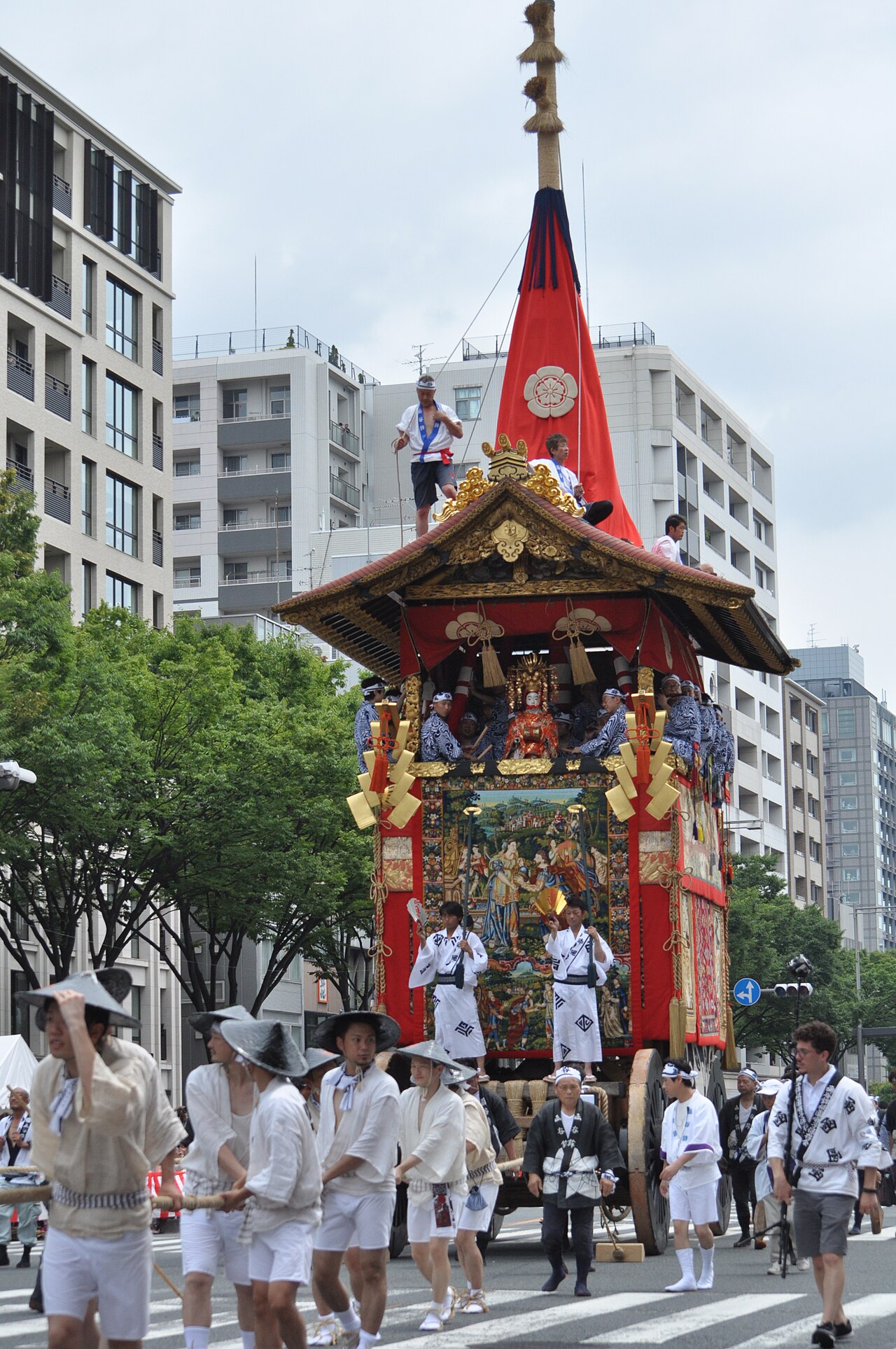
Information verified: August 28, 2026. Centered on the thousand-year-old capital of Kyoto, the Kansai region preserves many of Japan’s most iconic traditional festivals. Among them, the Gion Festival (Kyoto) and Tenjin Festival (Osaka), both counted among “Japan’s Three Great Festivals,” along with the Nada Fighting Festival (Hyogo), one of “Japan’s Three Wild Mikoshi Festivals,” are must-see events symbolizing Kansai’s festival culture. Dates are broadly consistent year to year, but please check each official website for the latest information before you travel.
Gion Festival — A Thousand Years of History, Foremost Among Japan’s Three Great Festivals
Said to have begun in the Heian period as a grand festival of Yasaka Shrine, this month-long event is Kyoto’s largest festival. The highlight, the “Yamahoko Junko” parade, sees ornately decorated floats — so lavish they’re called a “moving art museum” — process through the streets of Kyoto. A distinctive feature is that the parade is held twice, in a “Saki Matsuri” (earlier festival) and an “Ato Matsuri” (later festival).
| Item | Details |
|---|---|
| Dates | A month-long event from July 1–31; the Yamahoko parade runs July 17 (Saki Matsuri) and July 24 (Ato Matsuri) — same dates in 2026 |
| Main venue | Central Kyoto City, Kyoto Prefecture (Shijo-dori, Kawaramachi-dori, Oike-dori) and Yasaka Shrine |
| Access | A short walk from Keihan Main Line “Gion-Shijo” Station or Hankyu Kyoto Line “Kyoto-Kawaramachi” Station |
| Cost | Free to watch from the street (paid viewing seats also available) |
| Official website | Gion Festival Yamahoko Federation official website |
Highlights include the dramatic “tsujimawashi,” in which the massive floats are wheeled around street corners, and “Yoiyama,” the evening before the parade when the floats are beautifully lit up. During Yoiyama, the streets become pedestrian-only and fill with food stalls. The Gion Festival also has historical roots as a prayer to ward off plague, and remains a beloved symbol of the Kyoto summer.
Tenjin Festival — Boat Processions and Dedication Fireworks Lighting Up Water City Osaka
With roughly 1,000 years of history as the grand festival of Osaka Tenmangu Shrine, this is one of Japan’s Three Great Festivals. The biggest highlight is the “Funa-Togyo,” a procession of around 100 boats along the Okawa River, where flotillas lit by bonfires and lanterns combine with dedication fireworks bursting over the water — a defining scene of the Osaka summer.
| Item | Details |
|---|---|
| Dates | Every year on July 24–25 (same dates in 2026; the land procession, boat procession, and dedication fireworks take place on the 25th) |
| Main venue | Osaka Tenmangu Shrine and the Okawa River (former Yodo River) area, Osaka City, Osaka Prefecture |
| Access | A short walk from Osaka Metro Tanimachi/Sakaisuji Line “Minami-Morimachi” Station or JR “Osaka Tenmangu” Station |
| Cost | Free to watch from the street (paid viewing boats and seats also available) |
| Official website | Osaka Tenmangu Shrine Tenjin Festival official information |
Highlights include the “Riku-Togyo” land procession beginning in the late afternoon of the 25th, followed by the “Funa-Togyo” boat procession, where boats carrying portable shrines, festival drummers, and lion dancers move along the Okawa River as around 4,000 dedication fireworks light up the sky from the far bank. Both riverbanks and the bridges make excellent viewing spots, drawing large crowds every year.
Nada Fighting Festival — Mikoshi Crash Together in One of Japan’s Three Wild Mikoshi Festivals
The autumn grand festival of Matsubara Hachiman Shrine, this powerful event is counted among “Japan’s Three Wild Mikoshi Festivals.” Three portable shrines are violently crashed together in the “mikoshi-awase,” while seven gorgeous festival floats compete in a display of carrying prowess — an intensely thrilling event known as the “Fighting Festival” for its rough-and-tumble nature.
| Item | Details |
|---|---|
| Dates | Every year on October 14–15 (fixed dates; same in 2026) |
| Main venue | Matsubara Hachiman Shrine and the Hirobatake festival ground, Himeji City, Hyogo Prefecture |
| Access | About 10–15 minutes on foot from JR San’yo Main Line “Harima-Katsuhara” Station or Sanyo Electric Railway “Shirahamanomiya” Station |
| Cost | Free to watch (paid stand seating also available) |
| Official website | Nada Fighting Festival official website |
The highlight is the “mikoshi-awase” on the 15th, the festival’s main day, when bearers violently crash three portable shrines together — it’s not unusual for the shrines to be damaged in the process. The sight of all seven festival floats being carried together at the festival ground is equally breathtaking, making this one of the fiercest and most powerful festivals in the Banshu region.
Tips for Enjoying Kansai’s Festivals
Because the Gion Festival and Tenjin Festival are concentrated in late July, careful planning can let you enjoy both Kyoto’s and Osaka’s summer festivals on the same trip. The Nada Fighting Festival is held in October, making it a good choice for an autumn visit. All draw very large crowds, so use public transportation and plan to arrive early.
Booking paid viewing seats or boats in advance for the Tenjin Festival’s fireworks and boat procession guarantees a good vantage point. At the Nada Fighting Festival, the mikoshi collide violently, so follow staff instructions and keep a safe distance while watching.
FAQ
Does the Gion Festival really last a whole month?
Yes — the Gion Festival features various rites continuing from July 1 to 31. The Yamahoko parade (Saki Matsuri on 7/17, Ato Matsuri on 7/24) and the Yoiyama evenings are especially popular with visitors.
Do these festivals go ahead in the rain?
The Gion Festival’s Yamahoko parade and the Tenjin Festival generally proceed in light rain, though some events may be cancelled or changed in severe weather such as a typhoon. The Nada Fighting Festival also generally proceeds in rain, but check the official website for details.
Can I visit as a day trip from Tokyo?
Kyoto and Osaka can be visited as a day trip from Tokyo using the shinkansen (about 2 hours 15 minutes to Kyoto or Shin-Osaka). However, the festivals draw huge crowds, so staying overnight is recommended.
Are these festivals suitable for children?
The Gion Festival and Tenjin Festival are both popular with families and offer plenty of festival food. Because the Nada Fighting Festival involves violently colliding mikoshi, families with young children should watch from a safe location.
Official references: Gion Festival Yamahoko Federation official website / Osaka Tenmangu Shrine Tenjin Festival official information / Nada Fighting Festival official website