

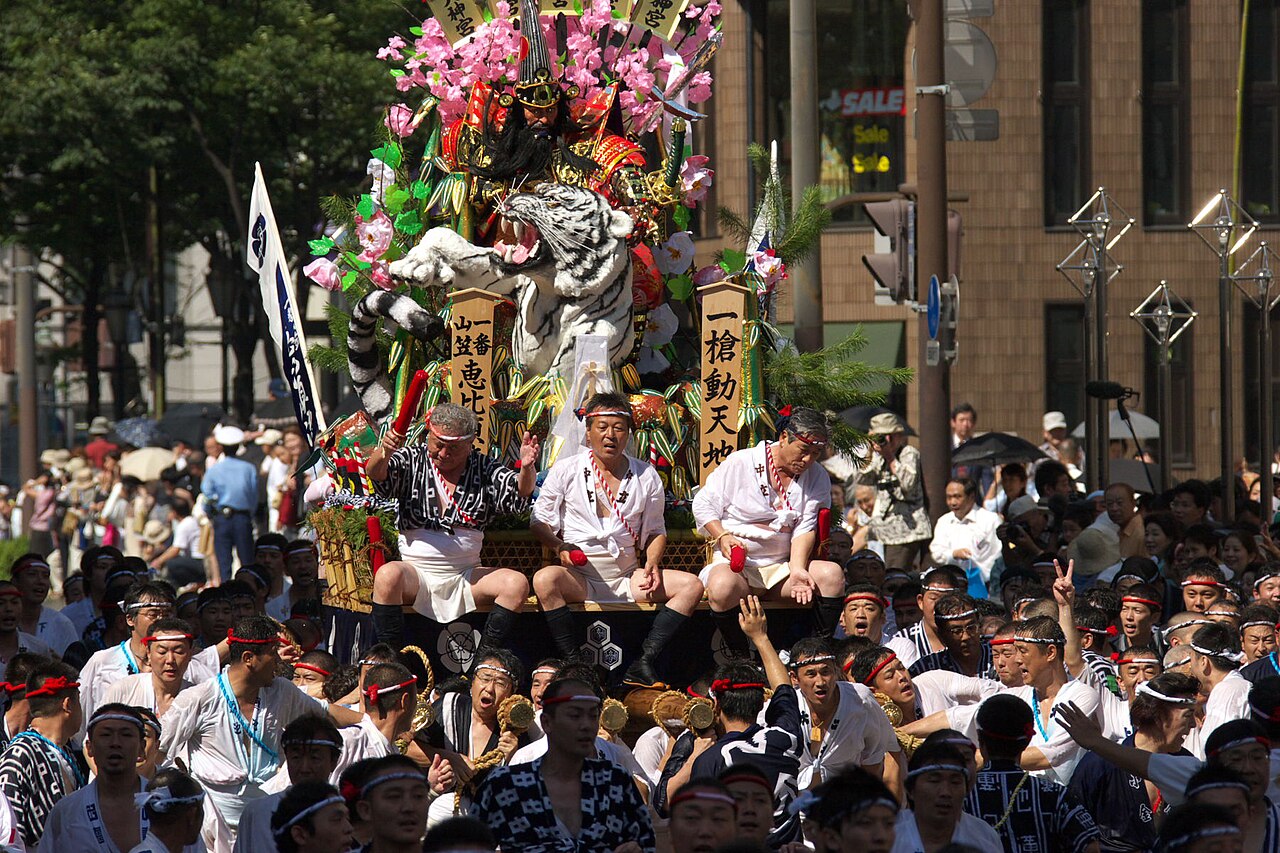
Information verified: August 29, 2026. Kyushu’s seven prefectures and Okinawa are home to an extraordinary range of festivals, from a UNESCO Intangible Cultural Heritage event to a celebration of Okinawa’s unique Eisa dance culture. This guide covers three standouts: the “Hakata Gion Yamakasa,” where towering floats race through the streets of Hakata (Fukuoka); the “Nagasaki Kunchi,” one of Japan’s “Three Great Kunchi Festivals” with its exotic performances (Nagasaki); and the “Okinawa All-Island Eisa Festival,” the largest Eisa event in Okinawa Prefecture (Okinawa). Dates are broadly consistent year to year, but please check each official website for the latest information before you travel.
Hakata Gion Yamakasa — A UNESCO Intangible Cultural Heritage Festival of Racing Floats Through the Streets of Hakata
Centered on Kushida Shrine in Fukuoka City’s Hakata Ward, this summer festival has roughly 780 years of history. Magnificent “kazariyama” display floats are set up throughout the city, while the festival’s climax — the “Oiyama” race on the early morning of July 15 — sees teams of men in traditional happi coats carrying “kakiyama” floats weighing over a ton, racing through about 5 kilometers of Hakata’s streets. The festival was inscribed on the UNESCO Intangible Cultural Heritage list in 2016.
| Item | Details |
|---|---|
| Dates | Every year July 1–15 (the climactic “Oiyama” race begins around 4:59 am on the morning of the 15th) |
| Main venue | Kushida Shrine and the surrounding Hakata district, Fukuoka City, Fukuoka Prefecture |
| Access | About a 15-minute walk from JR Hakata Station, or a 5-minute walk from Gion Station on the subway |
| Cost | Free to watch from the roadside (paid seating may be available for the Oiyama race) |
| Official website | Hakata Gion Yamakasa official website |
Highlights include the breathtaking speed of the “Yamakasa Time” sprint during the Oiyama race and the electric atmosphere created by the bearers’ rhythmic chants. Throughout the festival period, elaborately decorated kazariyama floats are displayed around the Hakata district, offering a chance to admire their craftsmanship up close. Many spectators arrive the night before to claim a good viewing spot for the early-morning Oiyama race, so plan to arrive early.
Nagasaki Kunchi — One of Japan’s Three Great “Kunchi” Festivals, Rich with Exotic Flair
This autumn grand festival of Suwa Shrine, the guardian shrine of Nagasaki City, is counted among Japan’s “Three Great Kunchi Festivals.” Reflecting the city’s long history of exchange with China and the Netherlands, neighborhood groups called “odorichō” present elaborately choreographed performances such as the dragon dance (“Ja-odori”) and the “Kokkodesho,” in which a portable shrine is tossed high into the air. Each neighborhood takes its turn performing once every seven years, a tradition carried on for centuries.
| Item | Details |
|---|---|
| Dates | Traditionally fixed on October 7–9 each year (a preview event, “Niwamise,” is held the day before on October 6) |
| Main venue | Suwa Shrine, the plaza in front of Nagasaki Public Hall, the Otabisho, and other locations around Nagasaki City, Nagasaki Prefecture |
| Access | About a 20-minute ride by streetcar or on foot from JR Nagasaki Station |
| Cost | Some performance venues can be viewed for free; paid seating is available at venues such as Suwa Shrine |
| Official website | Nagasaki Kunchi official website (Nagasaki Traditional Performing Arts Promotion Association) |
Highlights include the “Ja-odori” dragon dance, whose serpentine movements make the dragon appear alive, and the “Kokkodesho,” a powerful display in which a heavy portable shrine weighing up to a ton is thrown and caught by its bearers. At the “Niwamise” preview held before the main festival, visitors can get a close-up look at each neighborhood’s costumes and props.
Okinawa All-Island Eisa Festival — Okinawa’s Largest Celebration of Traditional Eisa Performance
Held in Okinawa City (also known as Koza), this is the largest Eisa festival in Okinawa Prefecture. Eisa is a traditional Okinawan performing art danced during the Bon holiday season to send off the spirits of ancestors, and the sight of performers moving in unison to powerful taiko drumming is spectacular. Dozens of groups take part, mainly neighborhood youth associations from across the prefecture, with performers occasionally coming from Okinawa’s outlying islands as well.
| Item | Details |
|---|---|
| Dates | Three days in early September each year (the 71st festival in 2026 is scheduled for September 4–6) |
| Main venue | Koza Athletic Park Stadium and the central shopping district (for the opening day’s street parade), Okinawa City, Okinawa Prefecture |
| Access | About a 1-hour bus or car ride from central Naha |
| Cost | The opening day’s “Michi-junee” street parade can be watched for free along the route. The stadium performances on the second and final days require paid tickets (some free viewing areas are also available) |
| Official website | Okinawa All-Island Eisa Festival official website |
Highlights include the overwhelming energy created as taiko drumming, whistling, and rhythmic chanting fill the venue all at once. On the opening day’s “Michi-junee” parade, groups perform as they move along Okinawa City’s main streets, letting visitors enjoy powerful performances up close for free. On the second and final days, the stadium hosts full-scale stage performances by multiple groups.
Tips for Enjoying Kyushu and Okinawa’s Festivals
The Hakata Gion Yamakasa runs in early-to-mid July, the Nagasaki Kunchi in early October, and the Okinawa All-Island Eisa Festival in early September — since the three fall in different months, it’s worth picking your destination to match your travel dates. All three draw large crowds, so using public transportation and booking accommodation early is recommended.
To watch the Hakata Gion Yamakasa’s climactic Oiyama race, arriving early to claim a spot along the route is essential. Seating tickets for the Nagasaki Kunchi can sell out early, so advance booking is worthwhile. Stand tickets for the Okinawa All-Island Eisa Festival are also popular, so it’s best to check the official website well in advance.
FAQ
Can anyone watch the Hakata Gion Yamakasa?
Yes, roadside viewing is generally free. The route of the Oiyama race gets extremely crowded, though, so arrive early if you want a good spot.
Do these festivals go ahead in the rain?
Both the Hakata Gion Yamakasa and the Nagasaki Kunchi generally proceed rain or shine. The Okinawa All-Island Eisa Festival also generally proceeds in light rain, but the schedule or content may change if a typhoon approaches, so check the official website for the latest information.
Can I visit Fukuoka, Nagasaki, and Okinawa all on one trip?
Since the three festivals are held in July, October, and September respectively, seeing all of them on a single trip is difficult — visiting on separate trips is recommended.
Are these festivals suitable for children?
All three festivals are popular with families. That said, the Hakata Gion Yamakasa’s Oiyama race and some of the Nagasaki Kunchi’s dedicated performances take place in the early morning or at night, so families with young children should choose viewing times that work well for them.
Official references: Hakata Gion Yamakasa official website / Nagasaki Kunchi official website / Okinawa All-Island Eisa Festival official website