

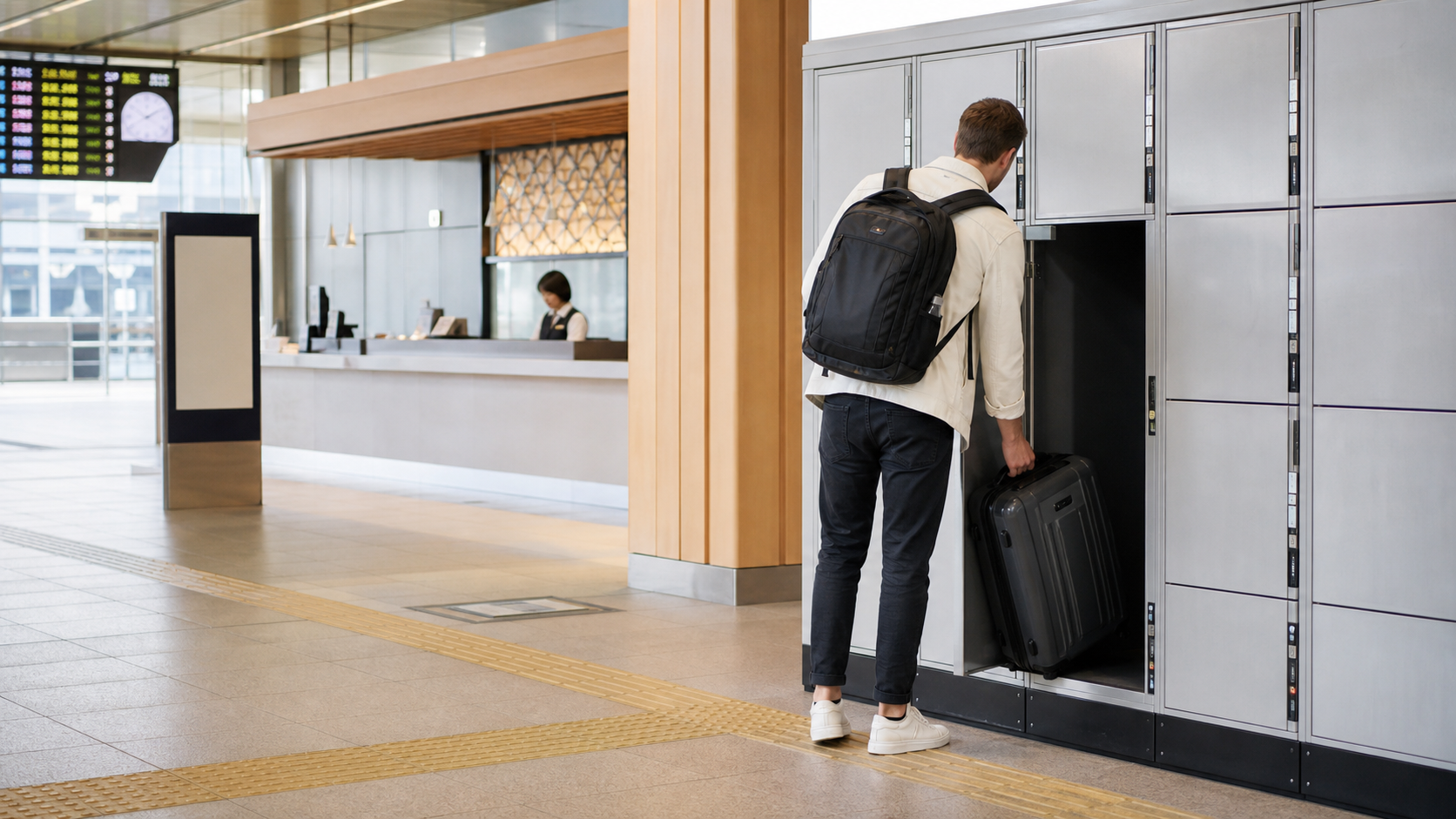
Dragging a suitcase through a crowded Japanese station can turn a simple transfer into the hardest part of the day. The good news is that travelers usually have three practical choices: a station locker, staffed storage, or luggage delivery. This guide helps you choose the right one, avoid full-locker surprises, and keep essentials with you.
Information checked: August 30, 2026. Prices, counter hours, acceptance limits and delivery times vary by operator and location, so confirm them before paying.
Quick decision: locker, counter or delivery?
| Option | Best for | Main limitation |
|---|---|---|
| Station coin locker | A few hours in the same area | Large lockers may be full; you must return to the same location |
| Staffed storage counter | Oversize bags or stations with full lockers | Opening and final collection times matter |
| Luggage delivery | Hotel-to-hotel or airport-to-hotel travel | Usually not instant; the receiving address must be able to accept it |
How station coin lockers work
- Photograph the locker bank, station exit and nearby landmark before leaving.
- Check the displayed size, fee and permitted storage period.
- Place the bag fully inside and close the door without forcing it.
- Pay by the method shown. Some lockers accept cash, while IC-card lockers can use a supported transit card as both payment and key.
- Take the receipt or save the locker number and instructions.
JR East explains that a Suica-compatible locker uses the card as the key and advises users to keep the receipt, which shows the locker location and contact details. Availability, dimensions and fees are not uniform, and lockers can be moved during station work. Check the specific station rather than relying on an old price chart.
What to do when large lockers are full
Do not spend an hour circling the same concourse. Try a staffed baggage counter, a less central station on your route, or delivery to your next hotel. At a huge interchange, confirm that an alternative locker is still convenient for your departure line; two locker banks inside the same station can be a long walk apart or separated by ticket gates.
Using staffed luggage storage
A counter is often the simplest solution for a large suitcase, stroller or unusually shaped bag. Before handing it over, check the closing time, last collection time, accepted dimensions, prohibited contents and what identification or claim ticket is required. Build a time buffer before your train: a counter may be in another terminal or station zone.
How hotel-to-hotel luggage delivery works
- Ask the sending hotel whether it can accept and dispatch courier luggage.
- Confirm that the next accommodation has a staffed reception and will receive a bag before you arrive.
- Show the destination’s name, address, telephone number, reservation name and check-in date.
- Choose a delivery date only after the counter confirms the route and lead time.
- Keep the waybill and tracking details until the bag arrives.
JNTO notes that major airports and many hotels offer delivery or storage services. Yamato’s official visitor guidance also warns that accommodation without reception staff, including some private rentals, may not be eligible for direct pickup or delivery. In that situation, ask about a staffed sales office; do not address a parcel to a convenience store for collection.
Airport delivery needs extra time
Sending a bag to an airport is different from same-day storage. Ask the carrier for the required drop-off deadline, eligible terminal counter and collection hours. Allow a conservative buffer rather than planning around your flight’s departure time alone. Put your passport, travel documents, medication, valuables and one change of clothes in your carry-on.
Never put these essentials in a forwarded suitcase
- Passport, residence card or other identity documents
- Cash, cards, keys and irreplaceable valuables
- Medication and medical devices needed during the delivery window
- Tickets, chargers and batteries needed that day
- Fragile, perishable, leaking or prohibited items
Carrier limits differ. JNTO gives general examples for size, weight, value and prohibited contents, but the accepting operator’s current rules control your shipment.
A practical two-night example
If you travel from Tokyo to Kyoto with a one-night stop in Hakone, send the large suitcase from Tokyo to your Kyoto hotel and carry a small overnight bag to Hakone. Confirm Kyoto’s reception and delivery date first. This works better than forwarding the suitcase to every stop and reduces risk when a rural bus or small inn has limited luggage space.
Frequently asked questions
Can I reserve a coin locker?
Some newer services support advance or online arrangements, but many ordinary station lockers remain first-come, first-served. Verify the exact facility.
Can I use a foreign credit card?
Payment methods vary. Carry some yen and a supported IC card as backups rather than assuming every locker accepts cards.
Will my bag arrive the same day?
Only certain counters and routes offer same-day service. Hotel-to-hotel and airport delivery may require one or more days, depending on location and conditions.
Can I send luggage to a vacation rental?
Confirm with both the carrier and host. A property without staffed reception may not accept delivery.
Official resources
- JNTO: Luggage & Storage
- Yamato Transport: Hands-Free Travel
- JR East: Welcome Suica and compatible coin lockers
Takeaway
Use a locker for a short same-area visit, a staffed counter when size or availability is uncertain, and delivery when you are changing cities. Confirm the receiving location and lead time, keep essential items with you, and save every receipt until collection.