

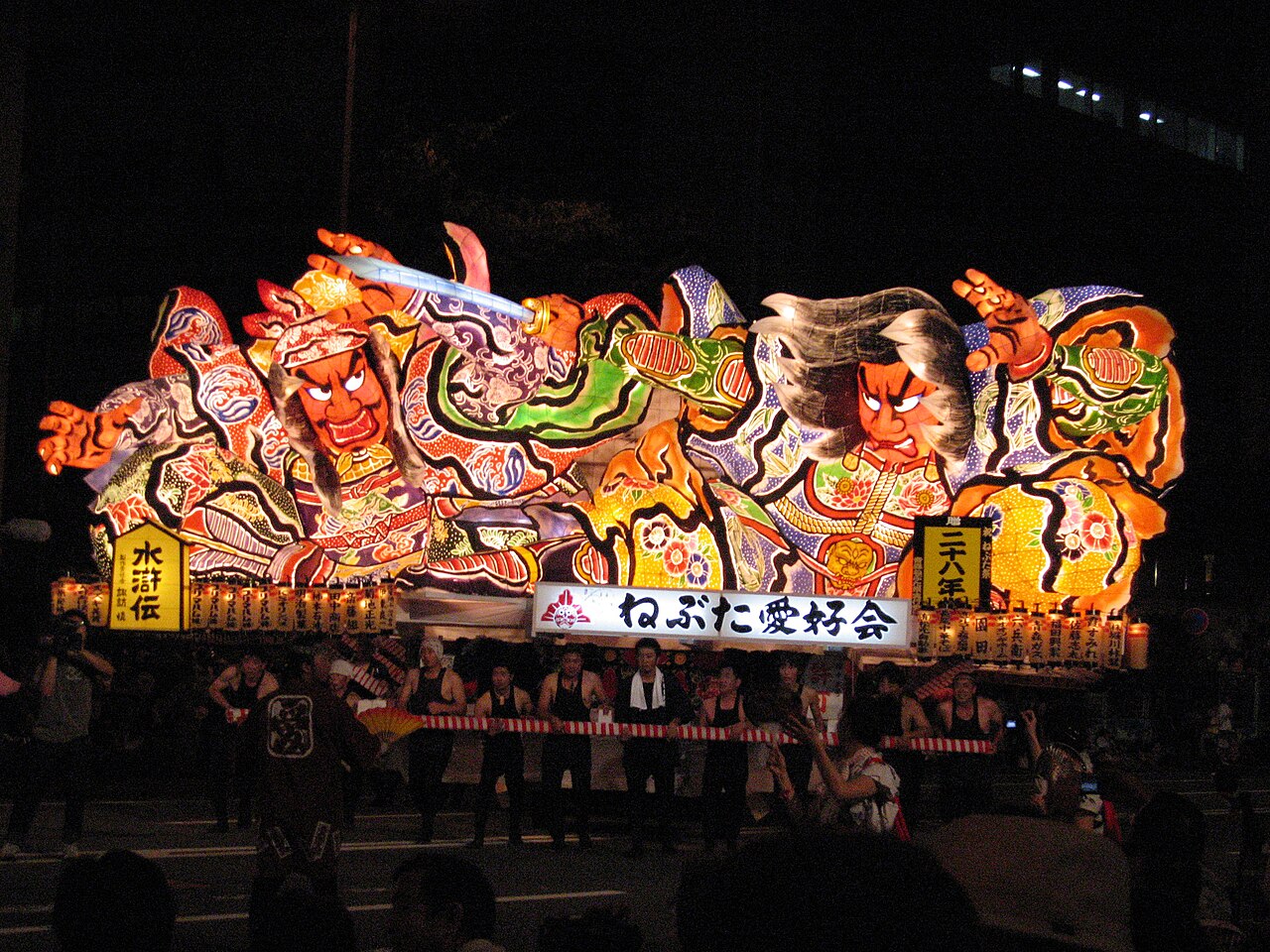
Information verified: August 28, 2026. Every year in early August, the Tohoku region hosts one of Japan’s most concentrated stretches of major summer festivals, held in quick succession across its prefectural capitals. The “Three Great Festivals of Tohoku” — Aomori Nebuta Matsuri, Akita Kanto Matsuri, and Sendai Tanabata Matsuri — are each recognized as Important Intangible Folk Cultural Properties and are must-know events for any visitor to Japan. Dates are largely fixed year to year, but always check the official website before you travel.
Aomori Nebuta Matsuri — giant illuminated floats parade through the night
Enormous, vividly painted floats depicting kabuki and mythological scenes — some 5 meters tall and 9 meters wide — are paraded through the streets of Aomori City to the beat of drums and flutes. Designated an Important Intangible Folk Cultural Property, the festival draws several million visitors over its run. Dancers called “haneto” leap and hop through the streets shouting “Rassera,” adding to the electric atmosphere.
| Item | Details |
|---|---|
| Typical dates | Every year, August 2–7 (a preview night is held August 1) |
| Main venues | Central Aomori City (the parade route around Shinmachi-dori and Hakkoda-dori) |
| Access | Walking distance from JR Aomori Station |
| Admission | Free to watch from the roadside (paid seating available) |
| Official site | Aomori Nebuta Matsuri official website |
The highlight is the dramatic effect of the floats lit from within after dark. On the afternoon of August 7, the award-winning floats parade once more, and that night a special “Nebuta Ocean Parade” and fireworks display cap off the festival. Visitors can even rent haneto costumes with advance registration and dance in the parade themselves.
Akita Kanto Matsuri — a display of balance skill honoring a good harvest
Performers balance long bamboo poles hung with rows of paper lanterns shaped like sheaves of rice — poles that can weigh around 50 kg — on their palms, foreheads, shoulders, and hips, in a tradition dating back to the Edo period. After dark, the countless lantern lights filling the night sky are a breathtaking sight, symbolizing a prayer for a bountiful harvest. It, too, is a nationally designated Important Intangible Folk Cultural Property.
| Item | Details |
|---|---|
| Typical dates | Every year, August 3–6 |
| Main venues | Central Akita City (Kanto Odori avenue) |
| Access | About a 10-minute walk from JR Akita Station |
| Admission | Free to watch from the roadside (paid seating available) |
| Official site | Akita Kanto Matsuri official website |
The highlight is watching skilled performers deftly control the towering kanto poles. Daytime sessions let visitors get a close look at the poles and techniques, and there are hands-on corners where visitors can try balancing one themselves. Pairing the daytime demonstrations with the main nighttime performance is the best way to experience it fully.
Sendai Tanabata Matsuri — an elaborate Tanabata display in the “City of Trees”
One of Japan’s largest Tanabata festivals, filling the shopping arcades of central Sendai with thousands of large, colorful paper streamers (“fukinagashi”). Said to date back to the era of feudal lord Date Masamune, the decorations traditionally include seven auspicious ornaments — including kusudama globes, streamers, and paper strips — each carrying its own meaning.
| Item | Details |
|---|---|
| Typical dates | Every year, August 6–8 (a fireworks display is held the night before, August 5) |
| Main venues | Central Sendai (the covered shopping arcades around Ichibancho and Chuo-dori) |
| Access | Walking distance from JR Sendai Station |
| Admission | Free to view |
| Official site | Sendai Tanabata Matsuri official website |
The highlight is the sheer spectacle of the lavish decorations overhead throughout the arcades. Each shop commissions its own display, sometimes costing hundreds of thousands of yen, and the increasingly creative designs are a talking point every year. The fireworks display the night before lights up Sendai’s summer sky, and many visitors combine both events into one trip.
Tips for enjoying Tohoku’s three great festivals
Because all three festivals are held within roughly the same week in early August, a well-planned itinerary can let you experience more than one on a single trip. That said, hotels across Tohoku’s major cities fill up fast during this period, and shinkansen and highway bus seats become hard to book, so make arrangements as soon as your travel dates are set.
Since viewing takes place mostly outdoors in midsummer heat, bring a hat, water, and sunscreen, and pack rain gear just in case. Paid seating is popular at all three festivals, so reserve in advance if you want a guaranteed seat.
FAQ
Can I see all three festivals?
Aomori Nebuta Matsuri (Aug 2–7), Akita Kanto Matsuri (Aug 3–6), and Sendai Tanabata Matsuri (Aug 6–8) overlap partially, so with careful planning around travel time between cities, visiting all three in one trip is possible — but build in a buffer.
Can visitors take part in the festivals?
At Aomori Nebuta Matsuri, anyone can join the dancing by renting a haneto costume with advance registration. Akita Kanto Matsuri and Sendai Tanabata Matsuri are mainly for watching, though hands-on experience corners sometimes appear.
Are the festivals canceled in bad weather?
They generally proceed in light rain, but severe weather can change or shorten the program. Check each official website for the latest updates.
Are these festivals family-friendly?
Yes, all three are popular with families. Crowds get heavy at night, though, so keep an eye on children and stay prepared for the summer heat.
Official references: Aomori Nebuta Matsuri official website / Akita Kanto Matsuri official website / Sendai Tanabata Matsuri official website