
Information checked: August 28, 2026. A typhoon forecast does not automatically mean that every part of Japan will shut down. It does mean that travelers should stop relying on a fixed itinerary. The practical questions are where the hazardous weather will occur, when transport may stop, whether your accommodation is safe, and how much flexibility you have before a flight or long-distance train.
This guide explains how to read official information, prepare without panic, and make sensible decisions before and during a typhoon in Japan.
First: understand what the forecast cone means
The Japan Meteorological Agency (JMA) states that a typhoon’s forecast circle is the area in which the center is expected to be located with 70% probability. It is not a drawing of the storm’s physical size, and the center does not necessarily follow the line through the middle of the circles.
Risk also exists outside the center track. Heavy rain, strong winds, high waves and storm surge can affect a broad area, and dangerous rain may continue after a typhoon becomes an extratropical or tropical depression. Use the JMA tropical-cyclone page together with local warnings and the real-time risk map rather than watching the track alone.
A 48-hour decision timeline
About 48–24 hours before expected impact
- Check the JMA forecast for the prefectures on your route, not only your current city.
- Review airline, shinkansen, local railway and ferry notices on each operator’s official website or app.
- Ask your hotel about extending your stay, cancellation terms and the safest place in the building.
- Move an essential long-distance trip earlier only if the operator is still running normally and the destination is safer.
- Charge devices and a power bank; save booking references and insurance details offline.
About 24–6 hours before expected impact
- Buy modest supplies before shops become crowded: drinking water, food that needs no cooking, necessary medicine and a flashlight.
- Keep passport, wallet, phone, charger and medicine together in a water-resistant pouch.
- Cancel exposed sightseeing such as coastal walks, mountain trails, river activities and observation decks.
- Do not relocate merely to preserve a reservation if transport disruption or local warnings make the journey unsafe.
During the strongest weather
Stay inside a sound building and follow hotel staff and local-authority instructions. Keep away from windows if winds are severe. Do not go outside to photograph waves, rivers or flooded streets. Never enter an underpass or road covered by water: depth and current are hard to judge.
What “planned suspension” means for trains
Japanese operators may announce a planned suspension before hazardous conditions arrive. The first notice can be a possibility or a broad time window; later updates may confirm the affected section and starting time. Service can also remain suspended after the rain and wind ease while tracks, overhead lines and slopes are inspected.
Check the operating company for the exact line. A navigation app may show a timetable without reflecting the newest suspension or crowd control. If a shinkansen or airport train is essential, confirm both the main line and the local connection used to reach the station.
Do not assume that the last train before a suspension will have space. Stations may become crowded, reserved seats may sell out, and connecting services can stop earlier.
Flights, ferries and rental cars
Airlines decide cancellations and changes by flight, airport and operational conditions. Check the airline’s own flight-status page and the departure airport. A flight can be cancelled even if the weather at your hotel looks mild because the aircraft or crew is affected elsewhere.
Ferries are especially sensitive to wind and waves, and disruption may last after the storm passes. Island travelers should keep at least one buffer day before an international departure.
A rental car is not a reliable workaround. Roads can close because of flooding, landslides, fallen trees or high winds. Avoid coastal roads, mountain passes and flooded areas, and follow road-manager and local-government notices.
Should you stay, extend or move?
Stay when your accommodation is in a safe building, local authorities are not directing evacuation, and moving would expose you to worsening weather.
Extend when transport is likely to stop, your next accommodation cannot be reached safely, or your flight has been moved. Ask before checkout time; availability can disappear quickly.
Move earlier only when there is adequate time, transport is operating, the route is not in a warned area, and the destination clearly reduces risk. Moving from one uncertain location to another solely to save a prepaid booking is rarely sensible.
Warnings and evacuation information
JMA warnings and risk maps help show where heavy-rain, landslide, inundation and flood danger is increasing. Evacuation instructions are issued by local municipalities. If hotel staff or authorities tell you to evacuate, follow the designated route and do not wait for conditions to look dramatic.
JNTO recommends its multilingual Safety tips app, which provides push alerts for earthquake, tsunami and weather warnings in multiple languages, plus evacuation guidance and useful phrases. JNTO also provides a 24-hour Japan Visitor Hotline for emergency assistance; verify the current number on the official emergency page before your trip.
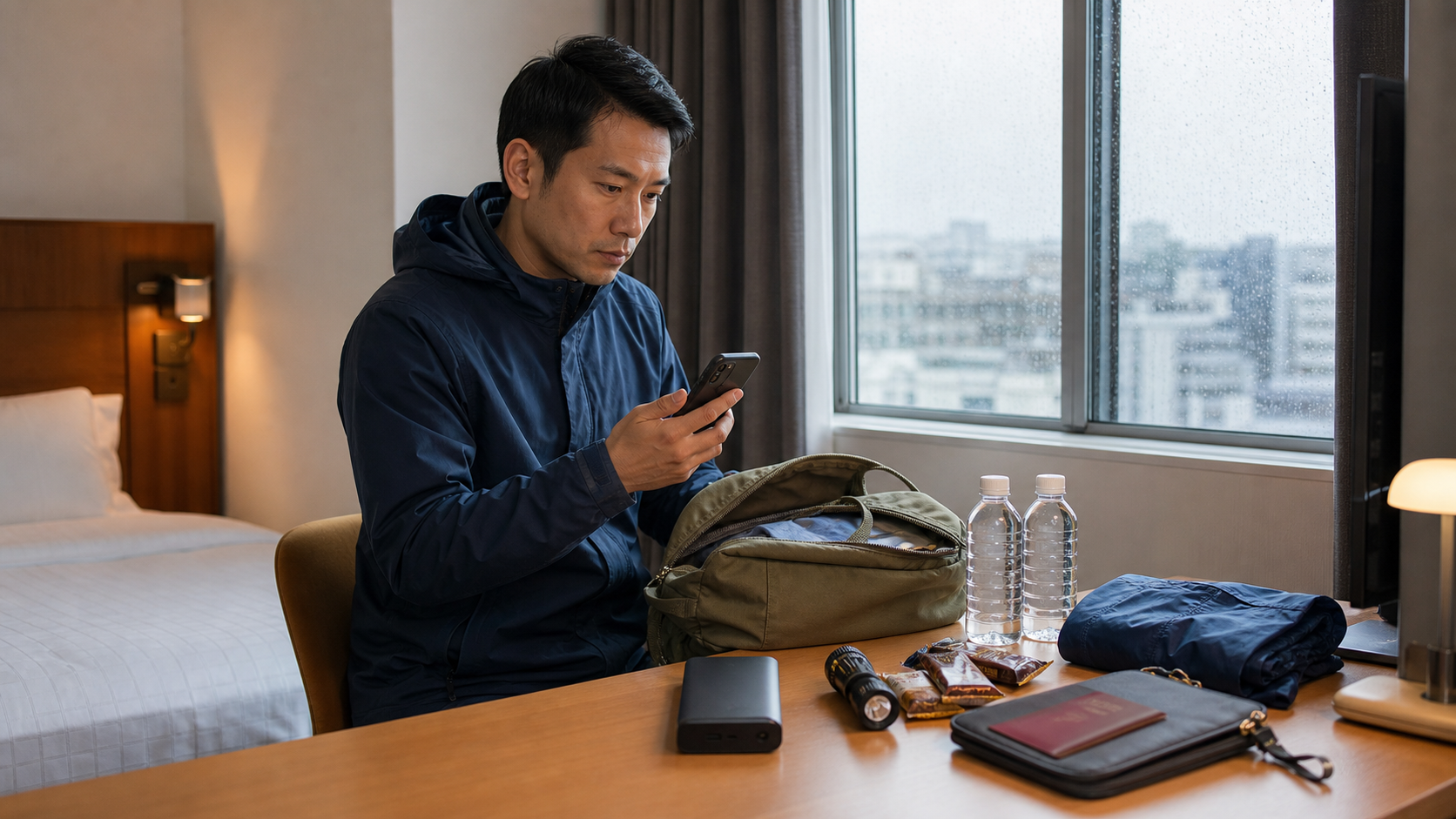
A compact hotel-room kit
- Phone, charging cable and charged power bank
- Passport, payment cards and some cash
- Regular medicine and a copy of prescriptions
- Water and food for roughly one day
- Small flashlight
- Rain jacket and dry socks
- Offline copies of tickets, hotel address and insurance contacts
This is a short disruption kit, not a reason to hoard. Leave supplies for residents and other travelers.
Insurance and booking evidence
Save screenshots or PDFs of cancellation notices, delay certificates, replacement tickets and hotel receipts. Whether insurance covers an extra night, missed connection or cancellation depends on the policy and the event timing. Contact the insurer before making an expensive alternative booking when possible.
A voluntary change made before an official cancellation may be treated differently from a carrier cancellation. Read the policy rather than assuming “typhoon” guarantees reimbursement.
Useful Japanese phrases
- この電車は運休ですか? (Kono densha wa unkyū desu ka?) — Is this train suspended?
- 今夜、延泊できますか? (Kon’ya, enpaku dekimasu ka?) — Can I extend my stay tonight?
- 避難場所はどこですか? (Hinan basho wa doko desu ka?) — Where is the evacuation place?
- 英語の案内はありますか? (Eigo no annai wa arimasu ka?) — Is information available in English?
Frequently asked questions
Does a typhoon near Japan mean I should cancel the whole trip?
No. Impacts vary greatly by location and timing. Base the decision on JMA information, operator notices, accommodation safety and your itinerary’s flexibility.
When will trains restart?
There is no universal restart time. Inspections may be required after weather improves. Use the operator’s official service page.
Is it safe to visit a convenience store during the storm?
Prepare before the strongest weather. Do not go out for nonessential supplies when warnings, flooding or severe winds are present.
Can I sleep at the airport or station if service stops?
Do not plan on it. Access may close, facilities may restrict entry and conditions can be uncomfortable. Arrange accommodation while rooms are available.
Summary
During a typhoon, the best travel plan is a flexible one. Read the forecast circle correctly, monitor local risk and transport operators, secure a safe place to stay, prepare a modest kit and avoid exposed sightseeing. Official information should always outweigh social-media photos or an outdated timetable.