

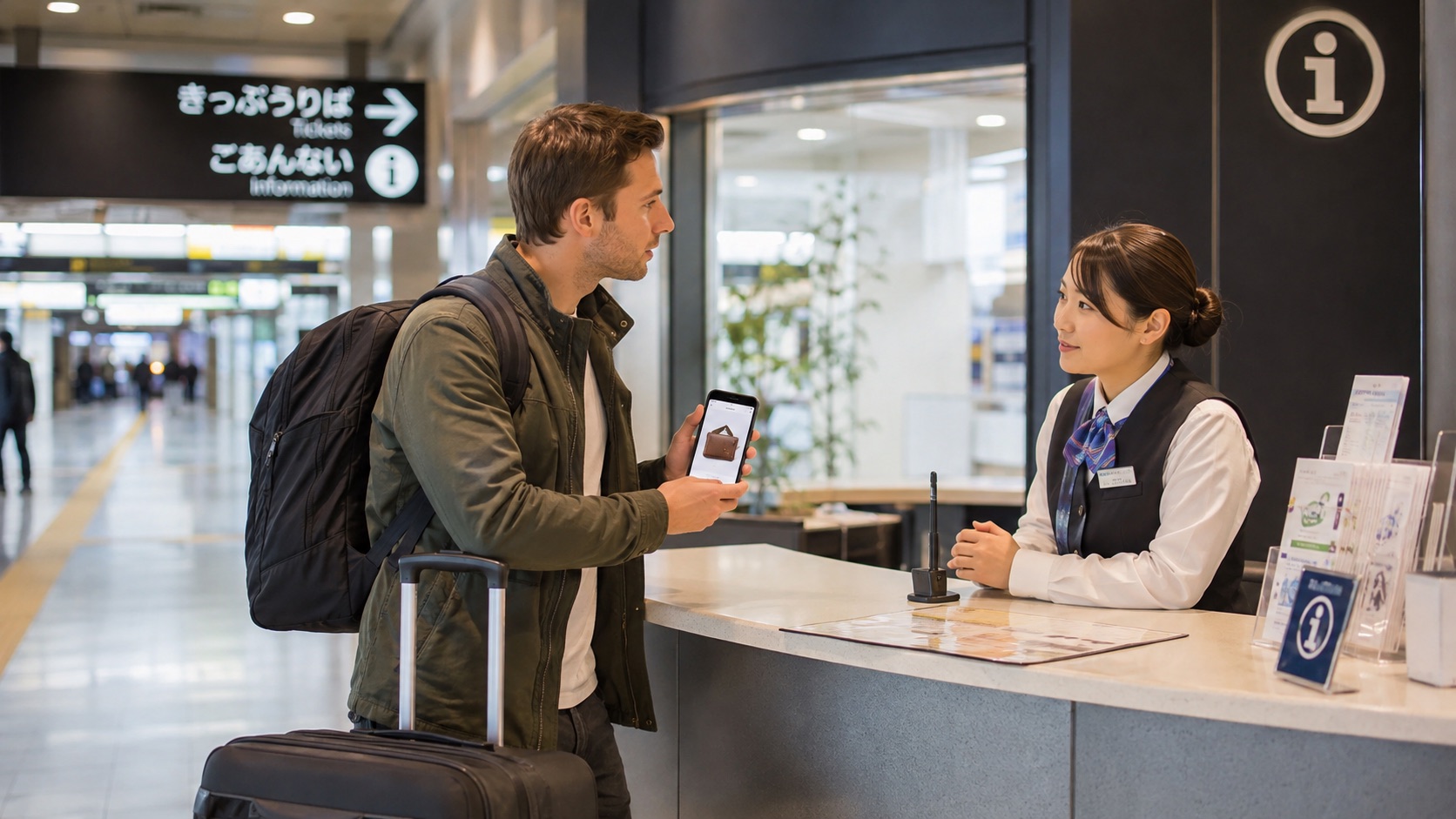
Lost a phone, wallet, bag, or passport in Japan? Start with the place where you last had it. Stations, trains, airports, taxis, shops, and hotels often hold items before transferring them to police. Acting quickly—and giving precise identifying details—gives you the best chance of recovery.
First 15 minutes: do this in order
- Stop and reconstruct your route, including time, train number, seat, shop, toilet, or taxi.
- Use another device to ring or locate your phone, but do not confront anyone or enter an unsafe place.
- Contact the facility or transport operator first.
- Freeze bank cards and mobile payment if a wallet or phone is missing.
- File a police lost-property report if the item is not immediately found.
- Save every reference number and the office handling the case.
Who to contact first
| Where it was lost | First contact |
|---|---|
| Train or station | Station staff or that railway’s lost-and-found service |
| Airport or aircraft | Airport lost property for terminal items; airline for items left onboard |
| Taxi | Taxi company using the receipt, vehicle number, app record, or payment statement |
| Shop, restaurant, museum, hotel | The business directly |
| Street or unknown place | Nearest police box (koban) or police station |
Do not report a routine lost item through 110. That number is for urgent police response. For emergency contacts, see our Japan emergency-number guide.
How to describe the item
Prepare the date and time range, exact route, location, brand, color, size, distinctive marks, and contents that only the owner would know. For a phone, keep the model, case description, telephone number, serial number, IMEI, and SIM details available. A photo of the item can help.
Filing a police lost-property report
Visit a nearby police box or police station. The Tokyo Metropolitan Police Department states that reports cannot be submitted by email; its English form can be prepared in advance but must be filed with police. Procedures outside Tokyo can differ, so follow the local police instructions.
Give a Japanese contact number when possible. Tokyo police note that they generally do not make international calls. A hotel, friend, or eSIM number that remains active can make follow-up easier.
If you lost a wallet
- Freeze credit, debit, and transit-linked payment cards.
- Check transaction alerts and report unauthorized use.
- Contact the railway or business before police if the location is known.
- Keep the police report number for insurance or replacement procedures.
- Do not cancel every reservation automatically; ask issuers whether digital cards remain usable.
If you lost a phone
Use the platform’s lost-device mode, display a safe callback message, and suspend the SIM if misuse is possible. Do not erase the phone immediately if tracking and recovery are still realistic; remote erasure can end location updates. Change critical passwords from a trusted device, beginning with email and financial accounts.
If you lost your passport
- Contact your embassy or consulate to learn its replacement requirements.
- File a report with police and request any certificate the embassy requires.
- Prepare identity evidence, passport copies, photographs, and travel itinerary as directed.
- Contact the airline if the replacement could affect departure.
- Notify your insurer if document replacement or changed travel is covered.
Police do not replace passports. Requirements depend on nationality, so your embassy or consulate is the authoritative source.
Railway lost property
Tell staff the operator, line, direction, boarding and exit stations, approximate time, car number, and seat. Items may move from a station to a central lost-property office and later to police, so ask where and when to follow up. JR East’s official guidance directs passengers to station staff first and offers multilingual lost-and-found assistance through its Infoline.
Collecting an item—or leaving Japan first
Bring valid ID, the report or reference number, and any notice you received. Confirm the exact office and opening hours before traveling there. Tokyo police describe procedures for collection by an authorized representative and, after verification, shipment to an address in Japan at the owner’s cost. Do not assume international shipping is available.
Useful Japanese phrases
| Phrase | Meaning |
|---|---|
| 財布をなくしました。 Saifu o nakushimashita. | I lost my wallet. |
| 電車に忘れました。 Densha ni wasuremashita. | I left it on the train. |
| 遺失届を出したいです。 Ishitsutodoke o dashitai desu. | I want to file a lost-property report. |
| 受理番号をお願いします。 Juri bangō o onegai shimasu. | Please give me the report number. |
FAQ
Should I call 110 for a lost wallet?
No, unless there is an urgent crime or danger. Contact the facility or transport operator, then visit a police box or station.
Can I search online?
Some police and transport operators provide databases or inquiry forms, often only in Japanese. Keep checking because registration and transfer can take time.
What if I think it was stolen?
Tell police why you suspect theft rather than simple loss. Use 110 only if the crime is occurring or immediate response is needed.
How can I prepare before travel?
Save passport and receipt copies securely, record device serial numbers, enable tracking, use luggage tags without exposing excessive personal data, and keep backup payment separately.
Summary
Contact the place or operator first, protect cards and accounts, then file a police report with detailed identifying information. For a passport, contact your embassy. Keep a reachable Japanese number and all case references until the item is returned or your claim is complete.
Checked September 7, 2026. Official sources: Tokyo Metropolitan Police Department Lost and Found, JR East Infoline, and JNTO safety guidance.