

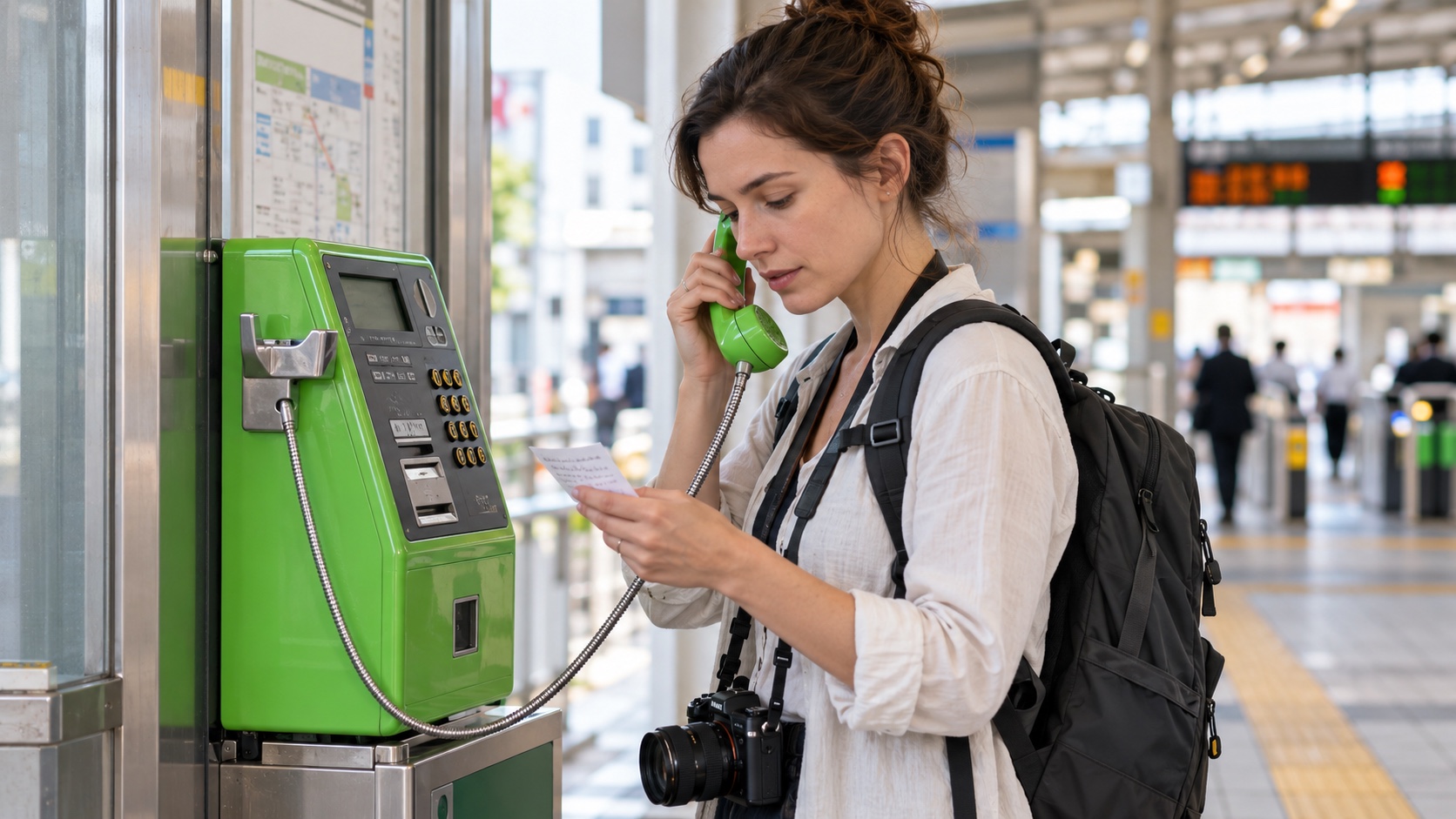
Japan’s public telephones are still useful when a smartphone is lost, out of power or unable to connect. Green and gray phones are found at some stations, hospitals, public facilities and street booths. The controls vary, so this guide separates ordinary, emergency and disaster use.
What to prepare
Carry the phone number you may need on paper, including the area code. Keep a few ¥10 coins; a ¥100 coin may be accepted, but official guidance warns that no change is returned when the call costs less. Telephone cards work on compatible phones, although card use can be unavailable during a power outage.
How to make an ordinary call
- Lift the receiver.
- Follow the machine’s order for inserting coins or a telephone card; phones with and without a red emergency button differ.
- Listen for the continuous dial tone.
- Dial the complete number shown in your reservation or contact record.
- When finished, replace the receiver and collect any returned coins or card.
If the display is dark or the coin box is full, that phone may not work. Move to another phone rather than repeatedly inserting money.
Emergency calls: 110, 118 and 119
Calls to 110 (police), 118 (Japan Coast Guard) and 119 (fire and ambulance) do not require coins or a telephone card. On a phone with a red emergency-call button, lift the receiver, press the button and dial. On a phone without that button, lift the receiver and dial the emergency number directly.
State the service needed, location, what happened and whether anyone is injured. Read a station name, address, nearby building or crossing from a sign. Do not use emergency numbers for directions, translation help or lost-property questions that are not urgent.
Calling a Japanese number
Dial the number exactly as written within Japan, including the initial zero and area code. A hotel or restaurant number copied in international format may begin with +81 and omit that zero; for a domestic call, use the Japanese domestic form. If unsure, ask the business to provide its number in domestic format.
International calls are not available on every phone
Official NTT guidance says a compatible phone displays that international calls are available. The dialing sequence can depend on the service: it may use 010 plus country code and destination number, or a carrier access code before 010. Check the instructions displayed on that specific phone. Internet calling or help from your accommodation may be simpler for a non-urgent overseas call.
Public phones during power failures and disasters
Availability depends on the telephone type. NTT West states that emergency calls remain available on listed analog and digital public phones during a power failure, but telephone cards cannot be used; some digital phones depend on batteries. Conditions can still prevent use, so do not rely on one device or location.
During a major disaster, NTT may make public-phone calls toll-free. Follow official announcements. Public phones can also access Disaster Emergency Message Dial 171 when that service is activated. Its operating conditions are set for the event, so use current NTT instructions rather than memorizing an outdated sequence.
How to find a public telephone
Look in station concourses, hospital entrances, municipal buildings and street booths, but availability is declining and hours may follow the host facility. NTT East and NTT West provide installation-location searches for their areas. Save a nearby location before a hike, coastal trip or event where mobile coverage may be uncertain.
Accessibility and communication tips
Some digital phones include volume controls and Braille indicators. If you cannot hear or speak reliably, plan an alternative such as asking station staff, hotel staff or a companion for assistance. Keep a written card with your name, accommodation, emergency contact, allergies and the Japanese description of the help needed—but avoid displaying passport or payment details unnecessarily.
Common mistakes
- Inserting a ¥100 coin without realizing that change may not be returned.
- Using the red emergency button for an ordinary call.
- Dialing +81 format instead of a domestic Japanese number.
- Assuming every phone supports international calls.
- Depending on a telephone card during a power outage.
- Calling 110 or 119 for non-emergency travel assistance.
Useful Japanese
公衆電話はどこですか。 (Where is a public telephone?)
電話がつながりません。 (The call will not connect.)
救急車をお願いします。 (Please send an ambulance.)
場所は〇〇駅です。 (The location is ___ Station.)
Official sources
- NTT East: Public Telephones
- NTT West: Types and How to Use Them
- NTT East: Disaster Emergency Message Dial 171
Frequently asked questions
Do emergency calls require coins?
No. Follow the procedure for whether the phone has a red emergency button.
Will a ¥100 coin return change?
No change is given when the call charge is less than ¥100, according to NTT guidance.
Can every public phone call overseas?
No. Look for the international-call indication and follow that phone’s displayed instructions.
Will every public phone work in a blackout?
No. Availability depends on the type, battery and local conditions; cards may not work.
Official NTT information checked November 1, 2026. Telephone locations and operating conditions can change.