

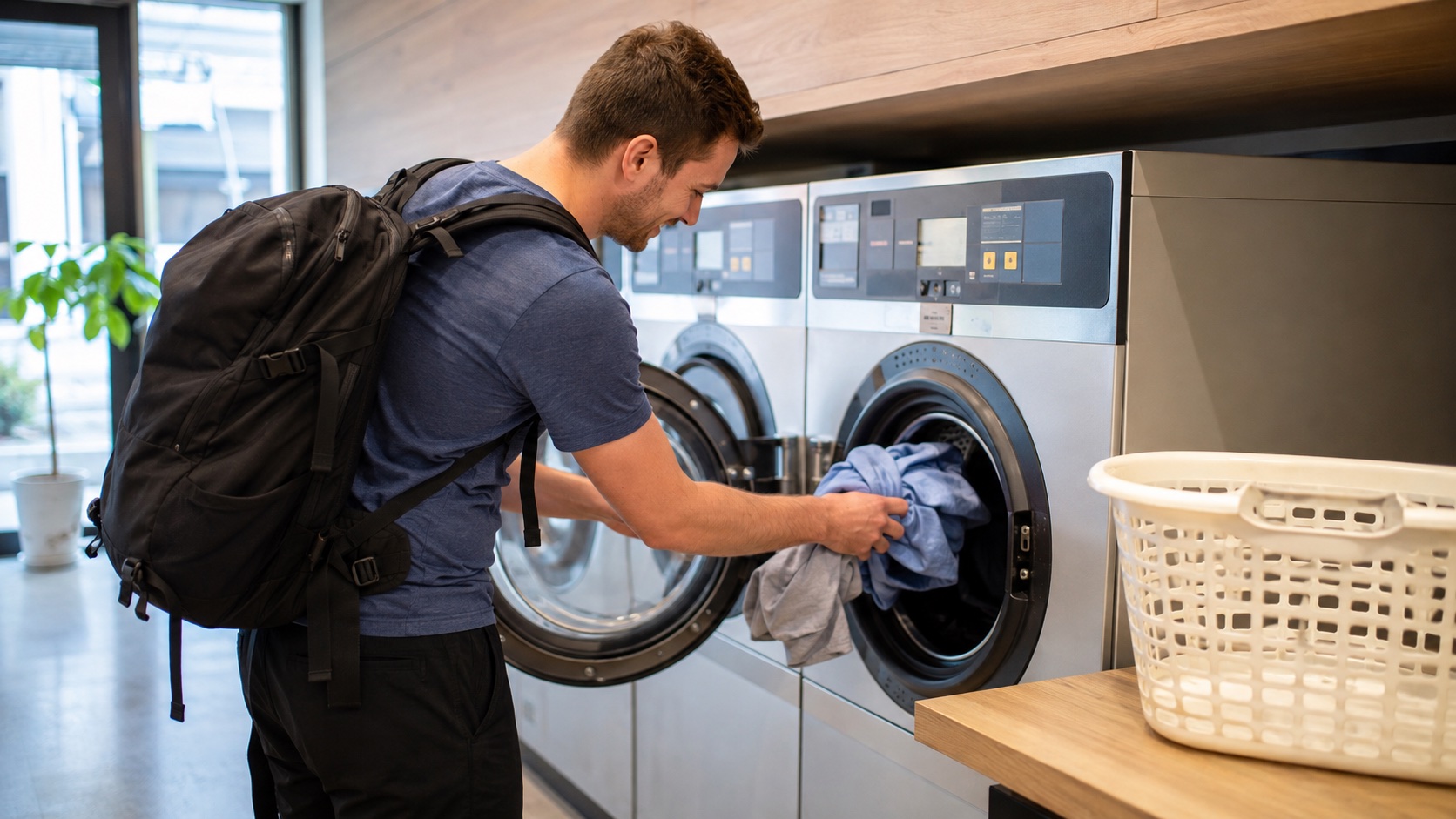
Coin laundries in Japan can make a long trip much easier, but the machines are not all operated the same way. Some wash only, some dry only, and many newer units run both cycles without transferring the load. Detergent may be added automatically, while payment may require coins, a central kiosk, a prepaid card, or an app.
Information checked: September 8, 2026. Prices, cycle times, payment methods and machine programs vary by store. Treat the display and notices on the machine you are using as the final instructions.
Quick answer: what should you bring?
- Clothes in a laundry bag
- ¥100 coins, even if the store advertises cashless payment
- Your phone for translation, timers and any required payment app
- A stain-removal product only if its label and the store allow it
Do not add your own detergent until you check the machine. Commercial washer-dryers often dispense detergent and softener automatically. Adding more can create excessive foam or leave residue.
Coin laundry, hotel laundry or cleaning service?
| Option | Best for | Main limitation |
|---|---|---|
| Street coin laundry | A normal travel load, larger drums and faster drying | You must travel to the store and monitor the finish time |
| Hotel coin machine | A small load without leaving the building | Fewer machines and queues in the evening |
| Hotel laundry service | Shirts or items you do not want to wash yourself | Higher cost and a collection deadline |
| Professional cleaner | Delicate, tailored or dry-clean-only garments | Not always same-day; language and collection times vary |
How to use a Japanese coin laundromat
- Read the care labels. Separate items marked dry-clean only, hand-wash only, or unsuitable for tumble drying.
- Choose the machine type. Look for washing only, drying only, or a combined wash-and-dry course.
- Check the drum. Make sure it is empty and clean. Some machines offer a free drum-cleaning button before loading; AQUA’s current user guide shows this as an optional first step.
- Load without overfilling. Clothes need room to move. The drying capacity can be lower than the washing capacity on the same combination machine.
- Check detergent instructions. Phrases such as “detergent automatically added” mean you should not pour in your own.
- Select the course before paying. Confirm wash only, dry only or wash-and-dry, plus temperature and load size.
- Pay and start. Some machines begin as soon as the required coins are inserted; others use a central touchscreen.
- Set a phone timer. Return before the displayed finish time and remove your load promptly.
Machine manufacturer TOSEI describes standard commercial combination units with separate washing, drying and wash-and-dry programs. Its guidance also notes that store prices and times differ, which is why an old online price list should never override the machine display.
How much time and money should you allow?
A normal wash can take roughly half an hour, while a combined wash-and-dry cycle commonly takes around an hour. Heavy cotton, towels and an overfilled drum may need extra drying. Cost depends on machine capacity, course and store; check the amount shown before adding money.
Bring more coins than the first displayed price in case you need another drying cycle. If the machine accepts ¥500 coins or cashless payment, keep ¥100 coins as a backup because the change machine or payment network may be unavailable.
Drying without shrinking your clothes
- Check every care label before tumble drying.
- Use low heat for synthetic or heat-sensitive items when the machine provides a temperature choice.
- Remove bras, glued decorations, waterproof garments and foam-padded items unless their labels explicitly permit tumble drying.
- Do not assume “aburi-like” extra heat is better: a very hot cycle can damage elastic, prints and technical fabrics.
- Split a dense load between dryers when needed; airflow matters more than packing everything into one drum.
What should not go into a standard machine?
Do not wash items contaminated with oil, solvents, fuel, chemicals, heavy pet hair or bodily waste. Avoid shoes unless the store has a clearly marked sneaker washer. Futons and blankets require a compatible large machine and a suitable care label; not every filling or construction is washable.
When uncertain, show the care label to the attendant or use a professional cleaner. A machine being physically large enough does not make the item safe to wash.
Etiquette and security
- Do not occupy folding tables with luggage that is not being used for laundry.
- Clean lint filters only when the posted instructions ask customers to do so.
- Do not leave clothes in a finished machine. Another customer or staff member may move them according to store rules.
- Never put someone else’s laundry on the floor; contact the posted support number if a machine is blocked.
- Take passports, wallets and electronics out of every pocket before loading.
- Keep valuables with you. A door lock or PIN protects the cycle, not unattended bags.
Useful Japanese labels
| Japanese | Meaning |
|---|---|
| 洗濯 | Wash |
| 乾燥 | Dry |
| 洗濯乾燥 | Wash and dry |
| 標準 | Standard |
| 少量 | Small load |
| 低温 | Low temperature |
| 洗剤自動投入 | Detergent added automatically |
| ドラム洗浄 | Drum cleaning |
| 残り時間 | Time remaining |
| 運転終了 | Cycle finished |
Frequently asked questions
Can I leave while the machine runs?
Check the store rules first. If you leave, take valuables and return before the cycle ends. Do not expect a finished machine to remain occupied indefinitely.
Is detergent always included?
No. Many modern commercial machines add it automatically, but older hotel or top-loading machines may require detergent. Read the exact machine instructions.
Can I wash sneakers?
Only in a clearly designated sneaker washer, and only when the shoe materials are suitable. A normal clothing machine is not the safe default.
Why are my clothes still damp?
The load may be too large, too dense or unsuitable for the chosen time. Remove heat-sensitive items, loosen the remaining clothes and add drying time if their labels permit it.
Bottom line
Check the care labels, identify the machine type, confirm whether detergent is automatic, leave room in the drum and return before the timer ends. Those five steps prevent most coin-laundry problems in Japan.
For another practical part of traveling light, see our Japan luggage storage and delivery guide.