

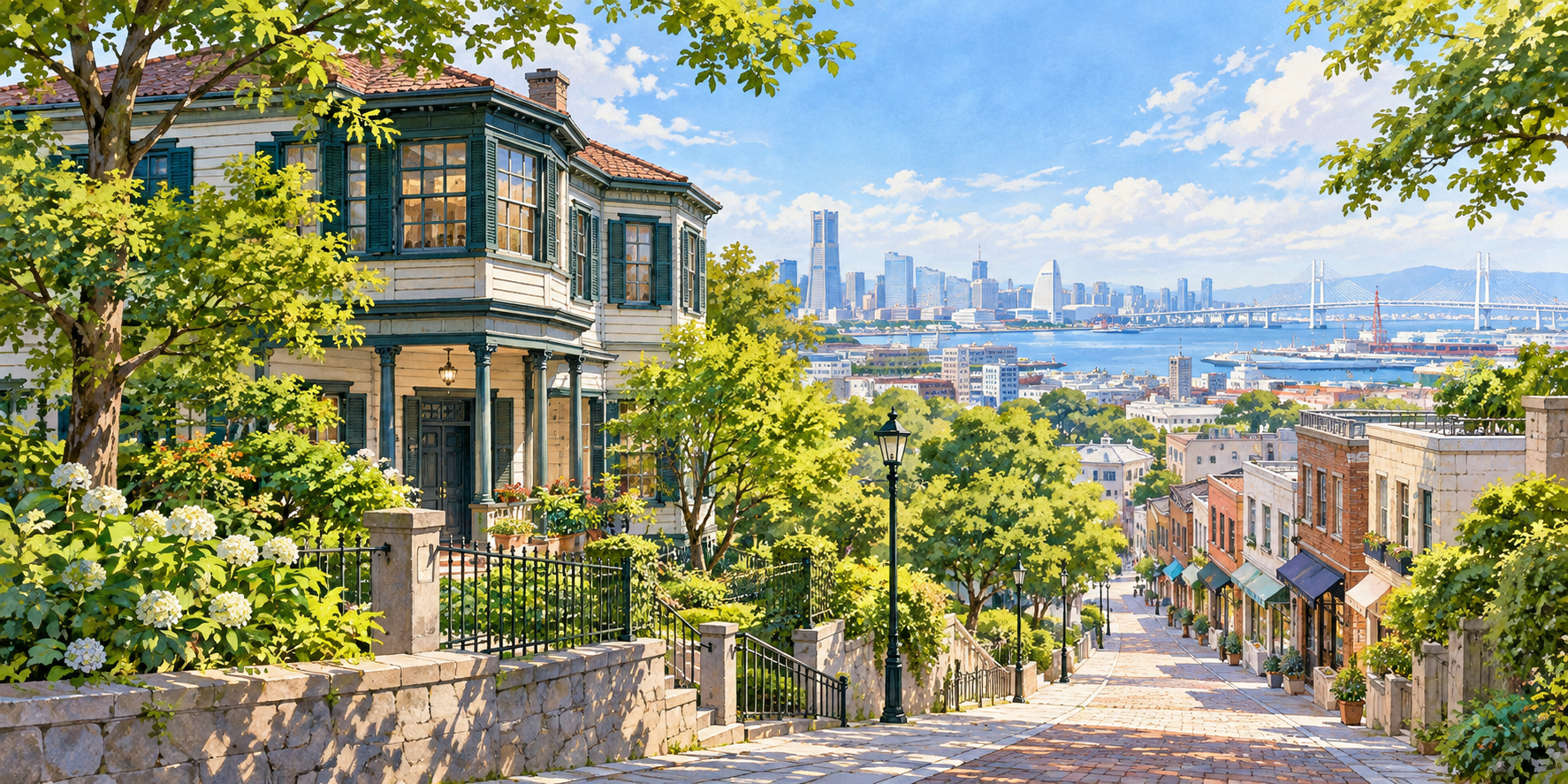
Yamate, Motomachi and Yokohama Chinatown are close enough to visit on one outing, but they are not one neighborhood. Yamate is the hilltop area of historic Western-style houses and parks. Motomachi is the shopping street below it. Chinatown is a separate district for food, shops and streetscapes. Understanding that geography makes a first visit easier—and helps you choose how much uphill walking to do.
Why these places look different
Yokohama opened its port to international trade in 1859. Foreign residents subsequently lived in Yamate, while commercial life developed around Motomachi. The surviving houses are not a single untouched nineteenth-century settlement: several are from the early twentieth century, and some were relocated or restored. Yokohama City’s account of the Yamate Western-style houses explains their varied histories. Chinatown has its own identity and sits below the hill, rather than inside Yamate.
Yamate: choose a few houses, not a checklist
A walk from Motomachi-Chukagai Station up toward Harbor View Park puts the hilltop landscape first. Around Motomachi Park, Yamate 234-Bankan was built as accommodation for foreign residents, Ehrismann Residence was originally built in 1926 and later relocated, and Berrick Hall has a different scale and architectural character. Visiting two or three and reading the displays will tell you more than racing past every building for a photo. Yokohama’s official Oku-Motomachi walking itinerary shows how the area connects.
Opening days, hours and special events can change by building. Check Yokohama City’s current opening-hours guidance before setting out. Yamate has slopes and some stairs; on a hot or wet day, or if mobility is limited, shorten this part of the route rather than forcing a complete circuit.
Motomachi: a working shopping street
Descend toward Motomachi for shops, cafés and a break. The appeal is not a fixed list of supposedly famous products: shops and menus change. The street is a useful contrast with Yamate’s preserved houses because it is still an active commercial place. If you have a particular store in mind, check the Motomachi Shopping Street’s official directory rather than relying on an old recommendation. Its access page identifies both Motomachi-Chukagai Station and JR Ishikawacho Station as useful approaches.
Chinatown: allow time to choose where to eat
Continue from Motomachi toward Chinatown when you are ready for a meal. It has multiple entrance gates and many dining options, so there is no need to detour to one particular gate. Check posted menus, prices and opening hours at the restaurant you actually choose. The Yokohama Chinatown official access guide is more reliable for station approaches than a static claim in an older article.
A flexible half-day walking plan
- Start near Motomachi-Chukagai Station and go uphill: head toward Harbor View Park if you want views and can manage the slope.
- Explore Yamate: choose two or three houses around the parks, checking which are open that day.
- Walk down to Motomachi: browse or stop for coffee. You can end the outing here.
- Finish in Chinatown: leave time to compare menus and eat without rushing.
This is a direction of travel, not a guaranteed timetable: hills, exhibitions, weather and meal queues all affect the pace. If you would rather stay on flatter streets, visit only Motomachi and Chinatown. For a different Yokohama outing focused on the waterfront, see our Minato Mirai and Red Brick Warehouse half-day guide; do not assume both half-day routes fit into the same morning.
Quick questions
Is every Yamate house open every day?
No. Check the city’s information for each building and the date of your visit. Exhibitions or events may follow separate arrangements.
Do I need to climb Yamate Hill to enjoy Motomachi and Chinatown?
No. Motomachi and Chinatown work well as a shorter, lower-level visit. Add Yamate if historic architecture and parks interest you and the climb suits your group.
Fact-checked against Yokohama City, Yokohama’s official visitors guide, Motomachi Shopping Street and Yokohama Chinatown. Recheck hours and transport before travel.