

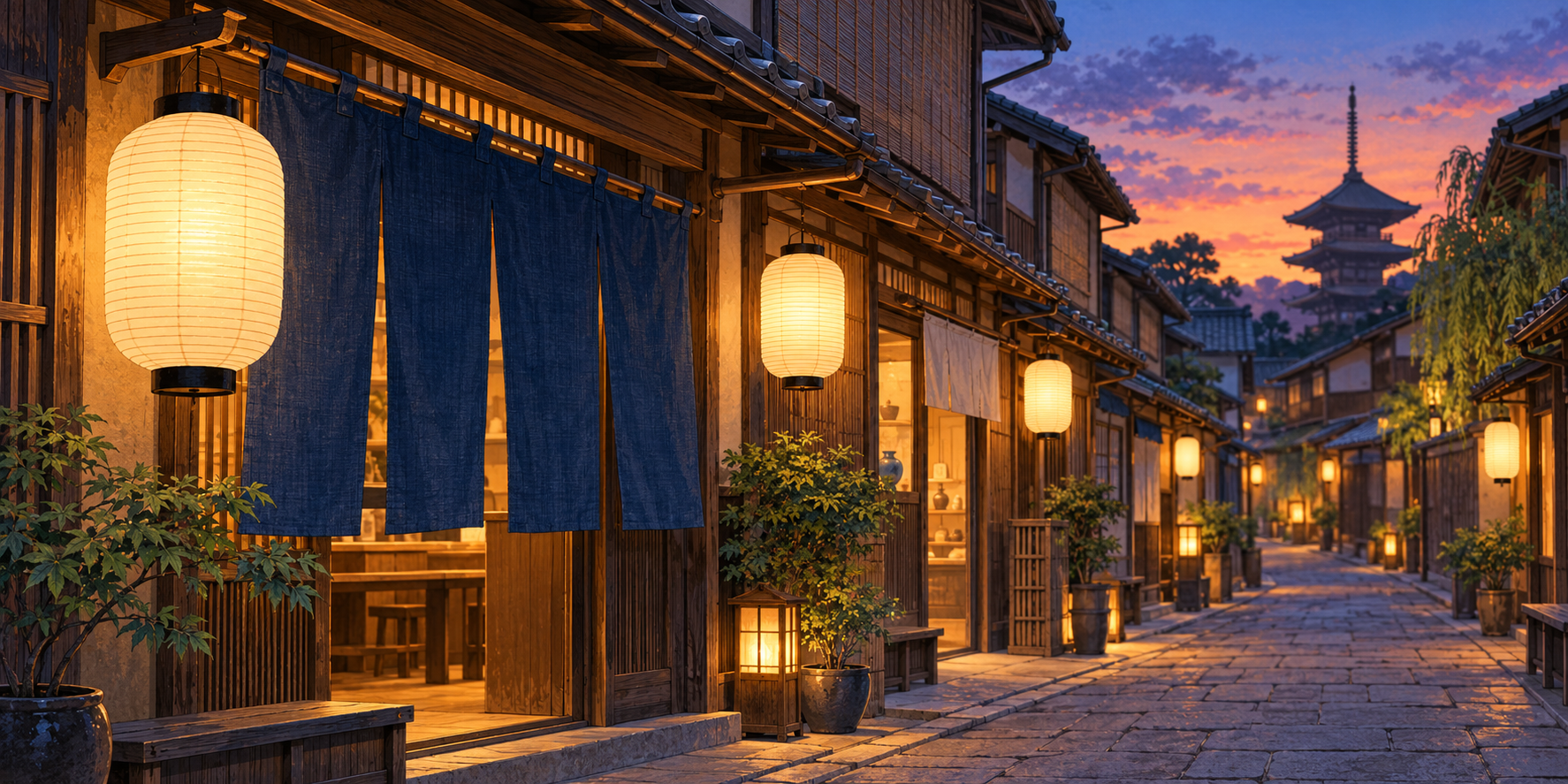
Updated 29 October 2026. Featured image: conceptual illustration, not a photograph of a real street.
A glowing paper lantern and a short cloth curtain can tell you a great deal about a Japanese street. The lantern, called a chōchin, attracts the eye after dark; the split curtain, or noren, marks an entrance while offering a little privacy. Neither has one universal meaning. Reading the setting—shop, restaurant, festival or shrine—is more useful than memorizing a supposed color code.
Chōchin: light, craft and a visible landmark
Traditional Japanese paper lanterns use a light framework and a covering that can be folded or shaped. Kyoto’s official tourism site explains that lantern makers attach the ribs in different ways, including individually or in a spiral. Today, lanterns still appear at festivals, religious sites and shopfronts, often with electric light rather than a flame. The material and construction matter as much as the color. See Kyoto City Official Travel Guide’s craft overview.
A lantern outside an eatery can help you find it, but it does not by itself guarantee that the business is open. Check posted hours or the doorway before entering. At a shrine or festival, avoid touching or moving lanterns installed for an event.
Noren: a doorway you can pass through
A noren is a fabric divider hung across the upper part of an entrance, usually in panels separated by vertical slits. The Metropolitan Museum of Art describes this practical structure in its record of a nineteenth-century Japanese indigo-dyed noren. A shop may print its name or mark on the fabric, but noren can also be decorative, and a curtain does not prove current opening hours. See the Met’s collection record.
To walk through, simply part the panels gently. If the entrance belongs to a private home or a closed business, a noren is not an invitation to enter. Ask before photographing staff or customers; a close-up of a curtain is different from photographing people inside a shop.
Where to notice them
For a concentrated look at noren in a historic streetscape, the Japan National Tourism Organization highlights the Katsuyama preservation district in Okayama, where distinctively designed curtains hang at shop entrances. Its official travel feature is a useful example of how a working textile becomes part of a town’s visual identity. Kyoto’s craft coverage is a starting point for noticing the construction of chōchin rather than treating every lantern as the same object.
A quick observation checklist
- Look at the entrance first: is it a shop, restaurant, festival stall or shrine?
- Notice whether a lantern is folded, ribbed or illuminated, without assuming it is antique.
- Observe the noren’s fabric, dye and printed mark; do not pull it aside for a photograph.
- Respect business hours and people inside. A beautiful street detail is also part of someone’s workplace.
Interested in another everyday craft? See our Kyoto textile crafts guide for more about Japanese fabric traditions.