
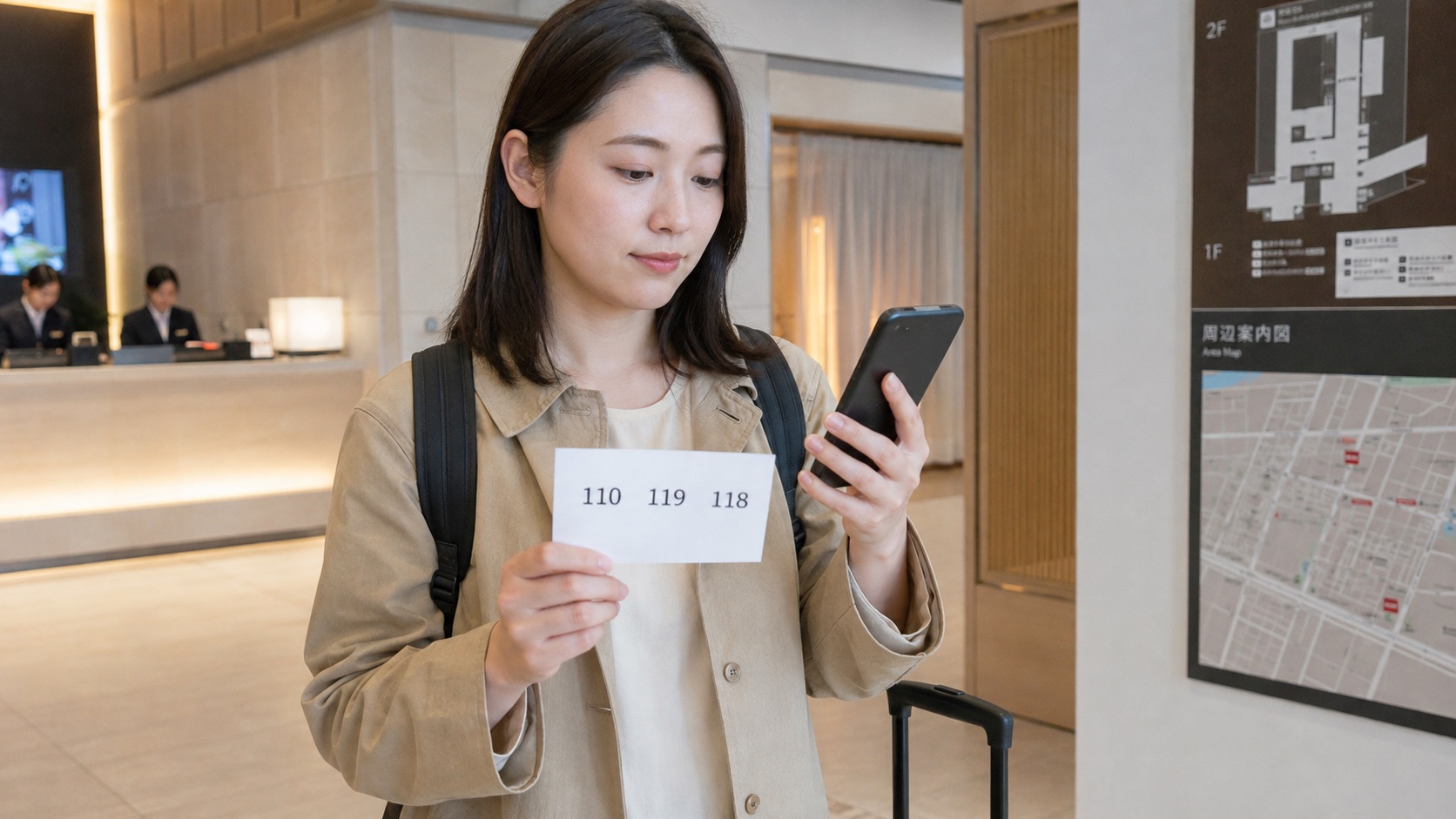
If an emergency happens during a trip to Japan, three short numbers matter: 110 for police, 119 for fire or ambulance, and 118 for emergencies at sea. This guide explains which one to call, what to say, and where multilingual visitors can get help.
Japan emergency numbers at a glance
| Number | Use it for | Examples |
|---|---|---|
| 110 | Police emergency | Crime in progress, assault, serious theft, dangerous traffic accident |
| 119 | Fire or ambulance | Serious illness or injury, fire, rescue needed |
| 118 | Japan Coast Guard | Marine accident, person overboard, distress at sea |
These are emergency lines, not general travel-information numbers. Calls can be made without an area code. If you are using a hotel-room phone, ask reception whether an outside-line prefix is required; using your mobile phone or asking staff to call may be faster.
When to call 110: police
Call 110 when immediate police response is needed—for example, a violent incident, a crime in progress, or a serious road collision. Japan’s National Police Agency identifies 110 as the national police emergency number.
A lost wallet, missing passport discovered later, or request for directions is usually not an emergency. Visit a nearby koban (police box) or police station instead. If your passport is missing, also contact your embassy or consulate because police cannot issue a replacement travel document.
When to call 119: ambulance or fire
Call 119 for a fire or a medical emergency that requires an ambulance. The operator will first ask whether the call is for kaji (fire) or kyūkyū (ambulance). Japan’s Fire and Disaster Management Agency states that ambulance services are available to anyone in Japan.
For a medical emergency, briefly describe the symptoms, the patient’s age if known, and whether the person is conscious and breathing. Follow the operator’s instructions. For non-urgent illness, use a clinic, your insurer’s assistance line, or JNTO’s medical guidance rather than an emergency ambulance.
When to call 118: emergencies at sea
Call 118 for incidents and accidents at sea. The Japan Coast Guard lists examples such as a marine casualty or a person in danger on the water. Give your location, what happened, the number of people involved, and identifying details of the vessel when possible. On a commercial ferry or tour boat, alert the crew immediately as well.
What to say on an emergency call
- State the service: police, ambulance, fire, or Coast Guard.
- Give the location first: address, hotel name, station exit, shop name, landmark, or map pin.
- Explain what happened: use one short sentence before adding details.
- Give the number of people affected and describe immediate danger.
- Provide your name and callback number.
- Stay on the line and follow instructions unless remaining there is unsafe.
If you cannot pronounce the address, show your screen to hotel, station, or shop staff and ask them to help. Keep your accommodation’s name and address saved offline in both English and Japanese.
Useful Japanese phrases
| Japanese | Meaning |
|---|---|
| 英語を話せますか? Eigo o hanasemasu ka? | Do you speak English? |
| 救急車をお願いします。 Kyūkyūsha o onegai shimasu. | Please send an ambulance. |
| 火事です。 Kaji desu. | There is a fire. |
| 警察をお願いします。 Keisatsu o onegai shimasu. | Please send the police. |
| 場所がわかりません。 Basho ga wakarimasen. | I do not know the location. |
Multilingual help for visitors
The Fire and Disaster Management Agency promotes three-way telephone interpretation for 119 calls, but implementation and available languages can vary by local fire department. Start with “English” or “Eigo” and speak slowly. Do not hang up while an interpreter is being connected.
JNTO’s Japan Visitor Hotline provides English, Chinese, and Korean support 24 hours a day, 365 days a year for accidents, illness, natural disasters, and visitor assistance. Its current number is listed on the official page; save that page before traveling so you can verify the latest details. In a life-threatening situation, call 110, 119, or 118 first.
Prepare before you need help
- Save 110, 119, and 118 in a note that works offline.
- Enable location services and learn how to copy your map coordinates.
- Carry your passport, insurance details, allergy information, and emergency contact.
- Download offline Japanese in your translation app.
- Save your hotel address in Japanese.
- Read our broader Japan travel apps guide and typhoon travel guide before departure.
FAQ
Is 911 used in Japan?
No. Memorize Japan’s local numbers: 110 for police, 119 for fire or ambulance, and 118 for the Coast Guard.
Can I text an emergency number?
Ordinary visitors should not assume SMS will reach emergency services. Specialized reporting systems exist for people with hearing or speech disabilities, but they may require advance registration. For most travelers, call or ask a nearby person or member of staff to call.
What if my phone has no signal?
Ask staff or another person to call, use an emergency intercom, or move to a safe staffed location. On trains, platforms, highways, beaches, and hiking routes, look for emergency phones or contact points rather than continuing into danger to find mobile reception.
Summary
Use 110 for police, 119 for fire or ambulance, and 118 for emergencies at sea. Give your location first, describe the immediate danger clearly, and stay on the line. Save official multilingual-support information before your trip.
Information checked September 5, 2026. Official sources: National Police Agency, Fire and Disaster Management Agency, Japan Coast Guard, and JNTO.