

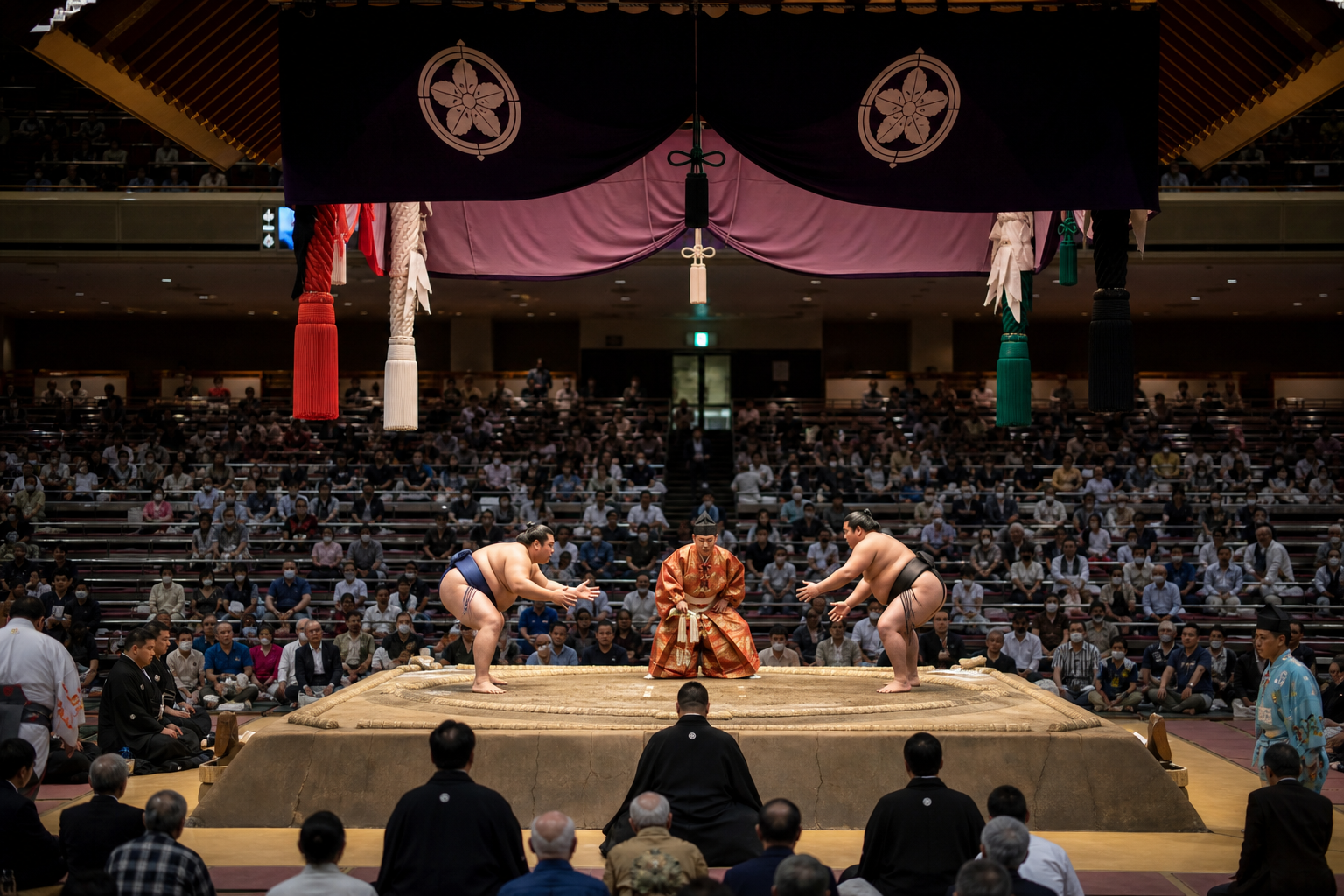
The 2026 sumo year has reached its final stretch. Five of the six grand tournaments are complete, and only the Kyushu basho in Fukuoka (8–22 November) remains. All five champions so far have been different, and the balance of power among the yokozuna, ozeki and san’yaku ranks has shifted substantially. This article reviews the 2026 tournament results, analyses the current hierarchy, introduces the wrestlers who shaped the year, and explains the changes taking place inside the sport.
2026 grand tournament results at a glance
Five different wrestlers have won the five tournaments held so far this year, a rarity in recent sumo.
| Tournament | Venue and dates | Champion | Record and notes |
|---|---|---|---|
| Hatsu (January) | Ryōgoku Kokugikan, Tokyo / 11–25 January | Ōzeki Aonishiki | 12–3. Beat maegashira Atamifuji in a playoff for his second straight title. The first new ozeki to win a championship since Hakuho in May 2006 |
| Haru (March) | Edion Arena Osaka / 8–22 March | Sekiwake Kirishima | 12–3. His third title, 14 tournaments after his previous one. His 34 wins over three tournaments earned him a return to ozeki |
| Natsu (May) | Ryōgoku Kokugikan / 10–24 May | Komusubi Wakatakakage | 12–3. Beat ozeki Kirishima in a playoff for his second title, 25 tournaments after his first |
| Nagoya (July) | IG Arena, Nagoya / 12–26 July | Sekiwake Aonishiki | 12–3. Won a three-way playoff against Atamifuji and Kirishima. First wrestler in history to regain ozeki and win the title in the same tournament |
| Aki (September) | Ryōgoku Kokugikan / 13–27 September | Yokozuna Ōnosato | 12–3. Beat ozeki Aonishiki on the final day in a winner-takes-the-title match, claiming his sixth Emperor’s Cup and a third consecutive autumn title |
| Kyushu (November) | Fukuoka Kokusai Center / 8–22 November | — | Banzuke released on 26 October |
Power analysis: where the top ranks stand
These were the results at the top of the September banzuke, the rankings currently in force.
| Rank | Wrestler | Aki result | Notes |
|---|---|---|---|
| Yokozuna | Ōnosato (26, Nishonoseki stable) | 12–3, champion | Sixth career title and a comeback win after a year disrupted by injury |
| Yokozuna | Hōshōryū (27, Tatsunami stable) | 0–0–15, absent | Right knee surgery and a third consecutive tournament missed. The Yokozuna Deliberation Council did not discuss a retirement resolution |
| Ōzeki | Aonishiki (22, Ajigawa stable) | 11–4, runner-up | Won in July on his return to ozeki; in September he tied for the lead but lost the final-day decider |
| Ōzeki | Kirishima (30, Otowayama stable) | 8–7 | Returned to ozeki after his March title but managed only a winning record in September |
| Ōzeki | Kotozakura (28, Sadogatake stable) | 9–6 | Won the Paris exhibition tournament in June and cleared kadoban status in July |
| Sekiwake | Fujinokawa (21, Ise-no-umi stable) | 11–4, Fighting Spirit prize | Eleven wins in his san’yaku debut, the starting point of an ozeki run |
| Sekiwake | Atamifuji (24, Isegahama stable) | 8–7 | Runner-up in January; his ozeki bid stalled with four straight losses at the end of September |
| Komusubi | Hakunofuji (23, Isegahama stable) | 5–10 | Made his komusubi debut after collecting gold stars in four consecutive tournaments in January |
| Sekiwake | Wakatakakage (31, Arashio stable) | 0–0–15, absent | Won his second title in May as a komusubi, then missed two full tournaments with injury |
1. Two yokozuna on paper, one on the dohyō
Hōshōryū (the 74th yokozuna) and Ōnosato (the 75th) were both promoted in 2025, so 2026 began with two yokozuna. But Hōshōryū injured his right knee at the Nagoya tournament, withdrew mid-way, and underwent ligament surgery on 29 July. He then missed the whole of the September tournament from day one — his fifth absence in ten tournaments as a yokozuna.
When the Yokozuna Deliberation Council met on 28 September, it did not discuss the resolution that can precede a retirement recommendation for a yokozuna absent from three consecutive tournaments. Its chairman, Riemon Ōshima, said he wanted Hōshōryū to heal, train and “fulfil his responsibility as a yokozuna”. Ōnosato, meanwhile, has been carrying the rank alone.
2. The ozeki hold the line while younger challengers press
Aonishiki, Kirishima and Kotozakura all preserved their ozeki rank in September: Aonishiki fought for the title to the final day, Kotozakura finished 9–6 and Kirishima 8–7. Aonishiki’s July title was historic — he became the first wrestler to be demoted from ozeki, regain the rank in a single tournament and win the championship at the same time.
Behind them, 21-year-old Fujinokawa took 11 wins and the Fighting Spirit prize in his first tournament at san’yaku. Atamifuji, runner-up in January, was 8–2 after ten days of his ozeki bid in September but lost his last four matches. Association chairman Hakkaku was blunt: “He is strong, but he was mentally weak. Ozeki is still a long way off.”
3. November: a yokozuna run, an ozeki run and a comeback
After the September tournament, judging department chief Asakayama said 11 wins was “quite a difficult” basis for a yokozuna run, indicating that Aonishiki’s promotion will not be at stake at the Kyushu basho. In practice, the Kyushu tournament will be about Aonishiki’s title chances, Fujinokawa’s ozeki bid and Hōshōryū’s return to the ring.
Wrestlers who defined 2026
Yokozuna Ōnosato Daiki (26, Nishonoseki stable, Ishikawa Prefecture)
Ōnosato was a student yokozuna and amateur yokozuna at Nihon University before his professional debut in May 2023. His promotion to yokozuna after just 13 tournaments was the fastest since the beginning of the Shōwa era, and he was the first yokozuna from Ishikawa Prefecture in 52 years. He has won six titles since his first in July 2024. A pushing-and-thrusting specialist with unusual balance at the edge of the ring, he missed tournaments in 2026 with a left shoulder injury but beat Aonishiki on the final day of the September tournament and wept during the award ceremony.
Ōzeki Aonishiki Arata (22, Ajigawa stable, Ukraine)
Born Danylo Yavhusishyn, Aonishiki came to Japan in April 2022 after the Russian invasion of Ukraine and made his professional debut in September 2023. He rose through the divisions to reach juryo in November 2024 and the top division in March 2025, winning his first title that November. Promoted to ozeki for January 2026, he set the fastest rise to the rank since the six-tournament system began (14 tournaments) and the fourth-youngest promotion at 21 years and eight months. After injuries and a demotion, he regained ozeki and won in July, then finished runner-up in September. He speaks fluent Japanese, enjoys saunas and lists beef tongue as his favourite food.
Yokozuna Hōshōryū Tomokatsu (27, Tatsunami stable, Mongolia)
Hōshōryū is the nephew of the 68th yokozuna Asashōryū and became the 74th yokozuna after winning his first title in January 2025. The 2026 season has been a battle with injury: he gave away three gold stars in January but still finished 10–5, was runner-up in March with 11–4, injured his right leg on the opening day in May, damaged knee ligaments in July, and missed the entire September tournament. On 5 October he joined Ōnosato for a dedication ring-entering ceremony at Meiji Shrine and said the experience left him feeling relieved physically. His return is one of the main stories of the Kyushu basho.
Ōzeki Kirishima Tetsuo (30, Otowayama stable, Mongolia)
Kirishima made his debut in May 2015, reached ozeki in 2023, then dropped back to sekiwake before winning his third title in March 2026 with 12–3. His 34 wins across three tournaments led the association to approve his return to ozeki unanimously on 25 March. He is the third wrestler under the current system to regain ozeki without relying on the immediate-reinstatement rule. He finished September 8–7.
Ōzeki Kotozakura Masakatsu (28, Sadogatake stable, Chiba Prefecture)
Kotozakura comes from a sumo family: his father was the former sekiwake Kotono-waka and his maternal grandfather was the 53rd yokozuna Kotozakura. Promoted to ozeki in 2024, he won his first title in January 2025. In 2026 he withdrew from the May tournament with a losing record, leaving him kadoban for July, but he secured his ozeki rank with a winning record there. He also won the two-day Paris exhibition tournament in June and finished 9–6 in September.
Sekiwake Fujinokawa Seigō (21, Ise-no-umi stable, Kyoto Prefecture)
The son of former maegashira Ōgane, Fujinokawa debuted in January 2023 and reached the top division in July 2025, when he took the hereditary Ise-no-umi stable name Fujinokawa. In 2026 he took gold stars from both yokozuna in March and won four consecutive bouts against yokozuna in July, earning an Outstanding Performance prize. Promoted to sekiwake for September, he went 11–4 and took the Fighting Spirit prize. He is the first wrestler from Kyoto Prefecture to reach sekiwake in nearly 200 years.
Sekiwake Atamifuji Sakutarō (24, Isegahama stable, Shizuoka Prefecture)
At 185 cm and 198 kg, Atamifuji debuted in November 2020. In January 2026 he finished 12–3 as a maegashira and reached the title playoff, winning the Fighting Spirit prize. He was promoted to komusubi in March and to sekiwake in May. His ozeki run in September began with eight wins in ten days but collapsed with four straight defeats. He is known for his powerful initial charge and right-hand grip.
Komusubi Hakunofuji Tetsuya (23, Isegahama stable, Tottori Prefecture)
A former high school yokozuna and industrial-league yokozuna, Hakunofuji made history by becoming the first wrestler to reach juryo in a single tournament from the makushita 15 entry rank. In January 2026 he collected a gold star in a fourth consecutive tournament, the third wrestler to do so since the start of the Shōwa era. He reached komusubi in September — the first wrestler from Tottori Prefecture to do so since 1964 — and finished 5–10.
Sekiwake Wakatakakage Atsushi (31, Arashio stable, Fukushima Prefecture)
Wakatakakage’s brother, Wakamotoharu, is also in the top division. He won his first title in March 2022 but then fell down the rankings through injury. In March 2026 he earned his first gold star by beating yokozuna Ōnosato on the opening day at the age of 31. In May he won his second title as a komusubi. He then missed the July tournament with a thigh injury and the whole of September, and will drop sharply down the rankings in November.
Other names to know in 2026
- Asahifuji (24, Isegahama stable, Mongolia): A heavyweight prospect who inherited the ring name of the 63rd yokozuna. In September he was promoted to juryo in just six tournaments from his debut, tying the fastest rise since the six-tournament system began.
- Ryūhō (19, Otowayama stable): A former junior high school national champion whose stablemaster is the 71st yokozuna Kakuryū. He will make his juryo debut in November, becoming the second sekitori from the stable after ozeki Kirishima.
- Enhō (31, Isegahama stable): He became the first wrestler with top-division experience to return to the salaried ranks after falling as far as the jonokuchi division, coming back to juryo in May.
- Daiseizan (26, Arashio stable, Inner Mongolia, China): Promoted to the top division in July, he is the second Chinese-born wrestler to reach makuuchi since Sōkokurai in 2010.
- Tamawashi (41, Kataonami stable): Relegated to juryo in July, which left the top division with no wrestlers born in the Shōwa era for the first time.
- Eisei (from the United Kingdom): Attended the sumo school entrance ceremony on 1 October and said he is studying Japanese. His progress will be closely watched.
How the sport itself is changing
Governance: a violence case, a stable dissolved and a chairman re-elected
The most serious story of the first half of 2026 involved Isegahama, the former yokozuna Terunofuji, and violence against his own wrestler Hakunofuji. On 9 April the Japan Sumo Association demoted him two ranks in its hierarchy and cut his pay by 10 per cent for three months. The stable was placed under the supervision of its faction, with a group coaching structure including four assistant coaches.
On 28 May the board decided to end the arrangement under which the former Miyagino stable — closed since April 2024 after a separate violence case — had been placed in Isegahama’s care. All its wrestlers formally became members of Isegahama stable, and Miyagino stable ceased to exist after no application was submitted to revive it.
In March, chairman Hakkaku (the 61st yokozuna Hokutoumi) was re-elected for a sixth two-year term. Four stablemasters joined the board as directors for the first time.
Popularity and tickets: a sell-out streak of 333 days
Attendance is booming. The run of sell-outs that began on day six of the January 2023 tournament reached 333 consecutive days on 20 September, exactly half of the all-time record of 666 days set between November 1989 and May 1997. If the streak continues, it would reach 666 days at the 2030 summer tournament. Sponsorship envelope applications for the January tournament hit a record 3,469.
Fans’ inability to obtain tickets has become a serious issue. On 19 September the association announced reforms including tougher measures against scalpers, a ban on entry with screenshots of tickets, and, from January 2027, limits on the seats each stable can reserve — one boxed seating area and 15 seats per day.
Higher ticket prices from January 2027, and an 8-year-first pay rise for wrestlers
A board meeting on 30 July approved new ticket prices from the January 2027 tournament. At Tokyo tournaments, prices will vary by day: the most expensive ringside tamari seats will cost 25,000 yen on weekdays, 27,500 yen at weekends and on holidays, and 30,000 yen on the final two days. Prices at the Nagoya and Kyushu tournaments are unchanged.
Wrestlers’ pay will also rise from January 2027: monthly salaries for sekitori will increase by 10 per cent, allowances for lower-division wrestlers by 6 to 9 per cent, and tour allowances by 20 to 50 per cent. Championship and special prize bonuses will also increase. It is the first salary revision in eight years.
The first rule change in 71 years: the topknot counts as part of the body
On 1 October the board amended the competition rules. Article 9 already stated that a wrestler loses if his hair touches the ground, but added an exception when he is in the process of throwing his opponent. That exception has now been deleted: a wrestler whose hair touches the clay first will lose even if he is executing a technique. The rule had been in place since 1955, and this is its first revision in 71 years.
Referee promotions moved forward by one tournament
The same board meeting approved promotions among gyōji (referees), announcers and hairdressers. Because the 39th Kimura Shōnosuke reaches retirement age on 30 October, the 43rd Shikimori Inosuke will become the 40th Kimura Shōnosuke from the November Kyushu tournament, and Kimura Kōnosuke will be promoted to Shikimori Inosuke. Promotions in the backstage roles normally take effect from the January tournament; the top referee ranks were brought forward by one tournament so that the two senior positions would not fall vacant.
Going global: Paris in 2026, Bangkok in 2027
On 13 and 14 June, Paris hosted a grand sumo exhibition at the Accor Arena, the city’s first in 31 years. Kotozakura won the first day by beating Kirishima, then beat yokozuna Hōshōryū on day two to take the overall title. On 1 October the association formally approved an exhibition in Bangkok on 11–13 June 2027 at One Bangkok Forum, marking its third consecutive overseas event after London in 2025 and Paris in 2026, and its first in Asia since Jakarta in 2013.
The dohyō is becoming more international as well. Two of the five champions in 2026 were born abroad (Aonishiki in Ukraine, Kirishima in Mongolia); two of the three ozeki and one of the two yokozuna are foreign-born. Daiseizan, from Inner Mongolia in China, reached the top division in July, and a British recruit, Eisei, entered the sumo school in October.
Tour reform and disaster relief
On 31 May the association announced that from 2027 the number of regional tour events will be capped at 70 per year, with longer stays in each location, following concerns that a crowded calendar contributes to injuries.
On 1 October the association decided to donate 10 million yen to Kumamoto Prefecture after the 2026 Kumamoto earthquake and another 10 million yen to Chiba Prefecture after August’s floods. Of the 20 million yen, 671,181 yen was collected from spectators in donation boxes at the Kokugikan during the September tournament.
A generational change: no Shōwa-era wrestlers in the top division
When Tamawashi dropped to juryo for the July tournament, the top division had no wrestler born in the Shōwa era for the first time. Wrestlers born in the late 1990s such as Ōnosato, Aonishiki and Fujinokawa now occupy the top ranks, and those born in the 2000s are arriving quickly. Faster promotion records are being rewritten one after another.
What to watch at the November Kyushu tournament
The final tournament of 2026 runs from 8 to 22 November at the Fukuoka Kokusai Center. The banzuke will be released on 26 October.
- Aonishiki’s yokozuna bid: He regained ozeki and won in July, then took 11 wins and finished runner-up in September. The judging department is cautious, but another title would strengthen his case.
- Fujinokawa’s ozeki run: Eleven wins as a new sekiwake. Another double-digit score would make promotion a realistic goal.
- Hōshōryū’s return: The yokozuna has missed three consecutive tournaments. He sat out the autumn regional tour and is reportedly waiting on a medical examination on 8 October.
- Ranking movement: Churanoumi (maegashira 3, 10–5), Asanoyama, Ura and Wakamotoharu are candidates for promotion to san’yaku, while Wakatakakage will fall sharply after missing September.
Practical information for visitors
Tickets
Tickets for grand tournaments go on sale roughly one month before each tournament through the Japan Sumo Association’s official website (sumo.or.jp) and authorised ticket agencies. Because tournaments sell out quickly — the current sell-out streak has run since January 2023 — weekends, holidays and the final two days are usually gone within minutes. Sale dates are usually announced when the banzuke is published, so check the official site and be ready to buy as soon as sales open.
From the January 2027 tournament, prices at Tokyo tournaments will change: ringside tamari seats will cost 25,000 yen on weekdays, 27,500 yen at weekends and on holidays, and 30,000 yen on the final two days. Nagoya and Kyushu tournament prices are unchanged.
Getting to the venues
The Tokyo tournaments (January, May and September) are held at the Ryōgoku Kokugikan, a short walk from the west exit of Ryōgoku Station on the JR Sobu Line and about five minutes on foot from Ryōgoku Station on the Toei Oedo Line. The building also houses the Sumo Museum. The November Kyushu tournament takes place at the Fukuoka Kokusai Center in Hakata, about ten minutes on foot from Gofukumachi Station on the Fukuoka City Subway.
Watching in English and ring-side etiquette
NHK broadcasts the grand tournaments and provides international coverage, and the Japan Sumo Association publishes rankings, results and ticket information in English on its official site. Photography for personal use is generally allowed, but avoid flash and loud noises, and stay quiet when the wrestlers are preparing for a bout. Eating at your seat is normal — chanko nabe, bento boxes and sweets are all popular — but throwing anything toward the ring is prohibited.
Summary
In 2026, Ōnosato restored his position with an autumn championship, while Aonishiki and Fujinokawa signalled a generational shift. Off the dohyō, the year brought a long absence for Hōshōryū, a violence case and the dissolution of Miyagino stable, higher ticket prices, and the first rule change in 71 years. The Kyushu tournament in November will settle this year’s hierarchy, and attention will then turn to how far sumo’s growing popularity travels with the 2027 overseas tour.
Sources
- Japan Sumo Association official website (rankings, results, ticket information)
- Sumo Reference (tournament records and banzuke database)
- Nikkan Sports, Sports Hochi, Mainichi Shimbun, Yomiuri Shimbun and Jiji Press reports from January to October 2026
- Wikipedia: “2026 in sumo”, “2026年の相撲” and individual wrestler articles, as of 5 October 2026
Written on 5 October 2026. Records, rankings and schedules are subject to change. Please check the Japan Sumo Association’s official information before attending a tournament or buying tickets.