

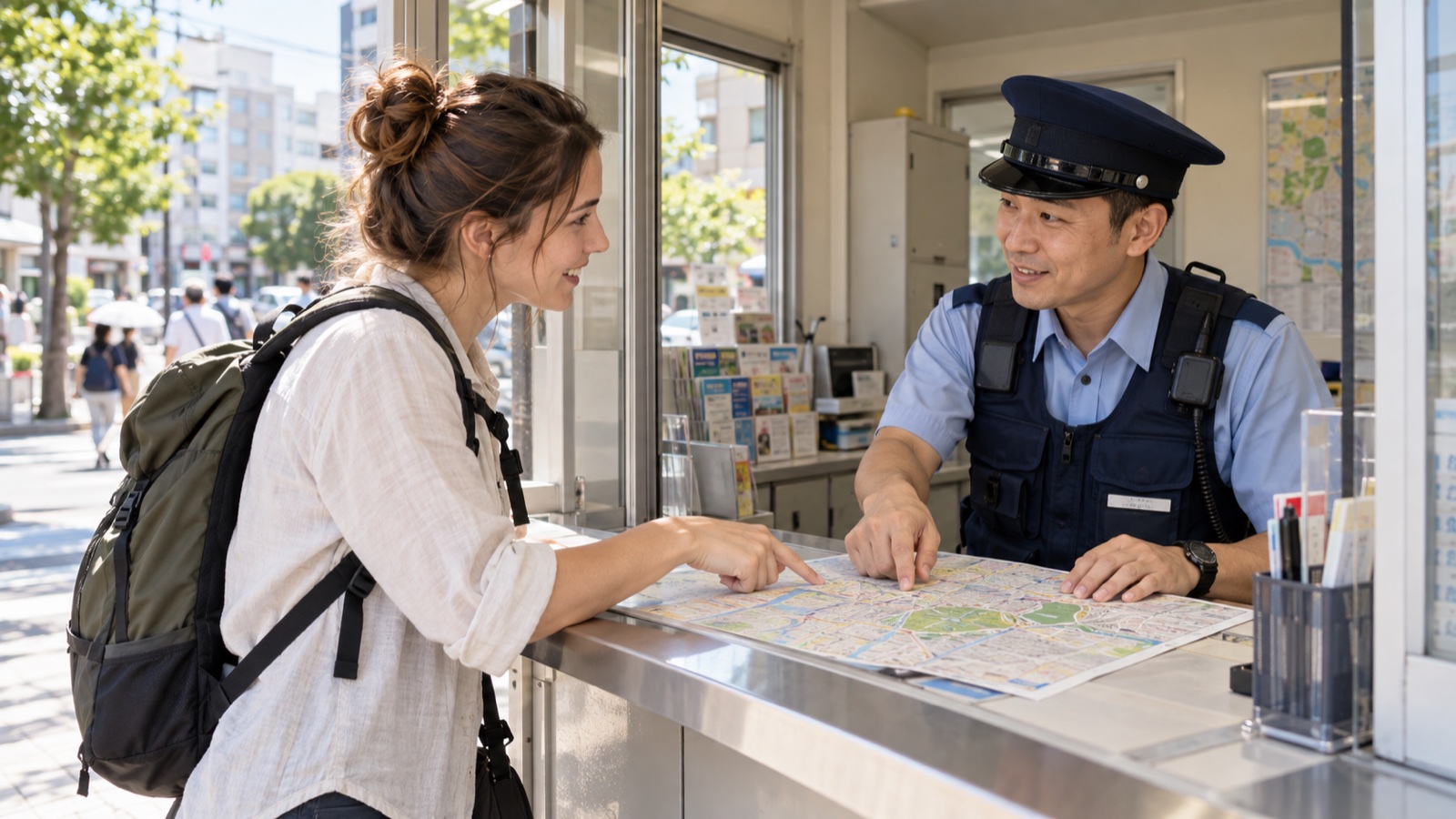
A koban is a neighborhood police box: a local base where officers respond to incidents, give directions, handle lost property and offer safety advice. It is not a tourist information desk, and urgent danger should still be reported to 110. This guide explains when walking into a koban is the right choice and what to prepare.
Koban, police station or 110?
- Koban: directions, a found item, a lost-property report, non-urgent local advice or reporting a past incident.
- Police station: matters requiring a specialist desk, complex documents or follow-up directed by an officer.
- 110: a crime or accident happening now, immediate danger, or urgent police response.
- #9110: non-emergency police consultation; availability and language support can vary by region.
What a koban can help with
Tokyo Metropolitan Police lists responding to incidents and accidents, directions, lost items and security advice among core koban services. Officers may also connect you with another unit or ask you to visit a full police station.
What to bring
- Passport or another ID, if available.
- The exact place, time and sequence of events.
- Photos, receipts, serial numbers or booking records.
- A Japanese address or map pin.
- Contact details for your hotel, insurer or embassy.
- A translation app, while keeping the original evidence unchanged.
Lost property
Explain where and when you last had the item, its distinctive features and any serial number. If it was lost inside a train, station, shop or taxi, contact that operator first because the item may not yet have reached police. Keep the report or reference number for insurance.
After theft, fraud or harassment
Prioritize safety, preserve messages and receipts, and do not confront a suspect. Tell the officer whether money, cards, passport or phone access is at risk. A police report does not replace contacting the card issuer, mobile carrier, embassy or insurer.
Language assistance
Not every koban has an English-speaking officer. Police may use an interpreter service, a translation tool or transfer you. Use short facts, dates and locations; avoid deleting evidence to free phone storage.
If no officer is inside
Officers may be patrolling. Look for the posted telephone or instructions, or go to the next koban or police station. In an emergency, call 110 rather than waiting.
Directions and everyday help
Officers often provide local directions, but prepare the Japanese place name and address. For restaurant recommendations, ticket booking or general sightseeing, use a tourist information center instead.
Privacy and photography
Do not film officers, victims, documents or the interior without permission. Keep other people’s information out of photos. Answer identification questions calmly and ask for clarification if you do not understand a document.
Useful Japanese
- Koban wa doko desu ka? — Where is the police box?
- Mono o nakushimashita. — I lost something.
- Higai ni aimashita. — I was a victim.
- Tsūyaku o onegai dekimasu ka? — Could I have an interpreter?
FAQ
Is a koban open 24 hours?
Staffing varies, and officers may be away on patrol. Do not rely on a specific box without checking.
Can police cancel my credit card?
No. Contact the issuer immediately; police handle the report.
Will a koban issue an insurance document?
Ask what record is available, then confirm your insurer’s exact requirement.
Related guides
Sources checked October 31, 2026: Tokyo Metropolitan Police: Koban, visitor safety guidance, and National Police Agency consultation guidance.