
Shopping for clothes in Japan is much easier when you ignore the letter on the tag and start with measurements. A Japanese M is not a universal size, and the same label can fit differently across brands, cuts and product lines. Bring your body measurements in centimeters, compare them with the shop’s size chart, and try the item on whenever possible.
Before you shop: save these measurements
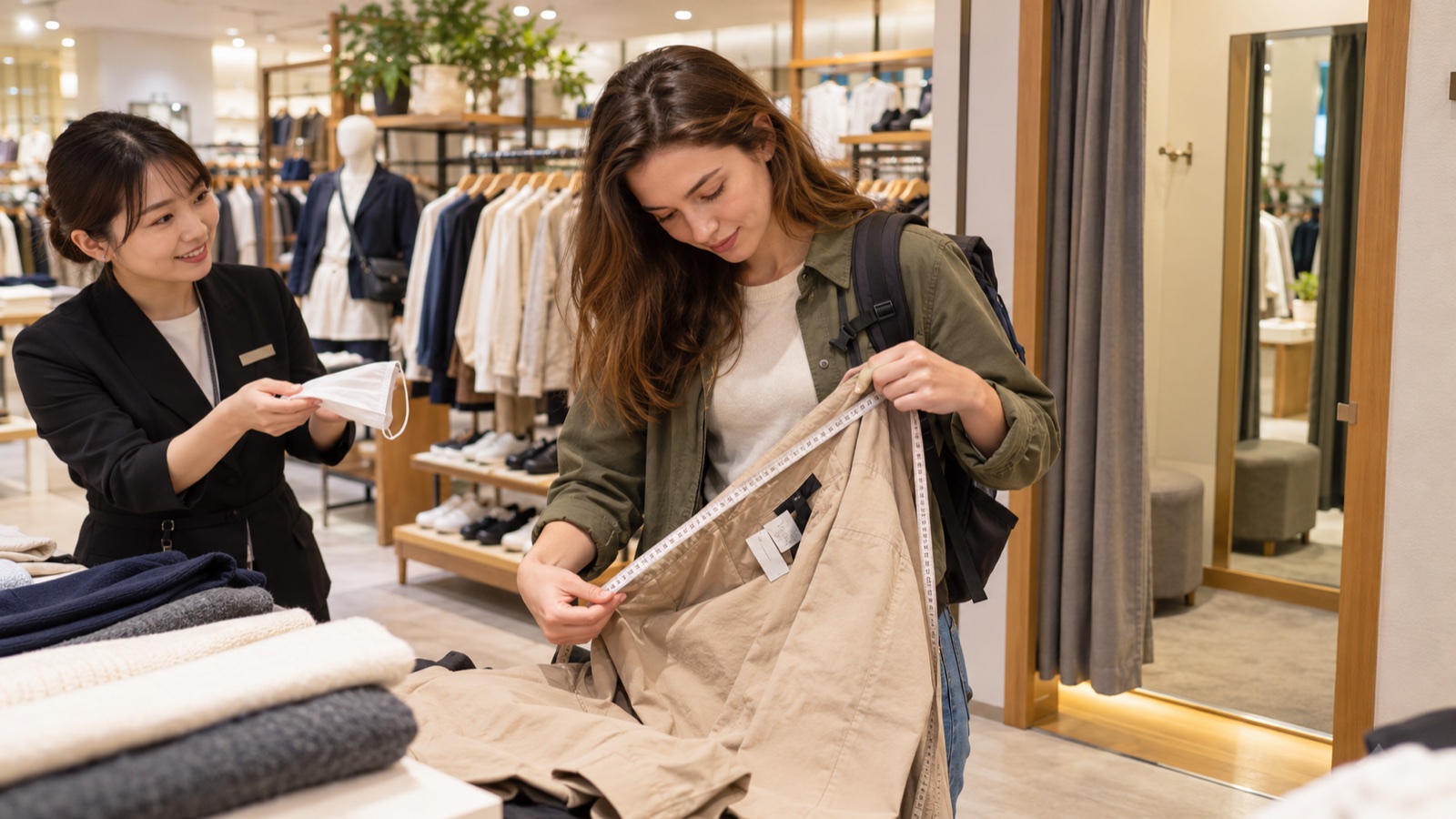
Record your height, chest or bust, waist, hips, inseam and foot length in centimeters. For a favorite jacket or pair of trousers, measuring the garment itself can be even more useful: shoulder width, pit-to-pit width, sleeve length, rise and inseam help you compare shapes without relying on S, M or L.
Useful question: Saizu-hyō wa arimasu ka? (Do you have a size chart?) If the chart lists body measurements, compare it with your body. If it lists finished garment measurements, allow room for the fit you want.
Clothing sizes: why direct conversion tables can mislead
Some stores publish international conversions, but there is no single conversion that works for every brand. Unisex clothing may use a different cut from women’s or men’s lines, and “one size” does not guarantee a universal fit. Treat any conversion as a starting point, then check the product-specific chart and fabric stretch.
- Structured items: prioritize shoulders, chest and sleeve length.
- Trousers and skirts: check waist, hips, rise and inseam.
- Knitwear: ask whether the displayed measurements are before stretching.
- Vintage clothing: use actual garment measurements; old labels may not match current sizing.
Shoe shopping: centimeters help, but shape still matters
Many Japanese shoe labels use foot length in centimeters. Measure both feet while standing, preferably later in the day, and use the larger measurement. Width, toe-box shape and arch position still vary, so try both shoes and walk briefly on the shop’s fitting area. Ask for another size with Chigau saizu wa arimasu ka? (Do you have another size?).
Do not assume that a familiar US, UK or EU conversion will feel identical. Socks, insoles and the intended activity can change the fit. For hiking or long city walks, test the shoes with the socks you plan to wear.
Fitting-room etiquette in Japan
Ask staff before entering rather than walking into an empty cubicle. Follow the store’s instructions: some fitting rooms require customers to remove their shoes at the raised entrance. Shops may also provide a face cover to protect clothing from makeup; place it over your head before pulling on the garment. The Japan National Tourism Organization specifically advises checking with staff, removing shoes where requested and using a face cover when provided.
- Tell staff how many items you have.
- Wait for the assigned room.
- Remove shoes or use a face cover if instructed.
- Return unwanted items to staff instead of rehanging them in the wrong place.
Some underwear, swimwear, earrings or hygiene-sensitive items cannot be tried on. Ask before opening packaging.
Check the return policy before paying
Return and exchange rules are set by each retailer. Sale goods, opened packages, altered garments, underwear and tax-free purchases may have extra restrictions. Before checkout, confirm the deadline, required receipt, acceptable condition and whether refunds go back to the original payment method. Do not remove tags until you are sure.
Useful question: Henpin mata wa kōkan wa dekimasu ka? (Can this be returned or exchanged?) For tax-free shopping, keep the purchase and receipt together and follow the store’s instructions.
Read the care label before buying
A perfect fit is not useful if the garment cannot be cleaned during your trip. Check whether it is machine washable, hand-wash only or requires professional cleaning. Japan’s Consumer Affairs Agency explains that the JIS L 0001 care-label system was revised in 2024, so use the current symbol—not guesswork—to decide how to wash, bleach, dry, iron or professionally clean the item.
For practical washing advice, see our guide to using a Japanese coin laundry. If you are buying gifts rather than clothing, our regional souvenir guide helps match purchases to each destination.
Quick checklist
- Save body and favorite-garment measurements in centimeters.
- Use the product-specific chart; do not trust the letter size alone.
- Try both shoes and check width as well as length.
- Ask before entering a fitting room and follow shoe/face-cover rules.
- Confirm return, exchange and tax-free conditions before paying.
- Check the care symbols and keep the receipt and tags.
FAQ
Are Japanese sizes always smaller?
No. Many travelers find some cuts narrower or shorter, but sizing varies too much for a universal rule. Measurements and trying on are more reliable.
Can I try on clothes without speaking Japanese?
Usually yes. Show the item to a staff member and gesture toward the fitting room. A translation app and the phrases above make the process smoother.
Can I return an item after leaving Japan?
Do not assume so. International returns may be unavailable or costly, and tax-free purchases can have special conditions. Confirm the policy at the store before purchase.
Information checked: October 31, 2026. Store rules and product sizing vary. Official references: JNTO customs and etiquette, JNTO shopping Q&A, and Consumer Affairs Agency care-label guidance.