
Public toilets in Japan are common in stations, shopping centers, department stores, parks, museums and larger tourist facilities. The challenge is rarely finding a toilet in a city; it is understanding the signs, choosing the right room and recognizing unfamiliar bidet controls without pressing an emergency button by mistake.
Quick answer: follow the toilet pictogram, carry tissues for older or rural facilities, use only the controls you understand, and leave accessible toilets available for people who need their extra space or equipment.
Where to find a public toilet
- Railway and subway stations: often inside the ticketed area, though some stations also have toilets outside the gates.
- Department stores and shopping centers: usually reliable during business hours.
- Convenience stores: some branches allow customer use, but toilets are not guaranteed and local policies vary.
- Parks, museums and tourist sites: availability and opening hours follow the facility.
- Highway service areas: generally designed for continuous road-travel use.
Map listings are useful, but opening hours and renovations change. At a station, ask toire wa doko desu ka? (“Where is the toilet?”) or show the word トイレ.
Reading the signs
The standard male, female and wheelchair pictograms are widely used. Common Japanese words include:
| Japanese | Meaning |
|---|---|
| トイレ/お手洗い/化粧室 | Toilet / restroom |
| 男性/女性 | Men / women |
| 多機能トイレ | Multifunction or accessible toilet |
| バリアフリートイレ | Barrier-free toilet |
| 使用中/空 | Occupied / vacant |
Facility terminology is not perfectly uniform. Check the pictograms for the equipment you need rather than relying only on one label.
Western-style and squat toilets
Most urban tourist facilities provide Western-style seated toilets. Squat toilets still appear in some older stations, parks and public buildings. For a Japanese squat toilet, face the raised hood, lower into a squat and keep clothing clear of the bowl. If this is difficult, look for another cubicle rather than risking a fall.
Washlet and bidet controls
Electronic bidet seats vary by manufacturer and age, but several functions are common:
- 止 or a square stop icon: stop the water.
- おしり: rear wash.
- ビデ: bidet/front wash.
- 水勢 with plus/minus: water-pressure adjustment.
- 音 or a music-note icon: privacy sound on some models.
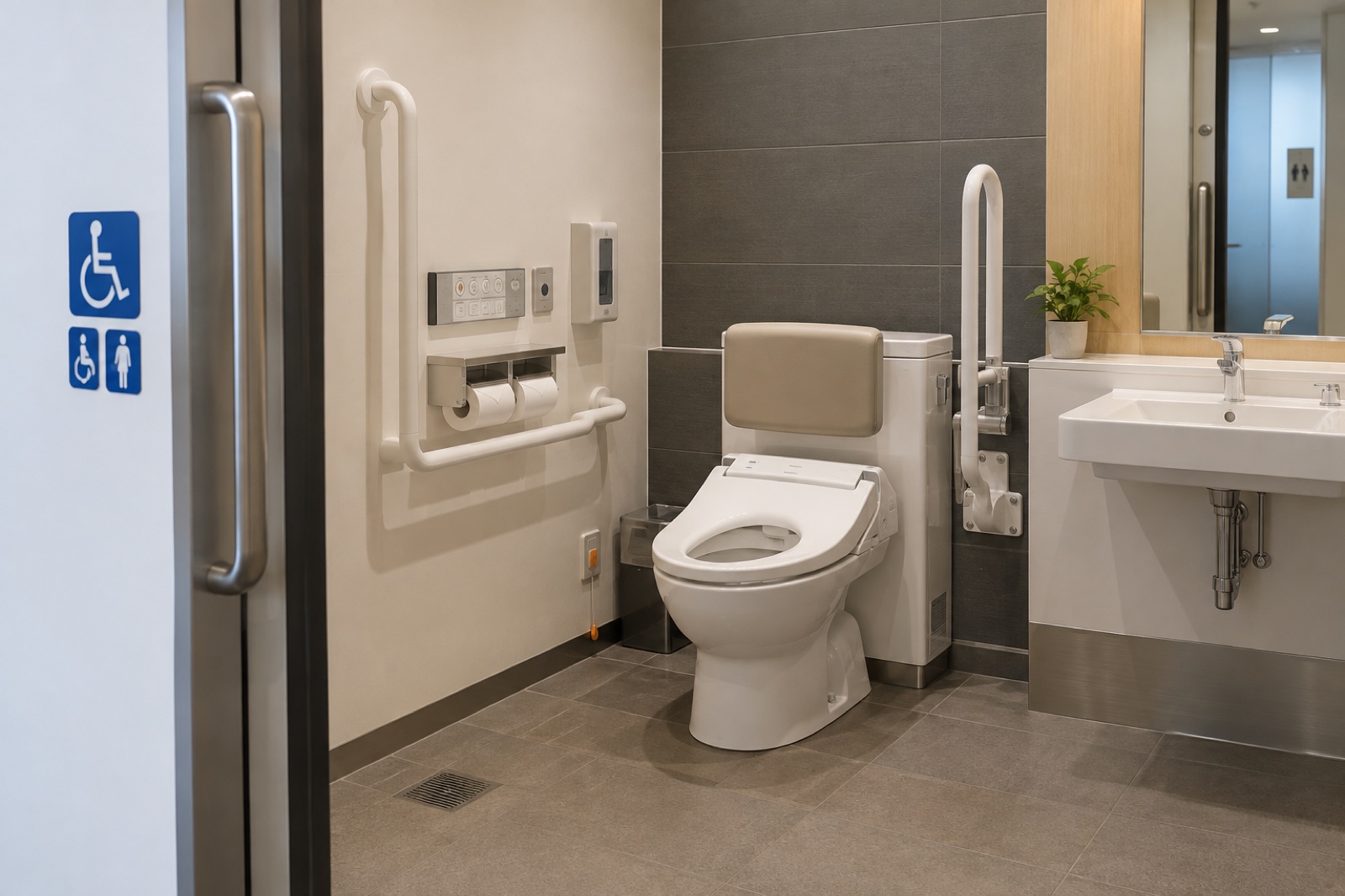
TOTO’s official control-panel guidance illustrates typical functions, but panels differ. Locate the stop button before starting a wash. Do not confuse a wall-mounted emergency call button or pull cord with the flush control.
How to flush
The flush may be a lever on the tank, a wall button, a sensor or a button on the control panel. Look for 大 (large flush) and 小 (small flush), or the word 流す (“flush”). If a sensor does not react, look for a nearby manual button. Avoid repeatedly pressing unrelated controls.
Toilet paper and waste
Where signs permit, ordinary toilet paper is flushed. Sanitary products, wipes, diapers, plastic and other rubbish belong in the appropriate bin. Do not put a thick stack of paper into the bowl at once. Some older or temporary facilities may display special instructions; follow the local sign.
Hand dryers, paper towels and soap are not universal. A small hand towel and tissues are useful additions to a day bag.
Accessible and multifunction toilets
Accessible toilets may include wider turning space, grab bars, an ostomate sink, an adult changing surface or baby equipment. Not every room contains every feature. Japan’s Ministry of Land, Infrastructure, Transport and Tourism publishes barrier-free facility guidance, while JNTO’s traveling-with-disability page provides planning resources for visitors.
If you do not need the extra equipment, use a standard cubicle when available. Before entering, check whether the room is shared, priority-use or assigned to a specific side of the restroom area.
Baby care and family use
Baby chairs, diaper-changing tables and child seats may appear in standard or multifunction toilets, but availability varies. Never leave a child unattended on a changing table. Dispose of diapers only where specifically allowed; otherwise seal and carry them out.
Etiquette and privacy
- Queue without blocking doors or accessible routes.
- Leave the cubicle clean and report serious problems to facility staff.
- Do not photograph people, reflections or occupied restroom areas.
- Keep luggage close without obstructing neighboring cubicles.
- Avoid long grooming sessions when others are waiting.
What to carry on a day trip
- Travel tissues
- A small hand towel
- Hand sanitizer for facilities without soap
- A sealable bag for personal waste when no bin is provided
- A translated note describing accessibility equipment you require
If something goes wrong
If a door, flush or bidet control fails, stop using unfamiliar buttons and contact station or facility staff. An emergency call button is for assistance, not routine flushing. If you become trapped or face a medical emergency, use the call system and clearly state that you need help. For broader emergencies, see our Japan emergency phone-number guide.
Frequently asked questions
Are public toilets in Japan free?
Many are free, particularly in stations, parks and shopping facilities, but access may require entering a paid station area or visiting during facility hours.
Can I use a convenience-store toilet?
Only when that branch permits it. Look for signs and ask staff; some branches have no customer toilet.
What if I cannot read the bidet panel?
You do not need to use it. Use the toilet normally and locate the separate flush control. If you start a wash, press 止 or the stop icon.
Does every accessible toilet have an ostomate sink or adult changing table?
No. Equipment varies. Check facility pictograms or official accessibility information before travel.
Summary
Japanese public toilets are generally easy to find, but layouts and controls differ. Identify the correct room, locate the flush and stop buttons, follow local disposal signs, and keep accessible facilities available for travelers who need them.
Facility and accessibility information checked September 18, 2026 against TOTO, MLIT and JNTO official resources. Equipment and access conditions vary by location.