

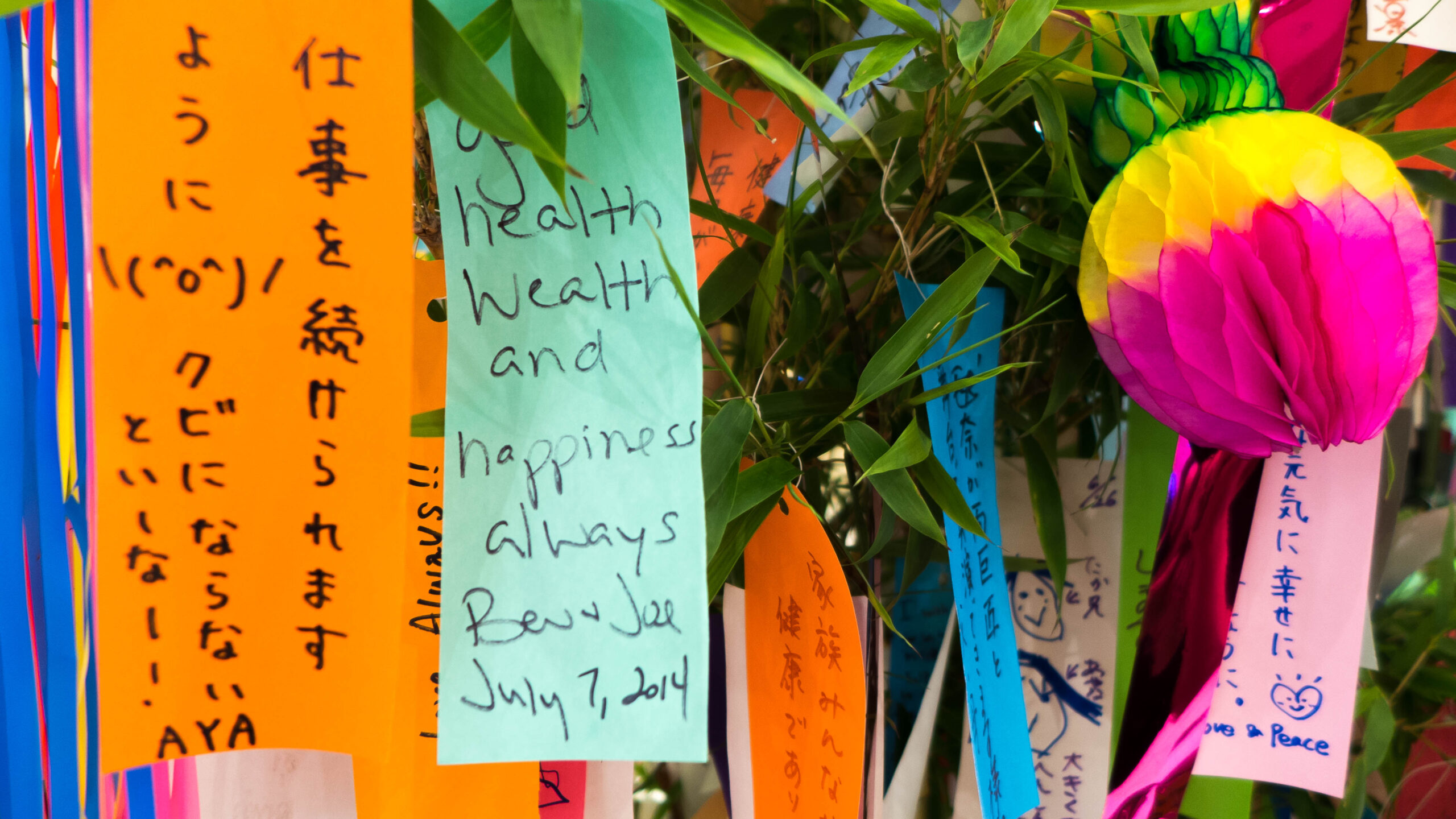
Japan’s Tanabata (たなばた/Tanabata) is a traditional summer festival held on July 7 every year, full of romance and prayer.Originating from the Chinese legend of the Cowherd and the Weaver Girl, after being introduced to Japan in the Nara period, it was combined with the Japanese native “Tanaki (たなばた)” myth to develop a unique Japanese Tanabata culture.
The Legend of the Weaver Girl and the Cowherd
The story of Chinese Valentine’s Day originates from the love legend between Vega (the brightest star in Lyra) and Altair (the brightest star in Aquila).The Weaver Girl is the daughter of the Emperor of Heaven and is good at weaving; the Cowherd is a hard-working young man herding cattle.After getting married, the two became obsessed with love and neglected their respective jobs.The Emperor of Heaven was furious and separated the two people with the Milky Way, allowing them to meet only once a year on the seventh day of the seventh lunar month.It is said that if it rains on Chinese Valentine’s Day and the river rises and the two are unable to see each other, the rain will be the tears of the Weaver Girl.
Write down your wishes in the short book
The most representative custom of Japan’s Tanabata is to write down your wishes on a five-color short book (long strip of colored paper) and hang it on a bamboo branch for decoration.The five colors (green, red, yellow, white, and black) are derived from the Chinese theory of Yin and Yang and the Five Elements, which respectively represent “benevolence, propriety, faith, righteousness, and wisdom.”By the Edo period, this custom became popular among ordinary people, and people used it to pray for the advancement of calligraphy and learning.Nowadays, people write down various wishes in short books such as “passing the exam”, “success in love”, and “health of the family”.Bamboo grows straight upward and is regarded as a medium that can convey wishes to the sky.
The specialties of Chinese Valentine’s Day decoration
In addition to short books, Chinese Valentine’s Day decorations also include paper clothes (symbolizing the Weaver Girl’s weaving thread and improvement in tailoring skills), origami cranes (to pray for longevity), cast nets (to pray for a good fishery harvest), paper money (to pray for business prosperity), lanterns (to illuminate wishes), and tassels (to symbolize the Weaver Girl’s silk thread).These decorations are collectively called “Tanabata decorations”, and each one has a unique meaning.
Three major Tanabata festivals in Japan
Sendai Tanabata Festival (Miyagi Prefecture, August 6th to 8th) is the largest Tanabata festival in Japan.The shopping street is decorated with giant bamboo ornaments that are 5 meters high. The seven colorful ornaments sway in the wind, attracting about 2 million tourists every year. Shonan Hiratsuka Tanabata Festival (Kanagawa Prefecture, early July) is the largest Tanabata festival in Kanto. The entire shopping street is decorated with gorgeous blowing decorations, and there are hundreds of food stalls and traditional performances. Anjo Tanabata Festival (Aichi Prefecture, early August) has the theme of “wishes”. There are special wish-making locations throughout the city, and the event format is unique and interesting.Modern ways to celebrate Chinese Valentine’s Day
In modern Japan, Tanabata is an important event in schools and kindergartens where children write short books and decorate bamboo branches.Supermarkets and shopping malls will also set up large-scale Chinese Valentine’s Day decorations around the Chinese Valentine’s Day.There is also a tradition of eating vegetarian noodles (そうめん) in the family. It is said that it comes from the Chinese eating habit of “suobing”, which means to ward off diseases and achieve health and longevity.
On the night of Chinese Valentine’s Day, if the weather is clear, you might as well look up and look for the Milky Way in the sky.Vega and Altair are clearly visible to the naked eye far away from city lights.If you are traveling in Japan, you might as well find a Tanabata bamboo, write down your wishes, and feel this unique Japanese summer style.