


A lower-carbon trip in Japan does not begin with the newest vehicle. It begins by reducing unnecessary distance, using the rail and bus network well, and walking or cycling the last few kilometres when conditions are safe. Electric cars and small electric mobility can help in the right place, but an electric label alone does not erase electricity generation, manufacturing, congestion or battery impacts.
What “lower carbon” should mean on a trip
Japan’s Ministry of the Environment encourages walking, cycling and public transport in place of private-car travel, and government transport data consistently place rail below private cars in emissions per passenger-kilometre. Exact savings, however, depend on occupancy, energy source, route and what the journey replaces. A nearly empty vehicle added only for sightseeing is not automatically the greenest choice.
Use a simple order: avoid an unnecessary transfer; choose an existing high-capacity service; walk or cycle a safe last mile; share a vehicle; then use a private vehicle only where it solves a real access need. This also supports Japan’s station-centred towns: spending time on foot near a station often keeps money in small local shops rather than moving quickly between distant car parks.
Choose transport by trip shape
| Trip | Usually start with | Check before choosing |
|---|---|---|
| Tokyo, Osaka or another major-city day | Rail + walking | Peak crowds, station exits, lift routes, last train |
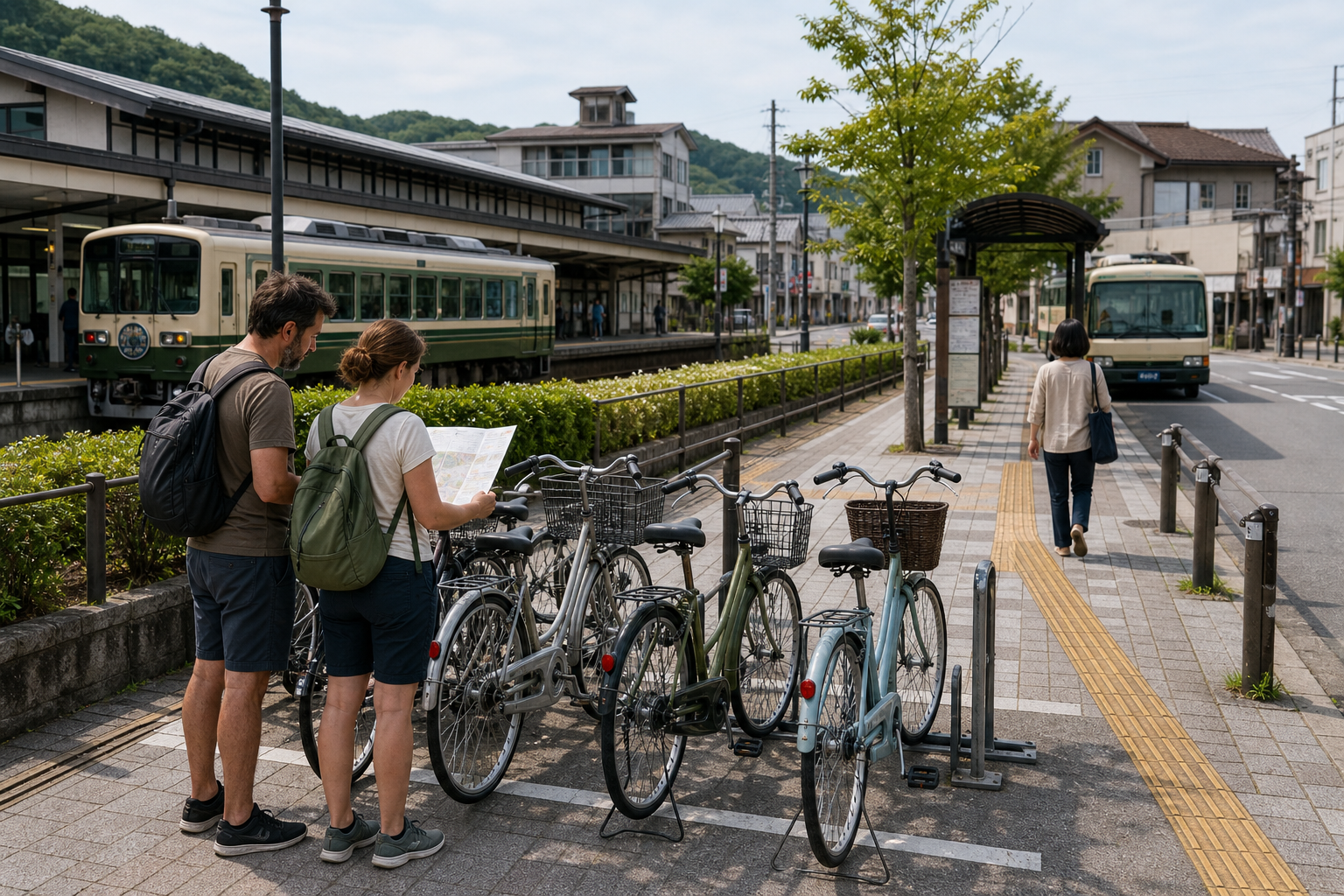
| Compact castle or port town | Rail/bus + walking or bicycle | Hills, rain, legal parking, bicycle return capacity |
| Rural sights on one corridor | Local rail/bus | Infrequent timetable, cash/IC acceptance, final return |
| Scattered rural sites or family luggage | Shared car or rental car | Whether an EV’s range and charging fit the route |
| Short urban gap not served by transit | Walk or bike share | Traffic skill, weather, luggage and app registration |
The lowest-impact option is not useful if it creates a safety risk or excludes a traveller. A step-free bus or short taxi link can be the responsible choice for someone with limited mobility. Sustainability includes dignity and access, not only a carbon calculation.
Rail and bus: the practical foundation
Rail works best when accommodation and activities are grouped along one line. Search the destination first, then compare the nearest station, correct exit and walking gradient rather than selecting a hotel solely by straight-line distance. In regional Japan, check the timetable for the return journey before departure; the final service can be much earlier than in a large city.
- Payment: major IC cards are widely useful but not universal. Some local buses, railways and community services require cash, a numbered ticket or a separate app.
- Reservations: limited express and Shinkansen services may have reserved and non-reserved rules that vary by train. Oversized baggage also has route-specific arrangements.
- Disruption: heavy rain, snow, wind and earthquakes can suspend service. Keep the operator’s official page and a realistic fallback.
- Etiquette: queue at markings, let passengers alight, keep bags off seats, speak quietly and avoid blocking doors with suitcases.
Rail travel is also a cultural window. The station-front shopping street, local bento and carefully timed bus connection reveal how a community has organised daily life around shared transport.
Walking: slow travel without romanticising distance
Walking makes small shrines, waterways, backstreet workshops and changes in neighbourhood scale visible. It is often the best way to understand a castle town or temple approach. But a map’s “20 minutes” may hide heat, snow, slopes, stairs or long signal waits.
- Use a shaded or underground route in extreme heat and schedule rests before you feel ill.
- Do not walk on a cycle lane, private verge or residents’ doorway for a photograph.
- Keep the tactile guidance path clear when stopping with luggage.
- At night, prefer lit public streets; “off the beaten path” is not permission to enter private land.
Bike share and rental bicycles
Share cycles complement public transport by allowing pickup and return at multiple ports. Operators, coverage, account requirements and prices vary by city, and a port shown in an app may be full or empty. Register and confirm that your phone number, payment card and app work before walking to a remote port.
- Before unlocking: check brakes, tyres, lights, saddle, battery level on an e-bike and any damage; report a fault in the app.
- Route: bicycles generally keep left on the road. Sidewalk riding is only allowed in legally specified circumstances, and pedestrians always have priority there.
- Helmet: wearing a bicycle helmet has been a duty to make reasonable efforts for all riders since April 2023. Choose a rental that supplies one or bring a suitable helmet.
- Never: use a phone while moving, ride holding an umbrella, ride two abreast where prohibited, carry a passenger on an ordinary bicycle or ride after drinking.
- Return: use a legal rack or the correct port, lock the bicycle and wait for the app to confirm completion. A full port may require another location and extra time.
Since 1 April 2026, the traffic-violation notice system applies to bicycles, with the new framework mainly covering riders aged 16 and over. Visitors are subject to Japanese traffic law; a rental agreement does not provide an exemption.
E-scooters: understand the law first
Only vehicles meeting Japan’s definition of a specified small motorised bicycle (特定小型原動機付自転車) receive the special rules often associated with rental e-scooters. A different model may require a licence and may not use the same spaces.
- You must be at least 16. A driving licence is not required for a compliant specified small motorised bicycle.
- The structural maximum is 20 km/h, but that is not a target speed.
- Road travel is the rule: keep to the left edge and obey vehicle signals and signs.
- Only a compliant “special specified” vehicle limited by its mechanism to 6 km/h may use a permitted sidewalk, and only where the sign allows it. Pedestrians have priority.
- No drink-driving, phone use while moving, two-person riding or illegal parking. Helmet use is an effort duty, but wearing one is the sensible choice.
If you cannot read the signs, make a right turn correctly or balance confidently beside traffic, choose walking or public transport. Novelty is not a reason to take a road risk.
When an EV rental car makes sense
An electric rental car can fill a genuine gap where sights are scattered and buses are extremely limited. It is not automatically preferable to an already-running train, and its life-cycle impact depends on the vehicle, electricity and use.
- Map the entire route, elevation and expected air-conditioning or heating use.
- Identify at least two working charging options, their hours, connector, output, access method and whether the car or rental plan includes a charging card.
- Ask the rental desk to demonstrate charging and confirm return-charge rules.
- Do not plan around the advertised maximum range; keep a weather and detour reserve.
- Never occupy a charger after charging finishes, and do not use an accessible bay unless entitled.
For a group with luggage, one appropriately sized shared vehicle can be more practical than several taxis. For a solo trip between well-connected cities, rail is usually simpler.
Green slow mobility and local experiments
Japan’s green slow mobility refers to small electric transport services travelling on public roads below 20 km/h. Communities may use them for older residents, station access or sightseeing. Their deeper value is social: a slow service can connect people and local businesses while addressing driver shortages.
Do not confuse a national programme, demonstration list or vehicle display with a current public ride. Confirm the municipality or operator, operating dates, eligibility, booking, fare, boarding place, weather policy and wheelchair conditions. The same caution applies to hydrogen buses and autonomous shuttles: interesting technology is not necessarily a bookable attraction.
Sample plans, accessibility and weather
Compact-town half day
Arrive by local rail, store large luggage, walk the historic core, use a rental bicycle only for a flat riverside or coastal extension, and return it 30 minutes before the train. This protects the final connection if the first port is full.
Regional full day
Choose one rail or bus corridor and two stops rather than crossing an entire prefecture. Eat near a station, buy from local shops and keep the last scheduled service as a hard deadline.
When to change the plan
Switch from cycling or an e-scooter to rail, bus or taxi during heavy rain, snow, strong wind, extreme heat, poor visibility or when carrying bulky luggage. Travellers who need step-free access should verify lifts, low-floor vehicles, bicycle-port clearance and accessible toilets individually; “eco” infrastructure is not automatically barrier-free.
FAQ
Is public transport always the lowest-carbon choice?
Not in every imaginable case, but existing high-capacity rail and bus services are a strong default. Compare the whole trip, occupancy and alternatives rather than the vehicle label alone.
Can tourists ride bicycles on Japanese sidewalks?
Not as a general rule. Bicycles normally use the left side of the road. Sidewalk use is limited to specified legal circumstances and pedestrians have priority.
Do I need a licence for an e-scooter?
Not for a compliant specified small motorised bicycle if you are 16 or older. Other powered vehicles may require a licence, so verify the vehicle category.
Should I reserve an EV just because it is environmentally friendly?
No. Choose it when a car is genuinely needed and charging fits the route. Rail, bus, walking or cycling may be simpler and lower impact.
Official references: National Police Agency bicycle rules for 2026; NPA specified small motorised bicycle rules; MLIT share-cycle policy; MLIT green slow mobility; JNTO sustainable travel guidance. Prices and operating areas are operator-specific and can change; verify immediately before use.