


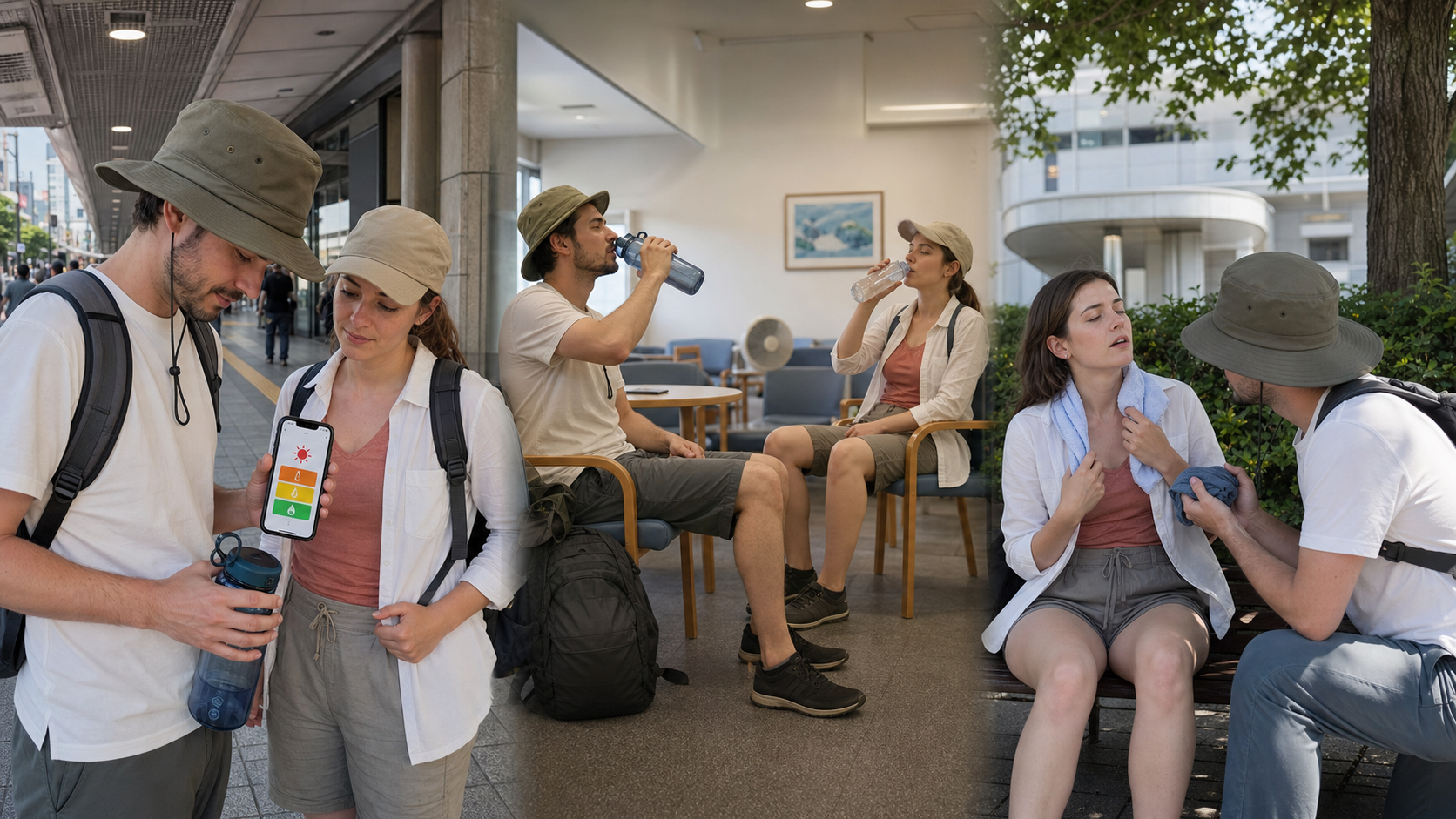
Japan’s summer is not one stable climate: humid cities, mountain valleys, northern regions and subtropical islands behave differently, and heat can remain dangerous after sunset or indoors. A fan, iced tea or “cool destination” does not make an ambitious itinerary safe. Check heat stress, move outdoor time, build air-conditioned recovery into the route and know when sightseeing must stop.
Risk = environment + body + activity
Japan’s Ministry of the Environment identifies high temperature, high humidity and low wind; lack of heat acclimatisation; and exertion as interacting causes. Temperature alone misses humidity, sunlight and radiant heat. The Japan Meteorological Agency notes hot, humid summers in eastern Japan and very hot, humid summers in western Japan, sometimes reaching 35°C or above. Northern or highland locations are not guaranteed cool on your date.
- Risk rises after travel from a cool/dry climate, especially during the first days.
- Fever, diarrhoea, poor sleep, hangover and some medicines can reduce tolerance.
- Children, older adults, pregnant people and people with chronic illness or disability may need a different route and earlier stop.
- Heat illness also occurs indoors and while apparently resting.
Use WBGT and official alerts, not “feels like 35°C”
Japan’s official Heat Illness Prevention site publishes current/forecast WBGT and Heat Stroke Alerts. WBGT represents heat stress using more than ordinary air temperature and varies by environment and activity.
| WBGT | Official exercise guidance | Travel decision |
|---|---|---|
| Below 21 | Appropriate water replacement | Still check individual condition |
| 21–25 | Replenish water often | Add shade and planned breaks |
| 25–28 | Provide rests often | Shorten exposed walks |
| 28–31 | Heavy exercise prohibited | Move sightseeing indoors/cooler hours |
| 31+ | Exercise prohibited | Cancel exposed exertion; stay cool |
A Heat Stroke Alert is a prompt to protect yourself and people nearby. A Special Heat Stroke Alert means exceptionally dangerous widespread conditions may cause major health harm; ordinary precautions may be insufficient and organisers may need to cancel, postpone or change activity. Check your exact area on the day, not yesterday’s screenshot.
A three-zone summer itinerary
| Time/zone | Suitable plan | Exit rule |
|---|---|---|
| Early, cooler period | One outdoor priority near transport | Stop before fatigue, not after symptoms |
| Peak heat | Museum, indoor market, seated meal, hotel rest | If cooling is unavailable, abandon the area |
| Evening | Short flexible walk | Recheck WBGT, humidity, storm and final transport |
Link every outdoor segment to a confirmed cooled refuge, toilet and transport exit. A shopping centre is private property with its own hours and rules, not a guaranteed free cooling centre. Do not design a long queue, temple approach, exposed castle, theme park or hike around a single vending machine.
Karuizawa, Kamikochi and Hokkaido can be cooler than major lowland cities in some conditions, but “around 25°C all summer” is false. Check the local forecast, sun exposure, altitude, storms and return transport; mountain ultraviolet exposure and sudden weather remain risks.
Hydration and salt: small, regular and appropriate to the person
- Begin hydrated and drink regularly before strong thirst; carry a refillable bottle plus a backup purchase plan.
- Water or caffeine-free mugicha can contribute fluid, but mugicha is not heat-stroke treatment and does not automatically replace salt lost in heavy sweating.
- With prolonged heavy sweating, official guidance includes fluid and salt replacement; oral rehydration solution has a medical purpose and is not simply an unlimited everyday soft drink.
- Alcohol can worsen judgement and hydration planning; never use it as fluid replacement.
- People with heart, kidney, endocrine disease, fluid/salt restrictions or medicines affecting heat/fluid balance should obtain clinician-specific advice—not copy a generic litre or salt target.
Do not force large volumes quickly. Nausea, vomiting, confusion or inability to drink changes the response from “have another bottle” to cooling and medical help.
Useful clothing and items—with honest limits
- Loose, breathable, quick-drying clothing; a brimmed hat and sunglasses.
- Compact sun/rain umbrella where safe and permitted; never block a narrow pavement or crowd.
- Fan or hand fan to support evaporation; it cannot replace air conditioning or hydration in dangerous heat.
- Cooling towel or cold pack wrapped from bare skin; never cause cold injury or rely on neck cooling alone.
- Sunscreen reapplied as directed, blister care, spare dry layer and power bank.
Portable fans can be culturally ordinary and convenient, but hot moving air is not proof the body is cooling enough. A folding fan, sensu, or round uchiwa is a tool, not protective equipment.
Indoor heat, hotel rooms and sleep
Heat illness can develop indoors. On arrival, learn the air-conditioner controls, do not switch it off solely to imitate an energy-saving slogan, block direct sun and ventilate only when outside conditions help. Ask accommodation staff if the system is central, timed or malfunctioning.
- Keep water and phone within reach overnight.
- Do not leave children, older adults or animals in a parked vehicle or uncooled room.
- If sleep is poor, diarrhoea/fever develops or the room never cools, reduce or cancel the next day’s outdoor activity.
- For evacuation, follow fire/disaster instructions; never obstruct vents or exits with improvised cooling equipment.
Japan’s culture of “ryō”: sensory coolness is not medical cooling
Japanese summer culture often creates a feeling of coolness through air, water, shade, sound and seasonality: uchiwa and folding sensu, reed screens, wind chimes, blue-and-white vessels, shaved ice and evening festivals. Uchimizu—sprinkling water at an entrance or street—has social and sensory meaning and may briefly cool a surface, but it is not a substitute for air conditioning during dangerous WBGT.
Enjoy these practices with context: do not splash public roads without permission, hang noisy wind chimes where they disturb neighbours, or treat a yukata as heat-protective sportswear. The most respectful summer choice can be to cancel a visit rather than turn heat endurance into cultural authenticity.
Summer foods: pleasure, energy and hygiene
Kakigōri, sōmen, hiyashi chūka and chilled sweets express the season, but shaved ice is not a balanced hydration plan and salty food is not a precise electrolyte prescription. Eat regular meals if tolerated and combine fluid, food and rest according to condition.
- Do not leave bentō, rice balls, dairy, seafood or cut fruit in a hot bag or car.
- Use cold storage and obey the package’s temperature/consumption instructions.
- Wash hands and do not assume a festival stall or convenience food is allergy-safe.
- For vomiting or diarrhoea, stop the itinerary and reassess dehydration/medical risk rather than pushing on.
Recognise symptoms and act in order
Official symptom examples include dizziness, faint feeling, numbness, muscle cramps, malaise, headache, nausea, vomiting, fatigue and behaviour that seems unusual. Severe signs include abnormal answers/confusion, unconsciousness, convulsions and a very hot body.
- Stop: do not make the person walk to complete the route.
- Move: reach air conditioning or a shaded, ventilated safe place.
- Cool: loosen clothing; cool the neck sides, armpits and groin; spray/wet and fan where appropriate.
- Drink only if alert and able: offer fluid/salt or appropriate oral rehydration in small amounts.
- Call 119 immediately for unconsciousness, confusion/abnormal response, seizure, very hot body, inability to drink, or deterioration. Follow dispatch instructions and send someone to meet the ambulance.
Do not leave the person alone, force drink, give alcohol or assume improvement after one cold bottle means the danger has passed. Seek professional assessment when symptoms persist or the person’s health increases risk.
Higher-risk travellers and morning checklist
- Children: more frequent observation, shade and water; never cover a stroller in a way that traps heat.
- Older adults: thirst and heat perception may be reduced; check the room and intake rather than asking only “Are you fine?”
- Pregnancy/chronic illness/disability: plan accessible cooled stops, toilets, medicine storage and an earlier exit with a clinician where needed.
- Solo travellers: share the route, carry the hotel address and do not hike alone in dangerous heat.
- Check local forecast, WBGT, Heat Stroke Alert and storm/typhoon status.
- Delete or move exposed activities; identify two cooled refuges.
- Pack water, payment backup, hat/umbrella, breathable layer, phone/power and personal medicine.
- Confirm everyone has eaten/slept, is not feverish or suffering diarrhoea/hangover, and knows 119.
- Agree that anyone can stop the group without debate.
Official references: Ministry of the Environment heat/WBGT portal; heat illness mechanism and prevention; MHLW symptoms and first response; JMA regional climate. Verify live alerts on the date.