



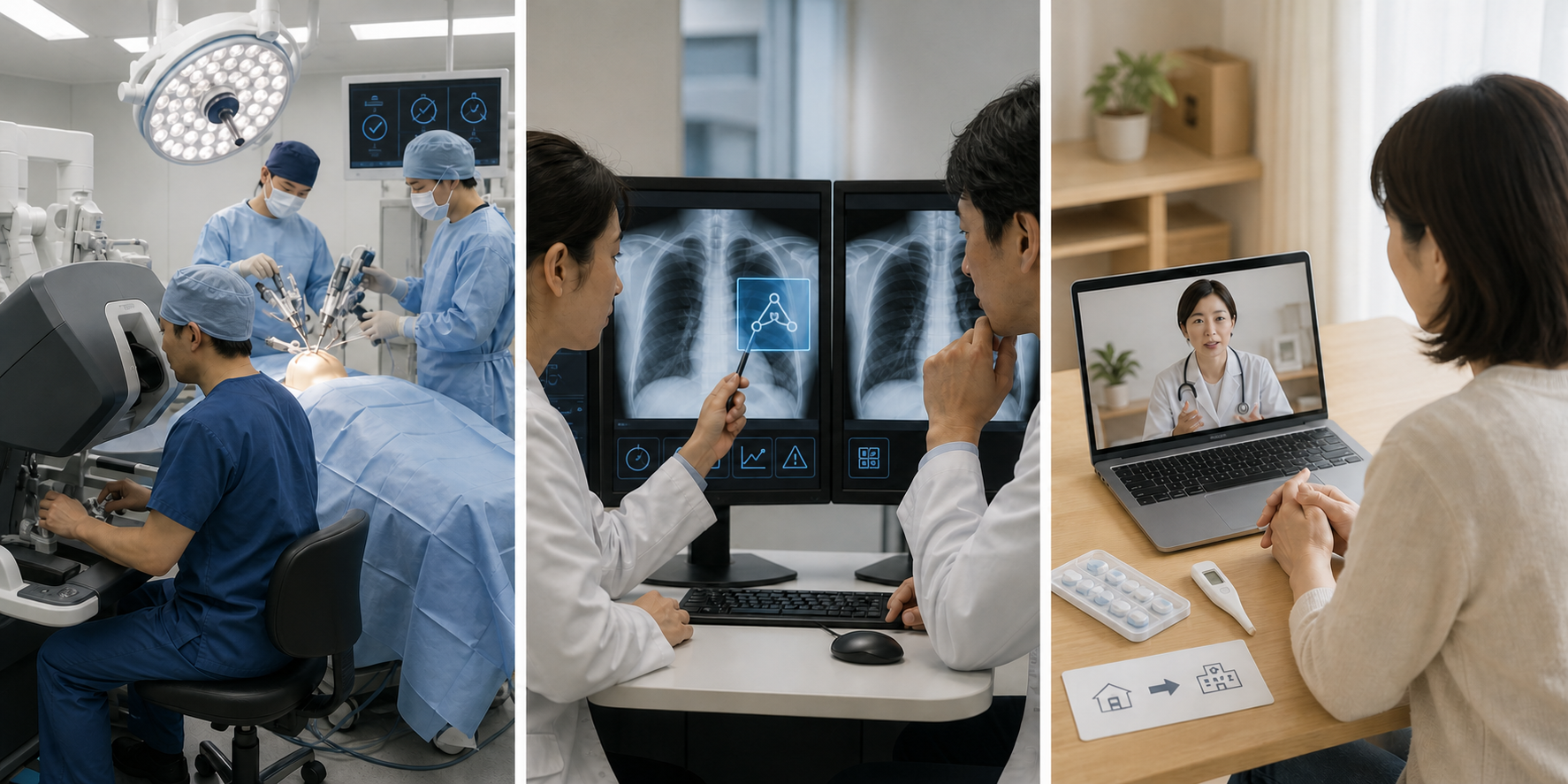
Japan’s medical technology is interesting not simply because robots and AI look futuristic. Its real value lies in how the skills of doctors, nurses and clinical engineers are combined with regulatory review, hospital procedures and informed patient choice. “Approved in Japan,” “installed at a hospital,” “suitable for me” and “covered at the same cost by public health insurance” are four different conclusions. This practical guide explains surgical-assistance robots, regulated medical AI and telemedicine without turning technology into medical advice. Information checked August 26, 2026.
A robot, medical AI and telemedicine are not one interchangeable “digital health” service
| Technology | Main role | Common misconception |
|---|---|---|
| Surgical-assistance robot | Transmits a surgeon’s movements and supports visualisation and instrument control | An autonomous robot performs the operation alone |
| AI-enabled medical software | Analyses images, waveforms or other data to support diagnosis or treatment decisions | One general AI diagnoses every disease |
| Telemedicine | A physician examines, diagnoses or advises through information and communications technology | It is identical to a symptom checker or health chat |
Instead of beginning with a brand, ask who uses the system, for which patients, with what input, to produce what output, and who makes the final decision. Japan uses both domestic and overseas technology; “developed in Japan” is not synonymous with “approved and used in Japan.”
A surgical-assistance robot is an instrument operated by a trained surgeon and team
In a typical system, a surgeon at a console controls the camera and instruments. Magnified three-dimensional vision, tremor filtering and articulated instruments can aid work in a confined space. The machine does not independently decide where to cut, manage bleeding or complications, or convert to an open procedure. Safe use requires the surgeon, bedside staff, anaesthesia, nursing and technical support, plus a plan for interruption or conversion.
Benefits and harms vary by organ, procedure, disease stage, comorbidity and team experience. Robot-assisted surgery is not automatically safer, faster, painless or more complete than laparoscopy, thoracoscopy or open surgery. Setup, positioning, instrument collision, equipment interruption and the fallback procedure are legitimate parts of informed consent.
Judge medical AI within its approved purpose, input and intended user
In Japan, software intended to diagnose or treat disease may be regulated, depending on risk, as Software as a Medical Device (SaMD). Examples support interpretation of radiology, endoscopy, pathology or electrocardiograms, but not every wellness app is a medical device.
- Indication: disease, age, test, body site and exclusions.
- Input: specified equipment, image quality, acquisition conditions and format.
- Output: candidate marking, detection, measurement, classification or prediction.
- Intended user: a health professional, a patient, or both.
- Final decision: who checks the output against symptoms, history and other results.
Do not generalise that AI “never misses” or “is more accurate than doctors.” Check the package insert, review report, warnings, precautions and post-update information for the exact product and version.
Marketing authorisation, hospital adoption, clinical suitability and insurance are separate gates
Depending on classification and product, Japanese medical devices may follow notification, certification by a registered certification body, or ministerial marketing-authorisation routes. PMDA reviews quality, efficacy or performance and safety evidence for approval applications, while post-market safety information and malfunction reports remain relevant after launch.
- Approval or certification: may the product be marketed for its defined purpose and conditions?
- Hospital adoption: has a facility acquired it and established staff, training and procedures?
- Clinical decision: is it reasonable for this particular patient?
- Coverage and cost: does the procedure meet the applicable reimbursement and billing conditions?
Approval does not mean that every hospital offers the technology, that it is the best treatment, free, or automatically reimbursed. Accelerated or conditional pathways do not mean that review or post-market confirmation is unnecessary.
“95% accuracy” does not reveal performance—or your chance of benefit
Sensitivity, specificity, positive and negative predictive values and AUC answer different questions. Predictive value can change with disease prevalence even when sensitivity and specificity remain the same. Ask whether evaluation was independent from training data; single- or multi-centre; retrospective or prospective; what the comparator was; how false negatives and false positives behaved; which subgroups were represented; and whether workflow, treatment or outcomes improved in practice.
For robotic surgery, a difference in blood loss or length of stay is not identical to survival, complications, reoperation, quality of life or total cost. Never convert a promotional percentage into “my probability of cure.”
Japanese telemedicine is real-time clinical care with a route to in-person examination
Under the Ministry of Health, Labour and Welfare guideline, telemedicine involves a physician using information and communications technology to examine a patient and provide diagnosis, results or prescriptions in real time. It is distinct from ordinary email or text-only advice based only on submitted words or photographs. A first visit may be possible in some circumstances, but if adequate medical information cannot be obtained safely, the physician should move to in-person care.
Initial online prescribing has restrictions involving narcotics and psychotropics, medicines requiring particular safety management when baseline information is unavailable, and limited prescription duration in specified circumstances. A requested medicine is never guaranteed. Confirm identity checks, privacy, the plan for connection failure, medicine collection and a nearby facility able to examine you if symptoms change.
A wearable alert is neither a diagnosis nor proof that disease is absent
Heart rate, oxygen saturation, sleep and activity estimates from watches or rings vary by device, function, fit and regulatory status. No alert does not prove good health; an alert does not establish disease. Symptoms take priority over the screen.
For telemedicine and apps, check the operator and medical institution, purpose of use, retention, third-party sharing, overseas transfer, deletion, shared-device exposure, recording and screenshots. Read consent for research or secondary data use separately from consent to the immediate consultation.
Eight questions to ask before choosing the technology
- What precise purpose does this technology serve for my diagnosis, stage and condition?
- What are the standard alternatives, including no intervention?
- What benefits and common, serious and device-specific harms apply?
- What experience, training and emergency-conversion procedure does this team have?
- Who reviews an AI output, and what happens when it conflicts with clinical judgment?
- Is this within the authorised intended use; if off-label, what evidence and uncertainty differ?
- Is it insured care, an advanced-medical-care arrangement or private care, and what is the total cost through complication management?
- In what format and language can I receive records, images and a referral letter?
Visitors should organise the care pathway, language and payment before pursuing a technology name
Planned medical travel differs from illness during a holiday. For planned care, confirm the accepting hospital, possible Medical Stay Visa, payment guarantee, qualified interpretation, postoperative stay, complication plan and follow-up after returning home through formal channels. A tourist status, travel policy or overseas prescription does not by itself secure planned treatment.
For illness during a trip, use JNTO’s official medical-facility search and visitor assistance, then reconfirm language, specialty, reception time and payment directly with the facility. Travel insurance may exclude pre-existing disease, planned care, remote consultations, certain self-arranged treatment, transport or interpretation. Call 119 for an ambulance or fire emergency and 110 for police.
Verify in the order of product, facility and individual patient
- Use PMDA approval information to find the generic and trade names, intended use, approval date, review report and package insert.
- Check PMDA recall and safety information for updates, alerts and malfunctions.
- Read the current MHLW telemedicine guideline and patient explanation.
- Ask the hospital directly about the procedure, indication, clinician, price, interpreting and data transfer.
- Discuss personal condition, alternatives, emergency arrangements and aftercare with the treating clinician.
The most revealing aspect of Japanese medical technology is not a futuristic machine. It is whether a limited purpose, professional responsibility, testable evidence, patient choice and a safe failure pathway form one reliable system.
Principal official sources: PMDA, approval information for Software as a Medical Device, PMDA medical-device safety information, MHLW, information for telemedicine patients, and JNTO guide for visitors who feel ill. Verified August 26, 2026.