



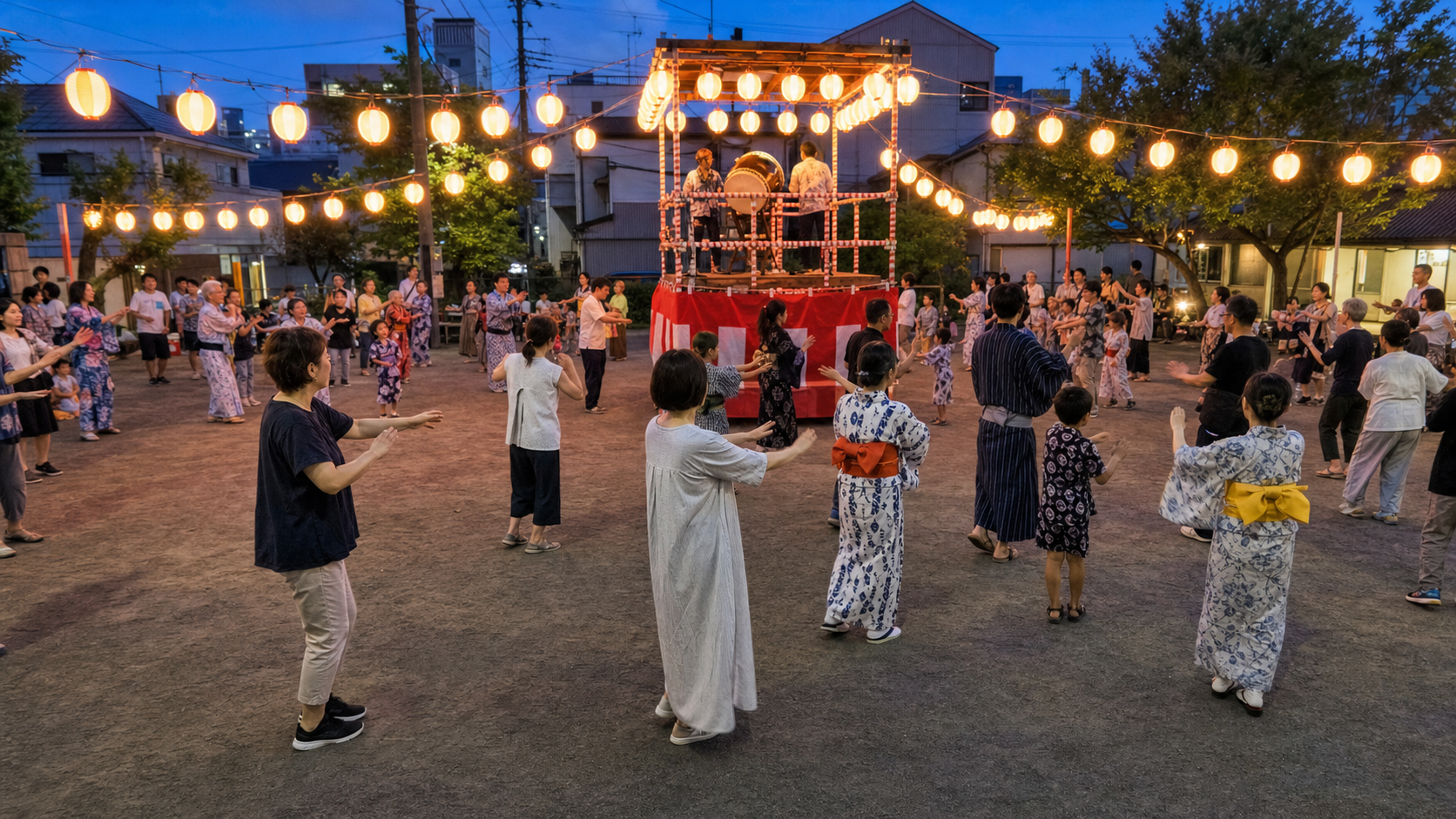
When drums and folk songs draw a circle around a yagura tower, you may have found a bon odori that welcomes visitors. Yet this is more than a summer dance party: it can connect Obon remembrance of ancestors, neighborhood memory and skills passed between generations. This guide explains how to verify an event, enter the circle, dress, photograph, eat and return safely without disrupting the community that hosts it.
Bon odori brings remembrance and community together
Japan’s Agency for Cultural Affairs describes Bon observances as a major annual turning point, shaped by Buddhism while retaining practices of welcoming and honoring ancestral spirits. Today’s dances range from solemn temple, cemetery or memorial events to neighborhood festivals and large tourism programs. Dancing may be joyful, but not every ritual or performance area is an open party. Agency for Cultural Affairs: Bon observances
There is no single date, formation or correct dance
Many events take place in July or August, especially around Obon, while others follow local or lunar calendars and continue into September. Dancers may circle a tower, form lines or move through streets; music can be live taiko, shamisen and singing or recorded accompaniment. Some traditions, including the distinctive movements of Tsushima Bon Odori, are protected folk heritage and related to UNESCO-listed Furyu-odori. Distinguish an open neighborhood circle from a preservation society’s dedicated or staged repertoire.
Use the current organizer—not last year’s video
- Check the municipality, tourism association, temple/shrine, shopping street or neighborhood association’s official site and social account.
- Search the place name with 盆踊り, 参加自由 (open participation), 練習会 (practice), 雨天中止 (rain cancellation) and 交通規制 (road restriction).
- Confirm event opening, dance start, final song, stall closing and controlled exit separately.
- Do not reuse a previous year’s time, songs, stalls or fireworks.
Address, access and fee: this is not one named event, so it has no fixed address, admission or closing day. Many local dances are free, but seats, lessons, yukata rental and food may cost extra. Follow the official public-transport, shuttle, bicycle-parking and road-control plan; nearby car parking is never guaranteed.
Six checks before you leave
| Check | Why |
|---|---|
| Open dance or viewing only | Do not enter a dedication or preservation-performance area |
| Rain/severe-weather decision | Cancellation, postponement or indoor move can be same-day |
| Finish and last transport | A safe return matters more than an encore |
| Cash/payment | Small community stalls may be cash-only |
| Toilet, rest and water | Reduce unnecessary movement and heat risk |
| Photo rules | Tripods, drones or identifiable portraits may be restricted |
How a beginner can enter the circle naturally
- Watch one song from outside for direction, spacing and hand/foot patterns.
- Confirm open participation and follow a beginner lane or teacher if provided.
- Enter from the outer edge into an empty space, moving in the same direction.
- Watch someone slightly ahead and to the side; keep movements small.
- If lost, ease outward without stopping the flow, then observe again.
Safe spacing matters more than perfection. Do not reverse direction, overtake, film a selfie in the center or cut into a children’s group. Quietly watching is also valid participation.
Yukata is welcome, not usually compulsory
Unless the organizer states otherwise, clean, breathable everyday clothes and broken-in shoes are enough. With rental yukata, plan for dressing repairs, hem length, a comfortably tied obi, toilets and return time. Do not walk long distances in unfamiliar geta. Carry water or oral rehydration drink, a small towel or fan, cash, transit card, charged phone, light rainwear, medicine and your accommodation address. Do not open an umbrella inside a dense crowd.
You are borrowing a neighborhood living space
- Do not touch the tower, drums, sound equipment, offerings, lanterns or preservation costumes.
- Do not rest or photograph in private entrances, driveways or delivery areas.
- Keep food queues outside the dance route and follow waste separation or carry-out rules.
- Do not enter the circle while intoxicated; obey age and smoking laws.
- Do not mock movements or treat spiritual background as a costume theme.
A yukata is wrapped left side over right. The reverse is associated with dressing the deceased, so follow the rental or dresser’s instructions and never adjust another person’s clothing without consent.
A photographable festival does not make everyone a subject
Wide venue photography may be allowed while close portraits of children, memorial rites, changing areas, private property and name tags require separate care. Ask the person—and a guardian for a child—before a recognizable portrait. Do not block paths or the circle with flash, tripod, monopod or selfie stick. Never fly a drone without organizer and legal authorization. Live streaming also exposes conversations and location, so it requires more caution than a still photo.
Prepare for heat, lightning and crowd flow after sunset
Temperature and humidity can remain high at night, while dancing and crowds raise body heat. Drink small amounts before thirst and never count alcohol as hydration. Stop dancing for headache, nausea, dizziness or unusual responsiveness, move to a cool place and contact event first aid; call 119 for a serious emergency.
After thunder, leave towers, trees, metal fences and open ground and follow evacuation instructions. In congestion, do not walk against the flow to search for an item; agree on a reunion point in advance. Follow station one-way controls and aim for the train before the last service.
A first bon odori in 90 minutes
- Previous day: save official time, participation, weather, transport and photo rules.
- 20 minutes early: locate toilets, water, exits and first aid while it is light.
- First song: watch direction and local cues from outside.
- Next 2–3 songs: enter from the outer edge if open; rest before fatigue.
- Later: eat in the designated area and leave with transport margin.
The value is not a perfect dance video. It is sharing one song and circle with strangers in a summer tradition a community has maintained. Helping that circle continue for the next participant is the most authentic way to join.