



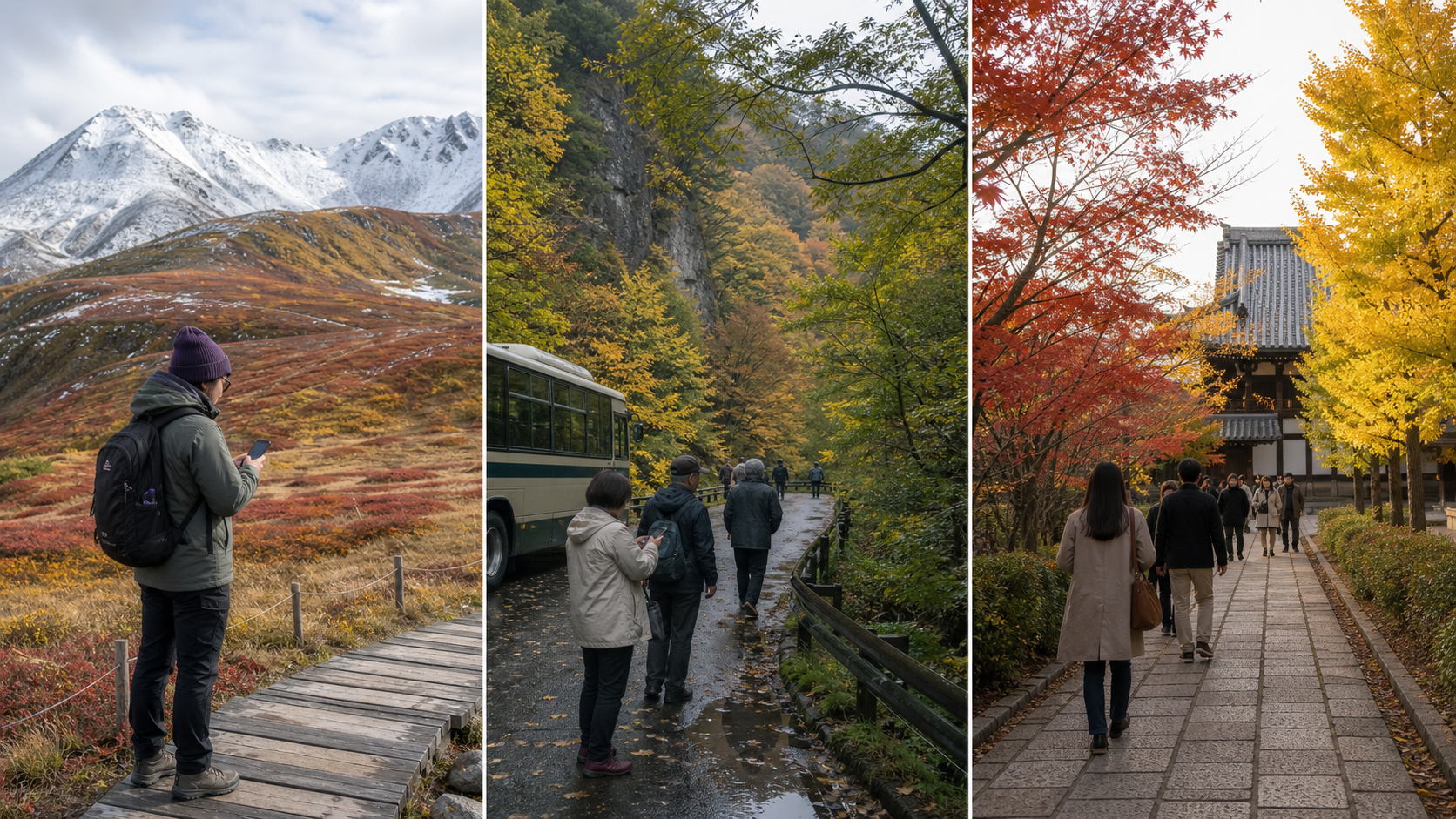
Information checked: August 26, 2026. Japan’s autumn foliage cannot be planned with a rigid formula such as “Hokkaido in September, Kyoto in November and Kyushu in December.” Latitude matters, but so do elevation, tree species, sunlight, night temperatures, wind and rain. Even within one city, colour can descend from a summit to the streets over several weeks. This guide does not promise a peak date: it shows how to choose both good colour and a journey you can complete safely.
The autumn foliage front is not a single line
The broad movement is from colder mountains and northern Japan toward lower, southern ground. Yet rowan, birch, maple and ginkgo change at different times and in different colours. A storm can strip leaves before a predicted “peak,” while a warm year can delay urban trees. Give more weight to the elevation zone and same-day official report for your exact destination than to one prefecture-wide date.
A September-to-December decision matrix
| Window | Most promising setting | Examples | Main risk |
|---|---|---|---|
| Early–late September | Hokkaido alpine zone | Daisetsuzan, Asahidake | Wind, fog, first snow, last descent |
| Late September–late October | Northern Japan and Honshu highlands | Oirase, Oku-Nikko | Road congestion, full buses, ice, sunset |
| Early November–early December | Honshu cities and gardens | Tokyo, Kyoto, Nara | Crowding, timed entry, visiting hours |
| Late November–mid-December in some years | Warm lowlands and gorges | Boso, Takachiho, Yabakei | Forecast miss, short daylight, sparse transport |
These are planning ranges based on usual seasonal movement, not 2026 peak dates. December colour is especially localised, so never make foliage the only condition for the trip to succeed.
Use a three-stage check in 2026
- Two to four weeks ahead: use historical ranges to reserve accommodation and flexible transport. Treat commercial front forecasts as directional, not contractual.
- Three to seven days ahead: check the site manager’s recent photographs or colour report, the JMA forecast, mountain-versus-city temperatures, ropeway and bus operation, and trail notices.
- On the morning: recheck wind, heavy rain, lightning, fog, snow, road or rail disruption and the final return service.
Use Japan Meteorological Agency warnings for hazards. A closure or entry restriction always overrides a colourful social-media post.
September: Daisetsuzan sits between autumn and winter
Daisetsuzan’s alpine zone offers some of Japan’s earliest colour. The national-park guide describes a mid-September peak and the first winter snow in October. Asahidake Ropeway reaches Sugatami Station at 1,600 metres, but this is mountain weather, not Asahikawa city weather. Carry windproof, insulating and rain layers; do not continue toward a summit in thin city shoes. The Sugatami Pond loop normally takes around 60–90 minutes, but shorten it for fog, wind, snow, fitness or the last descending ropeway. National Parks of Japan
October: choose the gorge or elevation in Oirase and Nikko
At Oirase Stream, wet leaves, roots and sections close to the road require attention. Instead of walking the entire corridor out and back, choose a short one-way section around bus stops, toilets and sunset. Nikko spans very different elevations; its tourism authority describes a long usual window from Oku-Nikko down to the shrine-and-temple district. Select one of the highland, lakeside or city zones after checking colour that morning. Build a substantial bus buffer because Irohazaka congestion can turn a short timetable into a multi-hour transfer.
November: in Kyoto, design the visit around worship
Kyoto’s foliage is a cultural landscape combining temple gardens, belief, water, light and long-term horticultural care. Do not stop a passage merely to make worshippers your photograph’s background. Kyoto City Tourism Association explicitly warns of foliage-season congestion and recommends its comfort map and live cameras. One paid temple plus a nearby walk is more respectful and reliable than racing through three famous gates. Avoid residential shortcuts, standing in the road and taxi drop-off congestion.
December: make foliage a bonus, not the sole purpose
Colour sometimes remains into December in warm lowlands of southern Kanto or Kyushu, but “Kyushu is best in December” is not a safe promise. Yabakei’s viewpoints, including Hitome Hakkei, are spread across a wide gorge and are difficult to tour freely by infrequent public transport. Check the live foliage report, then build the day around the area’s stone bridges, hand-cut tunnel history, gorge landscape, hot springs or regional food. With early sunset and limited return options, do not add an unplanned mountain detour.
Addresses, access, prices and closure conditions
| Base | Address and access | Price and hours | Closure and recommended use |
|---|---|---|---|
| Asahidake Ropeway | Asahidake Onsen, Higashikawa, Kamikawa, Hokkaido 071-1472. About 100 minutes by bus from Asahikawa Station. | June 1–October 31 adult round trip ¥3,500. Check the date-specific operating table. | Wind, lightning and maintenance may stop service. Use the Sugatami loop without forcing a summit. Official site |
| Oirase Stream | Oirase, Towada, Aomori. Confirm operating dates and last departure of seasonal buses from Aomori or Hachinohe. | Walking the stream is free; it is not a staffed 24-hour attraction. | Weather, winter transport and trail condition are the practical closures. Walk one way using a bus. National-park guide |
| Tofukuji Temple | 15-778 Honmachi, Higashiyama-ku, Kyoto. About 10 minutes on foot from JR/Keihan Tofukuji Station. | Nov. 14–Dec. 6, 2026: Tsutenkyo 08:30–16:00, adult ¥1,000; Hojo Garden from 09:00, adult ¥600. No autumn combination ticket. | Hours can change for observances. Choose one morning visit. Official site |
| Yabakei | Honyabakei-machi and Yabakei-machi, Nakatsu, Oita. Roughly 5–20 minutes by car from Ao-no-Domon/Rakanji IC, depending on the district. | The broad scenic area has no common ticket or common opening hours; individual temples and facilities differ. | Choose one district to match your transport instead of forcing Hitome Hakkei and Honyabakei into one day. Official Oita tourism |
Prices and timetables can change. Reconfirm each official site immediately before travel.
Crowds, mountain safety and photography etiquette
- Night illumination is not guaranteed to be quieter. Confirm the 2026 dates, last admission, separate fee and return transport.
- Wet paths, steps, moss, roots and fallen leaves are slippery. Never cross a barrier or step onto a cliff edge, waterfall lip or roadway for a photograph.
- Follow local rules for tripods, drones, lights and commercial work. Never occupy worship approaches, tactile paving or evacuation routes.
- Do not pick leaves, branches, fruit or moss, enter planted areas, or feed wildlife.
Dress for the destination’s dawn, dusk and elevation rather than the nearest city’s daytime high. Carry closed shoes with grip, rain protection, water, a small light and backup power.
Build a trip that still works when the forecast misses
- City-base model: save one high-elevation and one low-elevation option within 60–90 minutes by public transport; choose after the previous day’s report.
- Southbound model: do not change hotels every day for leaves. Use northern Japan, Chubu/Kansai and a warm region as multi-day bases.
- Culture-first model: pair a temple with architecture and worship, a gorge with geology and water, or a mountain with volcanic ecology and local belief. Treat colour as one seasonal layer.
If the forecast misses, the lasting experience is not the number of famous sites collected but the climate, forest, faith and daily life you learned to read. Do not place the entire value of a Japanese autumn journey on a few days of maximum colour.