



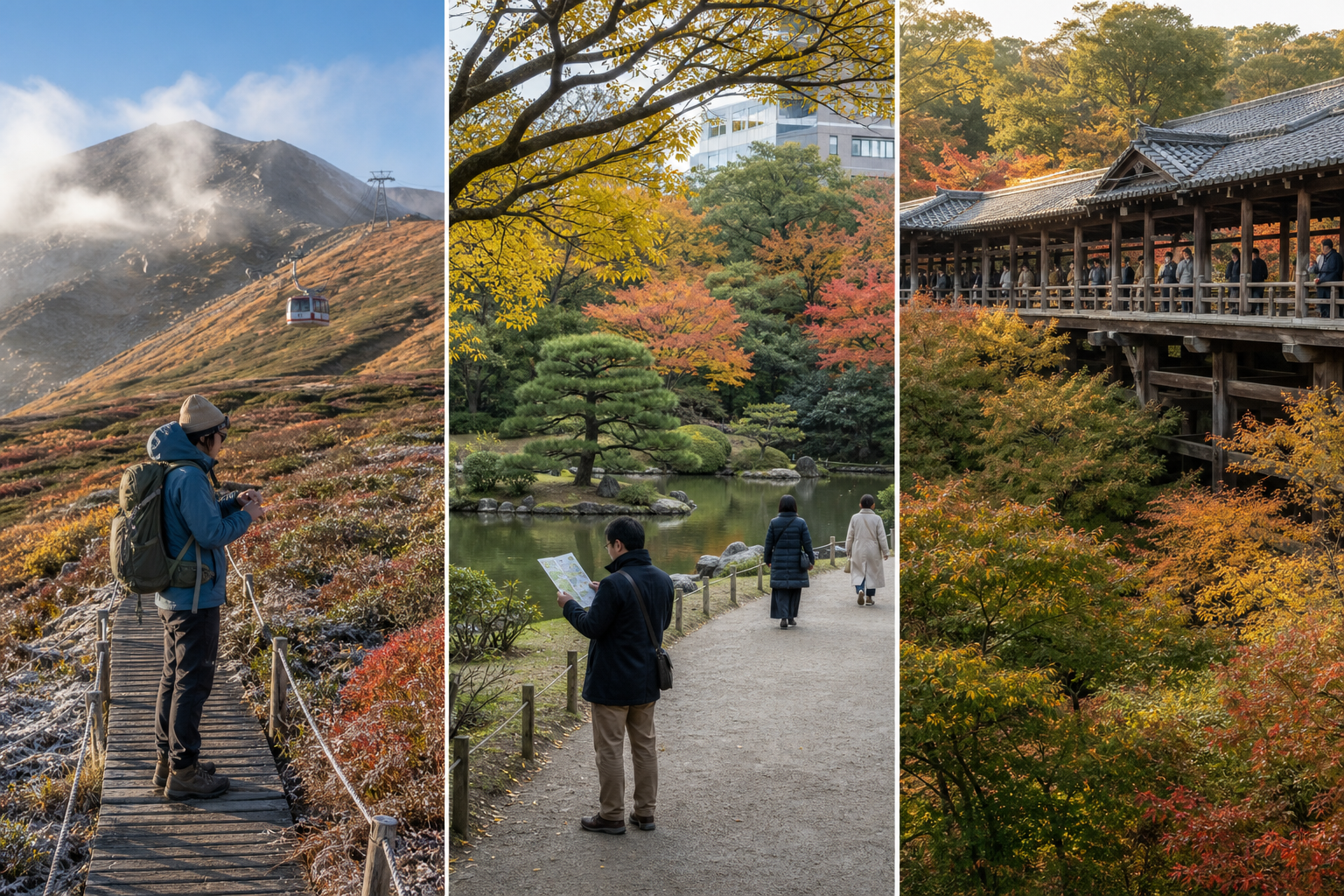
Japan’s autumn colour generally moves from north and high elevation toward south and lowland, but fixed promises such as “Hokkaido in September, Kyoto in November” fail with warm autumns, cold snaps, typhoons, dry weather and tree species. Use historical averages to select a region, then replace them with local colour, weather, transport and facility status. Using official information checked 26 August 2026, this guide builds practical trips around Asahidake, Tokyo’s Rikugien and Kyoto’s Tofukuji.
Read autumn as latitude + elevation + species + that year’s weather
| Terrain | Broad usual window | What changes it |
|---|---|---|
| Hokkaido/high mountain | mid-September–October | first frost/snow and wind can change or strip leaves |
| Tohoku/Central Alps | October–early November | summit, gorge and town peak separately |
| Kanto/Kansai city | November–early December | warm autumn, species, garden management, urban heat |
| Western lowland | late November–December | insufficient cooling, wind and salt damage |
These windows choose a destination; they are not one bloom date. Ginkgo may be yellow while maple turns orange-red and evergreen pine stays green, with colouring, peak and fall overlapping. A landscape need not be uniformly crimson to be successful.
Update 2026 conditions in four stages
- 2–4 weeks: use regional outlooks and keep one nearby higher/lower alternative.
- One week: check official local photos, colour reports, booking, closures and ropeway/temple/garden posts.
- Previous day: check warnings, wind, snow, roads, trains/buses, last service and illumination.
- Morning: use live images, operating status and crowd forecasts to reorder.
Old social posts may hide year, filter, time and elevation. When national and site status differ, prefer the official information nearest the visit. No update is not proof of peak, safety or opening.
Hokkaido Asahidake: treat early colour as mountain activity
The ropeway climbs from Asahidake Onsen to Sugatami Station at about 1,600 m in roughly ten minutes. The Sugatami Pond circuit is an official estimate of about 1.7 km/one hour, but weather and fitness alter it; climbing beyond is a different activity. The Ainu term Kamuy Mintar, often rendered as a playground/garden of the gods, reminds visitors this is not merely a red-mountain photo set.
- Location: Asahidake Onsen, Higashikawa, Kamikawa, Hokkaido 071-1472.
- Access: about 60 minutes by car from Asahikawa Airport and 70 from JR Asahikawa; date-check public transport and lock the return first.
- Fare: checked 2026 peak season June 1–October 31: junior-high+ return/one-way ¥3,500/¥2,200; primary child ¥1,750/¥1,100. Recheck.
- Hours: date-specific schedule; 15-minute summer/autumn examples, but first and last-down change. Wind, thunder and inspection can stop service.
- Closure: no weekly holiday; the calendar contains maintenance suspension. Uphill one-way sales end early on some late-summer/autumn afternoons.
Visibility and temperature change quickly. Carry grippy footwear, waterproof/windproof layers, gloves, warmth and water; remain on boardwalk. The operator warns of full parking on peak weekends/holidays and prohibits sleeping in vehicles.
Tokyo Rikugien: walk a daimyo garden that turns waka into terrain
Yanagisawa Yoshiyasu built Rikugien in the Genroku era as a strolling pond-and-hill garden. Landscapes praised in waka, including Kishu’s Wakanoura, are translated into its “88 scenes.” From Deshio-no-minato, read pond, island, pine, yellow leaves and maple together rather than chasing only red.
- Address: 6-16-3 Honkomagome, Bunkyo, Tokyo.
- Access: seven minutes from JR/Metro Komagome, ten from Toei Sengoku; no dedicated parking.
- Hours: 09:00–17:00, final entry 16:30. Special extension may require different tickets.
- Closed: December 29–January 1.
- Admission: adult ¥300, age 65+ ¥150; primary and younger, and Tokyo-resident/enrolled junior-high students free. Special night entry may be separate.
Rikugien is a nationally designated Special Place of Scenic Beauty. Do not pull branches, arrange leaves or enter planting. Model and wedding-style shoots generally require advance application regardless of commercial status and may be refused in peak periods.
Kyoto Tofukuji: Tsu-tenkyo colour belongs to a Zen valley and temple
Tsu-tenkyo links the hojo and Kaisando across Sengyokukan valley. The temple describes rare three-lobed maple associated with founder Enni’s return from Song China. The national-treasure Sanmon, meditation hall and hojo gardens matter too: visit as a Rinzai head temple, not only a viewing bridge.
- Address: 15-778 Honmachi, Higashiyama, Kyoto.
- Access: about ten minutes from JR/Keihan Tofukuji; JR Nara Line roughly three minutes from Kyoto Station. Public transport requested in autumn.
- 2026 autumn hours: Nov 14–Dec 6 Tsu-tenkyo 08:30–16:00, hojo garden 09:00–16:00; reception ends 16:00, gates close 16:30. Dates change yearly.
- Admission: in that period Tsu-tenkyo/Kaisando adult ¥1,000, primary/junior-high ¥500. Hojo from Nov 1 2026 adult ¥600, child ¥300. No combined autumn ticket; no re-entry.
- Parking: temple parking closes October 25–December 10 for foliage.
Arriving at the station early does not open every area. Bridge stopping/photography rules may change with crowds; follow staff. Admission supports a temple, garden and cultural property, not a private photo right.
Use elevation so a shifted peak does not become a failed itinerary
Within a region, a higher and lower option can extend the season: mountain versus onsen at Asahidake, Nikko highland versus Tokyo lowland, or Kyoto’s hills versus city gardens. Chasing distant sites on one day increases traffic and last-service risk.
- Choose one priority and one nearby higher/lower fallback.
- Use live images to read cloud, snow, surface and crowd—not only colour.
- If green, read architecture and garden structure; if fallen, read leaf, moss and water composition.
- If transfer time exceeds viewing time, switch to regional food, onsen or museum.
Crowd planning reduces transport burden, not merely queueing before opening
- Check official opening; early arrival does not guarantee entry.
- In Kyoto combine JR, Keihan, subway and walking by area rather than one bus.
- Use Kyoto’s official comfort forecast and live cameras to change area/time.
- Send/store luggage so paths and vehicles remain clear.
- Estimate Asahidake parking, Rikugien admission and Tofukuji walking queues separately.
- Protect one priority and be ready to abandon the next.
Pushing visitors into anonymous residential lanes is not dispersal. Use public facilities and streets; avoid private roads, closed temple zones and doorways.
Separate urban and mountain clothing and retreat thresholds
| Setting | Gear | Shorten/cancel |
|---|---|---|
| Urban garden/temple | adjustable layers, walking shoes, rain protection | strong rain/wind, wet steps, closure, illness |
| Mountain circuit | water/windproof, insulation, gloves, grippy shoes, light, map | poor visibility, snow/ice, suspension warning, lost route, last-down |
Leaves hide steps even when dry; rain makes stone, timber and bridges slippery. Never enter road, rail, cliff or closed ground for a photo. For mountain distress/incident call 110; urgent illness, injury or fire 119 and report position, route, group and condition.
Do not turn culture, photography and accessibility into leaf backdrops
- Prioritise worship circulation and follow indoor/bridge/garden rules for photos, tripods, selfie sticks and drones.
- Get consent for close portraits; do not stage staff, clergy or worshippers.
- Do not bend branches, take leaves/stones/moss or cross plant ropes.
- Read Rikugien as waka landscape, Tofukuji as a Zen valley and Asahidake as alpine ecology with Ainu cultural meaning.
Wheelchair, cane and stroller users should separately check gravel, grade, bridge, crowd, toilet and ropeway boarding—not only the gate. A discount does not prove a step-free whole route; describe assistance needs to the facility.
Build a fallback that works outside peak or in bad weather
- Booking: make one place the priority and retain a regional indoor culture/garden/onsen fallback.
- One week: save colour, opening, price, booking, final transport, works and parking limits.
- Previous day: check warning, wind, snow, rain, surface and service; be able to exchange mountain for city.
- Morning: use official live/status/crowds; aim well before final reception.
- There: if green, fallen or crowded, shift attention to garden design, architecture, moss, water and history.
Success is not reproducing one crimson social-media frame. Accept climate variation and read how short alpine autumn, Edo waka design and a Zen valley present time; value remains when the peak moves a few days.
Primary official sources: Asahidake Ropeway, Rikugien, Tofukuji and Kyoto Travel Congestion Forecast. Checked 26 August 2026.