



Information checked: August 26, 2026. A capsule hotel is not simply a tiny cheap hotel room, and a hostel dorm bed is not automatically more social or less private. Both normally place sleeping spaces, showers and circulation in shared areas, but their layouts, rules and guest experience differ. Use this guide to decide from evidence—not from a dramatic pod photo or an advertised “from” price.
Capsule, dorm bed and sleeping pod are product descriptions—not one legal category
Japan’s Hotel Business Act defines hotel/ryokan business, simple lodging business and boarding-house business. “Simple lodging” principally uses structures and equipment in which sleeping accommodation is shared by many people; capsule hotels and hostels often operate within this framework, subject to the permit and local rules that apply to the property. The marketing words capsule, cabin, pod and semi-private do not by themselves promise a lockable private room.
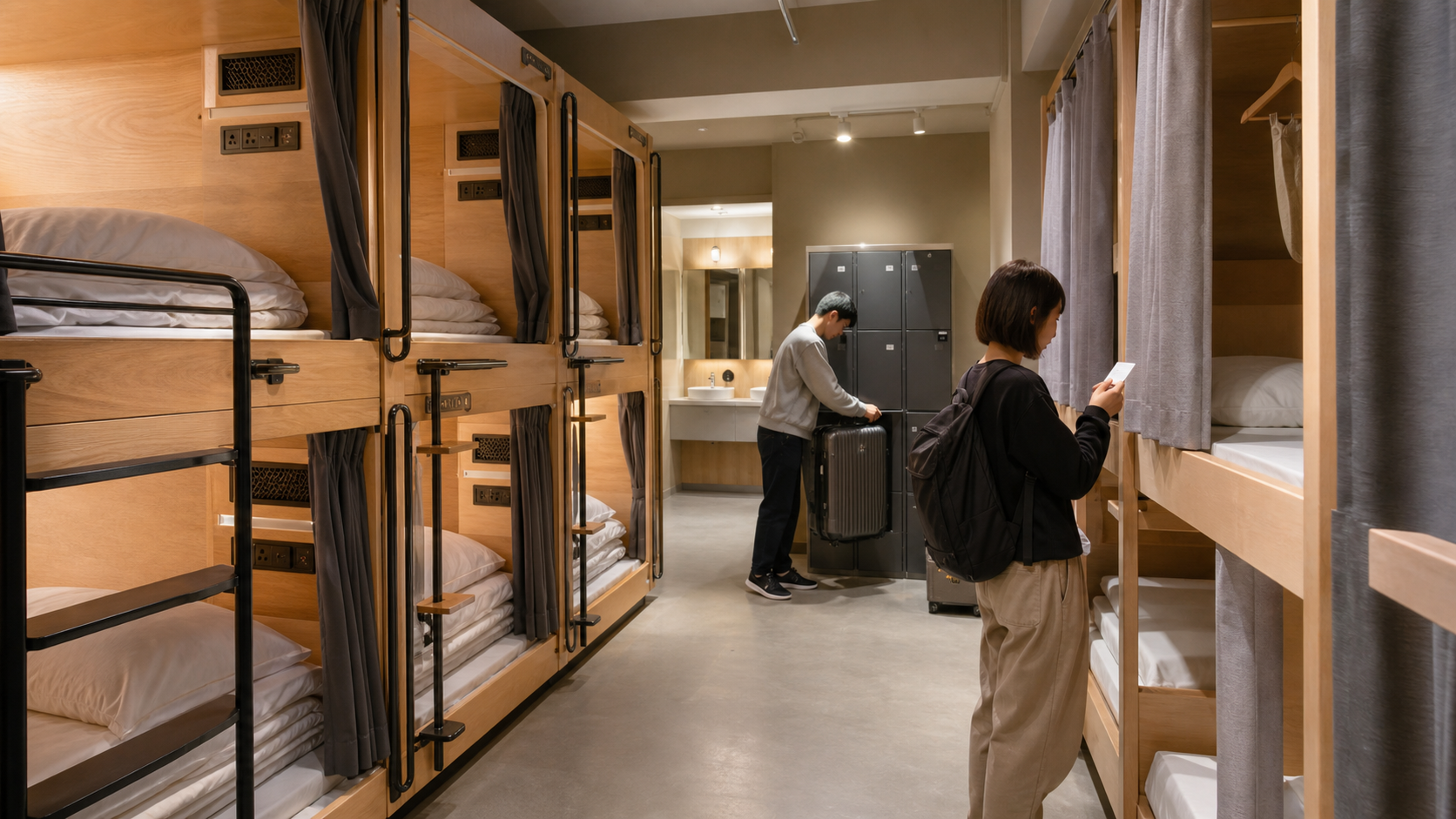
A classic capsule is a bed-sized unit opening onto a common aisle, usually paired with a separate locker and shared showers. A hostel dormitory places several bunks in one room and often gives more common-lounge or kitchen space. A wider “smart pod” or cabin may offer a taller bed, reclining mechanism or desk-like space, yet a curtain or blind is still not the same as a wall and lockable door. Confirm the actual room plan.
Which format suits your trip?
| Question | Capsule hotel | Hostel dormitory | Semi-private pod/cabin |
|---|---|---|---|
| Privacy | Visual screen at each unit; sound carries | Curtain may or may not be provided; roommates share one room | More personal space, but often no full-height locked door |
| Luggage | Usually a separate locker or luggage area | Under-bed cage, in-bed safe or luggage room varies | Do not assume a suitcase fits inside |
| Social atmosphere | Usually sleep-focused and quiet | Common room and kitchen are more likely | Varies by brand |
| Best use | Solo overnight, late arrival, early departure | Longer budget stay, meeting people, self-catering | Solo traveler wanting a wider sleep space |
| Poor fit | Severe claustrophobia, light sleeper, large mobility equipment | Light sleeper or traveler needing controlled privacy | Couples who need one shared private room |
Check these eight points before paying
- Total price: enter the exact date, guest count and taxes. Weekend, event and last-minute rates can differ sharply; an old ¥3,500 claim is not a quotation.
- Guest eligibility: check minimum age, gender-separated floors, mixed dorms and whether each guest must book separately.
- Dimensions and access: confirm pod height and length, upper-bunk ladder, lift route and step-free bathroom—not just mattress width.
- Luggage: compare locker dimensions with your largest case and ask about storage before check-in, after check-out and during multi-night cleaning.
- Bathroom: establish whether there are showers, a communal bath, private shower options, towels and changing space.
- Daily reset: some capsule properties require guests to vacate sleeping units during daytime cleaning even on consecutive nights.
- Cancellation: read the rate-plan deadline in the property’s time zone and whether shortening a stay triggers a charge.
- Location: verify the correct station, exit, last train and whether an airport property is before or after security.
Three verified Tokyo-area examples, each solving a different problem
nine hours Narita Airport: for an early flight or short rest
- Address/location: Narita International Airport Terminal 2, B1F, before security, Furugome, Narita, Chiba.
- Access: follow Terminal 2 signs; travelers using Terminal 1 or 3 must allow transfer time.
- Price: overnight rates are date-based on the official booking calendar. The airport’s current page lists day use at ¥1,500 for the first hour plus ¥500 per additional hour, and shower-only use at ¥1,000 for up to one hour.
- Hours/closure: open 365 days with a 24-hour front desk; overnight checkout is 10:00. Reconfirm temporary maintenance.
- Recommended use: one night before an early departure. Confirm your departure terminal first; the capsule is landside, not beyond security.
The Millennials Shibuya: a wider pod near central nightlife
- Address: 1-20-13 Jinnan, Shibuya-ku, Tokyo 150-0041.
- Access: approximately six minutes on foot from JR Shibuya Station according to the official site; allow extra time inside the large station.
- Price/closure: rates and inventory vary by date; check the official calendar and maintenance notices. There is no private parking.
- Recommended use: choose it for the pod-and-common-area concept, not because the word “smart” guarantees soundproofing or a private room. Check the current pod type and floor conditions before payment.
UNPLAN Shinjuku: hostel dormitory plus private-room choices
- Address: 5-3-15 Shinjuku, Shinjuku-ku, Tokyo 160-0022.
- Access: eight minutes from Shinjuku-sanchome Exit C7 or Shinjuku-gyoemmae Exit 3; about 20 minutes on foot from JR Shinjuku.
- Rooms: mixed dorms, a women-only fourth floor, a three-person curtained section and private family/double rooms are listed. Shared showers and a 24-hour common room distinguish it from a sleep-only capsule.
- Price/closure: check exact dates and room type on the official booking page; amenity and storage fees can change.
- Recommended use: select a dorm for social/common-space value, or pay for a true private room when a curtain is insufficient.
Arrival: passport, check-in time and the last-train trap
Japan requires a foreign guest without an address in Japan to enter nationality and passport number in the guest register and present a passport for copying. Carry the physical passport and check how a self-check-in property handles verification. This legitimate requirement does not excuse a suspicious payment link: use the official domain or the messaging system of the booking platform, and ask the property when uncertain.
Do not confuse a 24-hour front desk with unrestricted arrival. Some properties require notice after midnight, and missing the stated check-in window can be treated as a no-show. Save the address in Japanese, the entrance photograph or map, and a working contact method. If the last train is uncertain, compare a confirmed late-arrival policy with the cost of a taxi rather than assuming a capsule will accept walk-ins.
The sleeping floor is a quiet shared room
- Pack, make calls, eat and hold conversations only in designated locker or lounge areas.
- Set alarms to vibration or the lowest effective volume and silence notifications; never use speakerphone.
- Do not bring a large suitcase into the pod or block the aisle and emergency route.
- Use only your assigned bed and locker. Keep passport, cash and electronics in the provided safe/locker or on your person.
- Shower briefly at peak times, keep the changing area dry, and return towels or loungewear as instructed.
- Do not photograph occupied sleeping or changing areas. A stylish interior is still somebody’s temporary bedroom.
When a bargain bed is the wrong choice
Choose a conventional private room if you need reliable sound separation, space for medical equipment, a private toilet, a secure full-height door, overnight work calls, or one room for a couple and luggage. Travelers with claustrophobia, sleep apnea equipment, pregnancy-related needs, limited upper-body strength or difficulty climbing should ask for exact measurements and step-free routes before booking.
On arrival, locate the nearest two exits, keep the aisle clear and follow staff instructions in an earthquake or fire. Do not cover vents, add heating devices, burn incense or charge damaged batteries. If the property cannot explain emergency assistance, gender-area security or accessible bathing, book elsewhere.
Recommended ways to use shared accommodation
- Airport night: eat before the quiet-area cutoff, reorganize bags in the locker zone, shower, sleep, and set two discreet alarms. Allow terminal-transfer and security time.
- One urban night: leave the large case at a staffed storage service, carry a small overnight bag, check in before late dining, and return quietly.
- Three or more nights: a hostel with kitchen/common room or a private room may beat a capsule once daytime cleaning, locker limits and fatigue are counted.
- Couple or family: compare the total price of separate pods with one permitted private room; never place a child in a bed type below the facility’s minimum age.
FAQ
Can I lock a capsule from inside?
Do not assume so. Many units close with a curtain or blind rather than a lockable door. Use the assigned locker for valuables and confirm the specific design.
Are capsule hotels always cheaper than business hotels?
No. Dynamic rates, two separate beds for a couple, amenity charges and weekend demand can reverse the comparison. Compare the final refundable price for the same date.
Can two people share one capsule?
Normally each unit is sold to one registered guest. Book a room expressly offered for the required occupancy.
Are tattoos a problem?
Usually not for shower-only facilities, but a shared public bath or sauna may have its own tattoo policy. Check the exact property.
Primary sources: Hotel Business Act / MHLW passport guidance / Narita Airport capsule hotel / nine hours guest guide / The Millennials Shibuya / UNPLAN Shinjuku.