



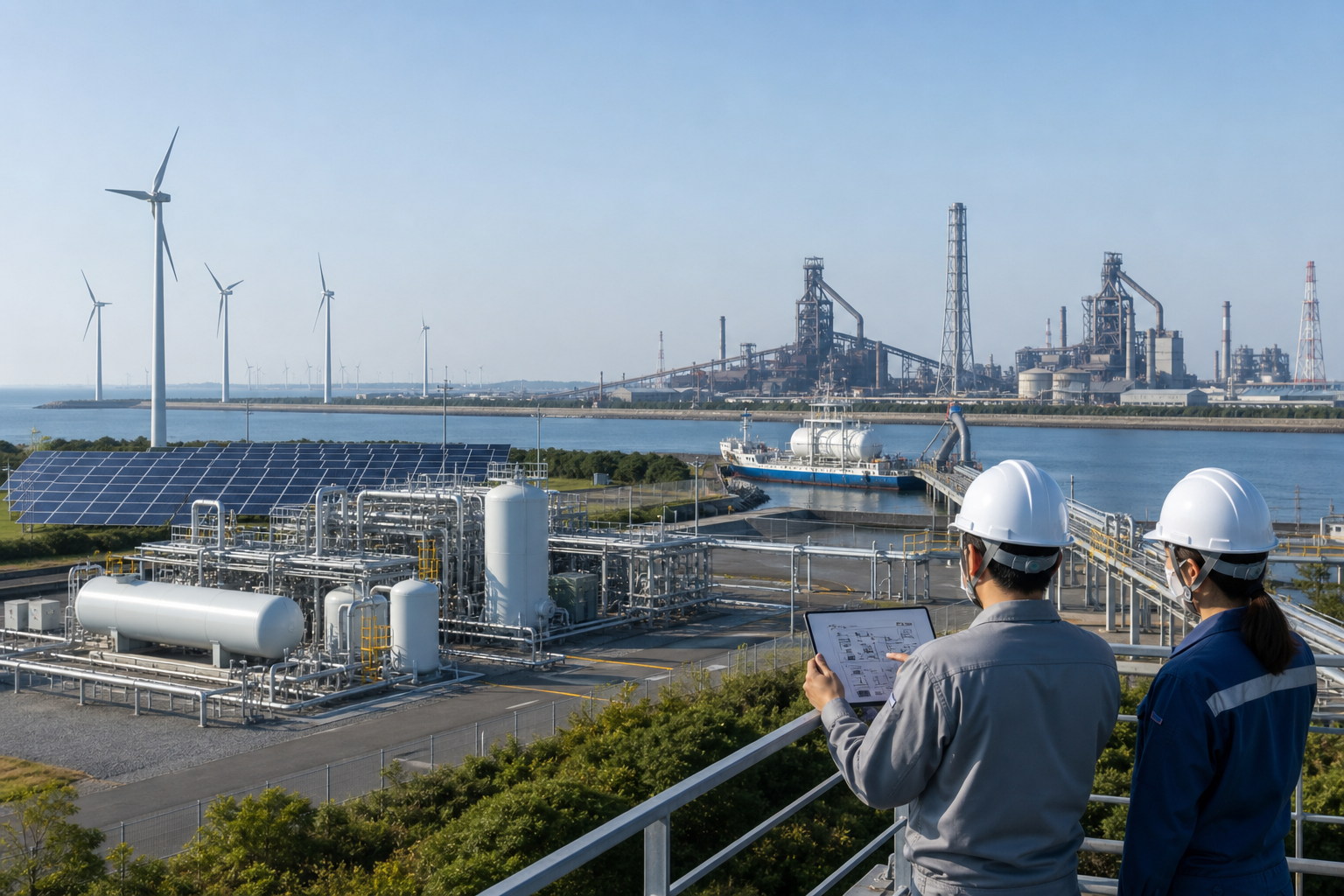
Hydrogen emits no carbon dioxide at the point of use, but its lifecycle emissions vary sharply with the feedstock, electricity, conversion, storage and transport. “Hydrogen” therefore does not automatically mean “zero emissions,” and Japan does not lead every part of the field. Using Japanese government material available through August 26, 2026, this guide separates targets from results and explains policy, priority uses, costs, safety and what the public can actually see.
Hydrogen is an energy carrier, not a ready-made source found in a tank underground
Hydrogen must be separated from water, natural gas, coal, biomass or another material. Electrolysis needs electricity; fossil-fuel reforming needs feedstock and heat. Compression, liquefaction or conversion into ammonia or methylcyclohexane (MCH) consumes more energy and requires dedicated equipment. A fuel cell then produces electricity and heat through an electrochemical reaction between hydrogen and oxygen.
The useful first questions are: where was it made, from what, with which electricity, how was it moved, and what did it replace? A clean tailpipe or fuel-cell exhaust does not describe the complete supply chain.
Japan’s policy is moving from demonstrations toward commercial supply chains
| Year | Policy step | How to read it |
|---|---|---|
| 2017 | Basic Hydrogen Strategy adopted | A common framework for production, transport and use |
| 2023 | Strategy revised | Expanded to ammonia and synthetic fuels, with industrial and safety strategies |
| 2024 | Hydrogen Society Promotion Act took effect | Created certification, price-gap and hub-support mechanisms for low-carbon hydrogen and derivatives |
| 2025 | Seventh Strategic Energy Plan and first price-gap approvals | Moved from broad goals to scrutiny of named supply-and-use plans |
This does not mean a nationwide “hydrogen society” is complete. Operating a pilot is different from supplying large volumes reliably, affordably and with verified low lifecycle emissions.
Japan’s volume and cost figures are targets, not current performance
The 2023 strategy targets hydrogen and related carriers at up to 3 million tonnes in 2030, about 12 million tonnes in 2040 and about 20 million tonnes in 2050. These figures include directly combusted ammonia and other carriers on a hydrogen-equivalent basis; they are not a measure of pure hydrogen produced domestically.
The stated supply-cost goals are ¥30/Nm³ in 2030 (shown in government material as ¥334/kg) and ¥20/Nm³ or less in 2050 (¥222/kg). They are not today’s hydrogen-station retail price, a power-generation tariff or the complete cost of an import project after conversion, shipping, storage and utilisation equipment.
What the 2024 act supports—and what the first 2025 approvals prove
The Hydrogen Society Promotion Act provides certification of low-carbon hydrogen supply-and-use plans, support focused on the gap from conventional feedstock prices, support for shared supply hubs and selected regulatory measures. In September 2025, Japan approved the first two price-gap-support plans:
- Aichi steelmaking: green hydrogen planned for use in Aichi Steel’s electric-furnace process in Tokai, Aichi.
- Kawasaki chemicals: waste plastic planned for gasification into hydrogen and ammonia, with the ammonia used to make and sell clothing feedstock.
Approval confirms a plan and its support framework. It is not a completion certificate showing that every asset already operates commercially or that the planned price and emissions results have been achieved over the full support period.
Read lifecycle numbers, not only “green,” “blue” or another color
| Example route | What to verify | Why the label is insufficient |
|---|---|---|
| Water electrolysis | Power mix, additional renewables, operating hours, water | Grid emissions can change the result |
| Natural-gas reforming + CCS | Methane leakage, capture rate, storage permanence | Adding capture does not make emissions zero |
| By-product or waste route | Avoided process, allocation of feedstock emissions, conversion efficiency | Waste origin alone does not prove low carbon |
Japan’s Ministry of the Environment stresses lifecycle assessment from feedstock and production through storage, transport, supply and use. Imported hydrogen also requires scrutiny of foreign electricity and methane emissions, liquefaction or carrier conversion, shipping, reconversion and dehydrogenation.
Hydrogen is most defensible where direct electrification is difficult
| Sector | Possible hydrogen role | Alternatives to compare |
|---|---|---|
| Steel and chemicals | Reducing agent, feedstock, high-temperature heat | Electric furnaces, recycling, process change, CCUS |
| Long-range/high-use transport | Fuel-cell trucks, buses and vessels | Batteries, overhead supply, rail or logistics redesign |
| Power and balancing | Long-duration storage, balancing and fuel | Transmission, batteries, pumped storage, demand response |
| Buildings | Stationary fuel-cell heat and power | Heat pumps, grid electricity and insulation |
Turning electricity into hydrogen, storing and moving it, then turning it back into electricity creates losses at each stage. For short-range cars or low-temperature heating, batteries or heat pumps may use the original electricity more efficiently. The right question is not “Can hydrogen do this?” but “Is it the best low-carbon option for this duty and location?”
The practical constraints are price, conversion losses and coordinated demand
- Price: low-carbon hydrogen commonly costs more than incumbent fuel; the duration and recipient of public support matter.
- Infrastructure: production, compression/liquefaction/carrier conversion, tanks, vessels, pipelines, stations and end-use equipment must connect.
- Coordination: suppliers need long-term buyers, while buyers hesitate without firm price and supply.
- Imports: currency, shipping, exporter policy, certification and local effects on water, land and labour remain relevant.
Price-gap support therefore evaluates linked commercial plans rather than one isolated machine. Readers should look beyond a large headline budget to reference prices, duration, self-sustaining operation, domestic industrial value and verified emissions intensity.
Safety must match hydrogen’s properties and each carrier’s separate hazards
Hydrogen is light and tends to disperse upward, but it has a wide flammability range, its flame can be hard to see, and some materials can suffer hydrogen embrittlement. Safe systems combine ventilation, leak detection, suitable materials and joints, pressure control, explosion protection, separation distances, emergency shutdown, inspection and training.
Ammonia is a different chemical with toxicity and corrosivity hazards and possible nitrogen-oxide emissions when burned. Calling it a hydrogen carrier does not give it hydrogen’s safety profile. Each facility must manage the actual chemical, pressure and process—not an umbrella marketing term.
What travellers and members of the public may actually encounter in Japan
Visible examples can include fuel-cell buses, trucks or cars; residential fuel-cell systems; public displays at municipal facilities, science museums or company showrooms; and reservation-only demonstration tours. Routes, vehicles, opening, fees, booking, language support and photography rules change, so verify the operator’s current page before travelling.
- Before visiting: confirm same-day opening, admission, reservation, age or ID conditions, language support and photography.
- On site: remain in the public route; never touch valves, pipes or vehicle filling connectors; obtain permission for drones, tripods or commercial work.
- When interpreting a display: ask whether it is a model or operating unit, a pilot or commercial plant, and what feedstock, electricity, capacity, utilisation and lifecycle boundary are reported.
A hydrogen station or industrial plant is not automatically a tourist attraction. Do not enter private or hazardous areas or obstruct roads, logistics, security and neighbouring residents for a photograph.
A six-question checklist for reading hydrogen announcements
- Production: what feedstock and electricity make the hydrogen?
- Emissions: does the figure cover only use or also production, conversion, storage and transport, and what is the comparator?
- Scale: is this laboratory, pilot, demonstration or commercial; is the number nameplate capacity or actual output?
- Use: is direct electrification difficult, and were efficiency, grids, batteries, recycling or demand reduction compared?
- Economics: is the price current or a future target, and does it include support, transport, equipment, currency and utilisation?
- Community and safety: are water, land, ports, employment, public consultation, leaks, fire and toxic carriers addressed?
Japan has substantial expertise in fuel cells, electrolysers, materials, components, transport, storage and residential cogeneration. Its value is strengthened not by a simple “leader” label, but by transparent lifecycle, price and safety evidence and by sustained results in uses where hydrogen genuinely outperforms the alternatives.
Principal official sources: METI, Basic Hydrogen Strategy, Agency for Natural Resources and Energy, Hydrogen Society Promotion Act, Seventh Strategic Energy Plan, METI on the first price-gap approvals, and Ministry of the Environment hydrogen LCA guidance. Verified August 26, 2026.