



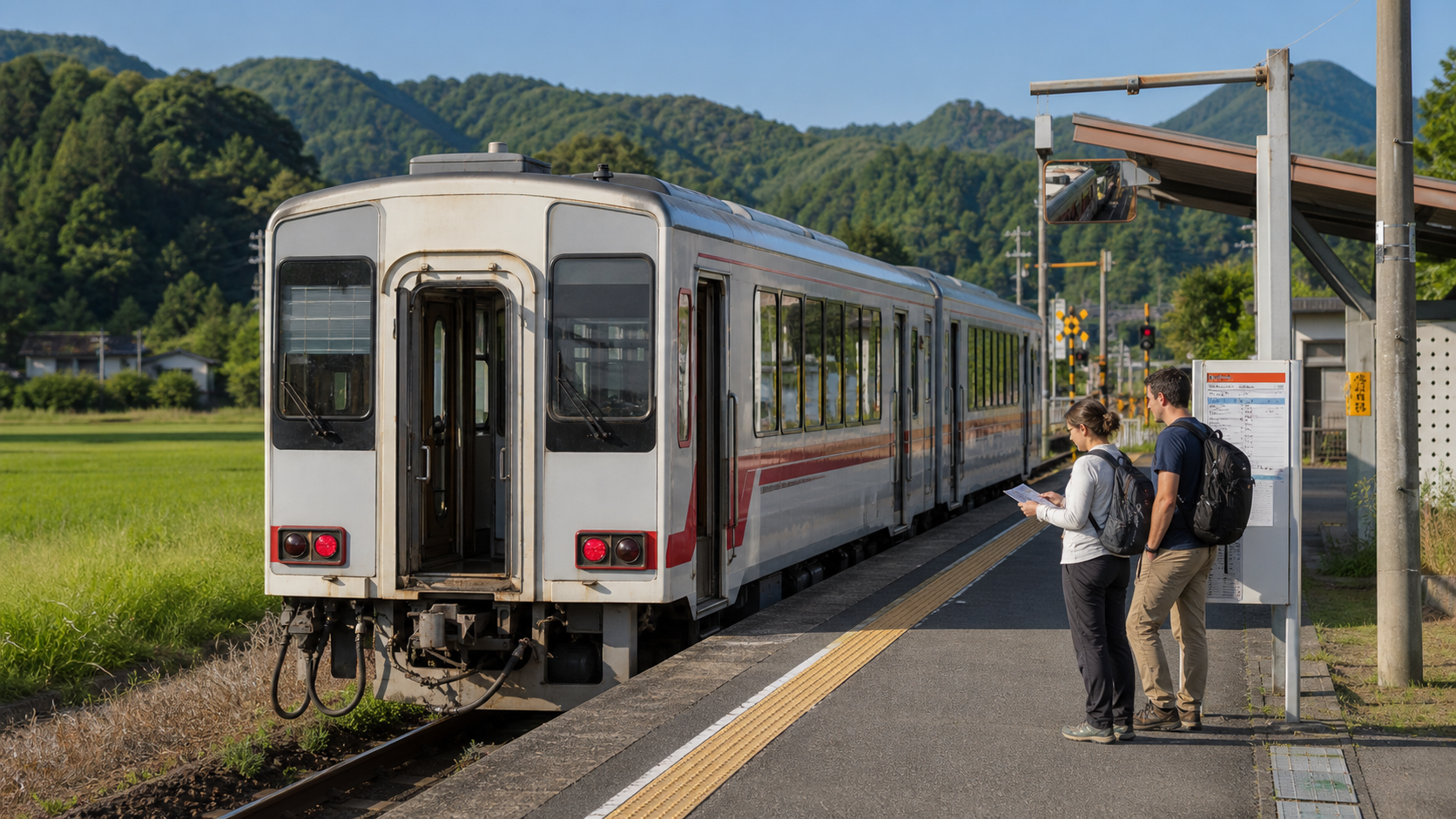
Information checked: August 26, 2026. A rural local train reveals Japan through ordinary movement: school commutes, fields, fishing ports and small station streets—not through a guaranteed “hidden view.” The rewarding part is learning how a line serves its community while travelling without disrupting it. This guide explains sparse timetables, one-person trains, tickets, safety and a realistic half-day plan.
“Local railway” describes a role, not one train type
Japan’s regional railways include JR local services, private railways, third-sector operators and short community lines. Some run modern electric trains; others use diesel railcars. A “local” service normally stops at every station, while rapid, express, limited-express and sightseeing trains can follow different fare or reservation rules. Do not infer the ticket from the train’s nostalgic appearance.
The cultural value is in connections: a station may link a market town to schools, hospitals and a regional centre. Treat residents as fellow passengers, not background actors. A quiet ride through rice fields is still public transport with work to do.
Plan the return train before choosing the view
- Use the operator’s official timetable and disruption page, not only a route app.
- Check the exact date: weekday, weekend, holiday and school-season patterns may differ.
- Write down train number or departure time, direction, platform, transfer time and final return.
- Confirm whether the service is local, reserved sightseeing, limited express or bus replacement.
- Choose one stop with a safe activity reachable on foot; leave a full service as a buffer.
- Save screenshots and the station name in Japanese because reception may be weak.
A two-hour gap is not “free time” if the attraction is closed or the return walk has no pavement. Check the destination’s address, opening hours, admission, closed days, last entry, luggage and walking route separately. Never create an unofficial shortcut across tracks, fields or private homes.
One-person trains may use only selected doors
Wanman means the driver operates without a conductor. Procedures vary by operator, station and train length. On some short trains at unstaffed stations, passengers board through a rear door, take a numbered ticket, then leave through the front and pay near the driver. At staffed stations or within specified IC areas, other doors and gates may be used.
Read the platform signs and onboard display rather than copying another line’s procedure. Press the door-open button if instructed. Take one numbered ticket per fare-paying passenger and keep it flat. Ask the driver only while the train is stopped; driving duties come first.
An IC card is useful, not universally valid
| Situation | What to do |
|---|---|
| Ticket office or machine | Buy to the destination and keep the paper ticket until exit. |
| Unstaffed boarding, no ticket | Take a boarding certificate at the station or numbered ticket inside, as instructed. |
| IC-supported trip | Tap at the designated reader or gate at both ends; ensure sufficient balance. |
| Outside IC area / crossing area boundary | Buy the operator’s specified paper ticket or ask before boarding; nationwide interoperability does not mean every station accepts IC. |
| Pass or reserved train | Confirm the covered operator, section, train type, seat supplement and reservation separately. |
Fare boxes may show the amount beside your numbered-ticket number. Prepare small cash, but do not assume the fare box gives change; a separate change machine may be provided. If uncertain, show the ticket or station name after the train stops.
An unstaffed station is not an abandoned space
There may be no toilet, shop, locker, cash machine, elevator or staff member. Check these before departure, carry water and take rubbish away. Keep tactile paving, ramps, doorways and the driver’s sightlines clear. Cross tracks only at the official crossing after checking signals; never step down from a platform or walk along the rails.
Some stations have request-stop or door-button procedures. A waiting room may close earlier than the last train. For a long wait, identify an officially open café, museum or public facility rather than assuming the station building stays heated or cooled.
The safest window is usually the best viewpoint
Sit only when seats are available and leave priority seating to those who need it. Keep voices low, silence calls and avoid eating on ordinary local trains unless the operator or train format clearly permits it. Do not press a lens against another passenger, photograph faces without consent or open a window that staff have not permitted.
On platforms, remain behind the tactile or safety line, keep tripods and bags out of circulation and obey no-entry signs. Never enter tracks, level crossings after the alarm starts, farmland or private property for a photograph. Ask before photographing staff, station shops or people. The Tourism Agency specifically warns against track intrusion and stepping into roads while shooting.
Accessibility and weather need line-specific confirmation
Small stations may have steps, narrow platforms, large train-floor gaps or only a track-level crossing between platforms. Contact the operator before travel to confirm staffed assistance, wheelchair boarding equipment, accessible toilets, elevator hours, transfer time and whether advance notice is required. “Unstaffed” does not mean assistance is impossible, but it must not be assumed.
Heavy rain, snow, wind, landslides, animals on the track or inspection can suspend service. Check the operator before leaving and again before the return. A route app showing a scheduled train is not proof that it is running. Do not travel to a closed station hoping for a replacement bus; follow the operator’s stated boarding point and ticket rules.
A low-risk half-day model
| When | Action |
|---|---|
| Previous evening | Verify official timetable, disruption notices, fare method, weather and destination opening. |
| 30 minutes before | Buy ticket/cash, use the toilet, save screenshots and confirm the return platform. |
| Outbound | Follow door and numbered-ticket instructions; observe daily life quietly. |
| At the stop | Use one verified public route and attraction; return 15–20 minutes early. |
| Return | Recheck operations before leaving the activity and keep one later service as buffer. |
Is a rail pass always cheaper?
No. Compare the pass price, covered company and trains with the exact point-to-point fares.
Can I get off wherever the scenery is good?
Only at scheduled stations or official stops. Never ask for an unscheduled stop or use railway land as a viewpoint.
What should I carry?
Small cash, charged phone and battery, water, weather layer, essential medicine and the Japanese station names. Keep luggage compact.
Official references: JNTO rail guide / JNTO local railways / JR East one-person train procedures / JR Shikoku local train guide / MLIT multilingual railway safety / Tourism Agency photography safety