


Information checked: August 26, 2026
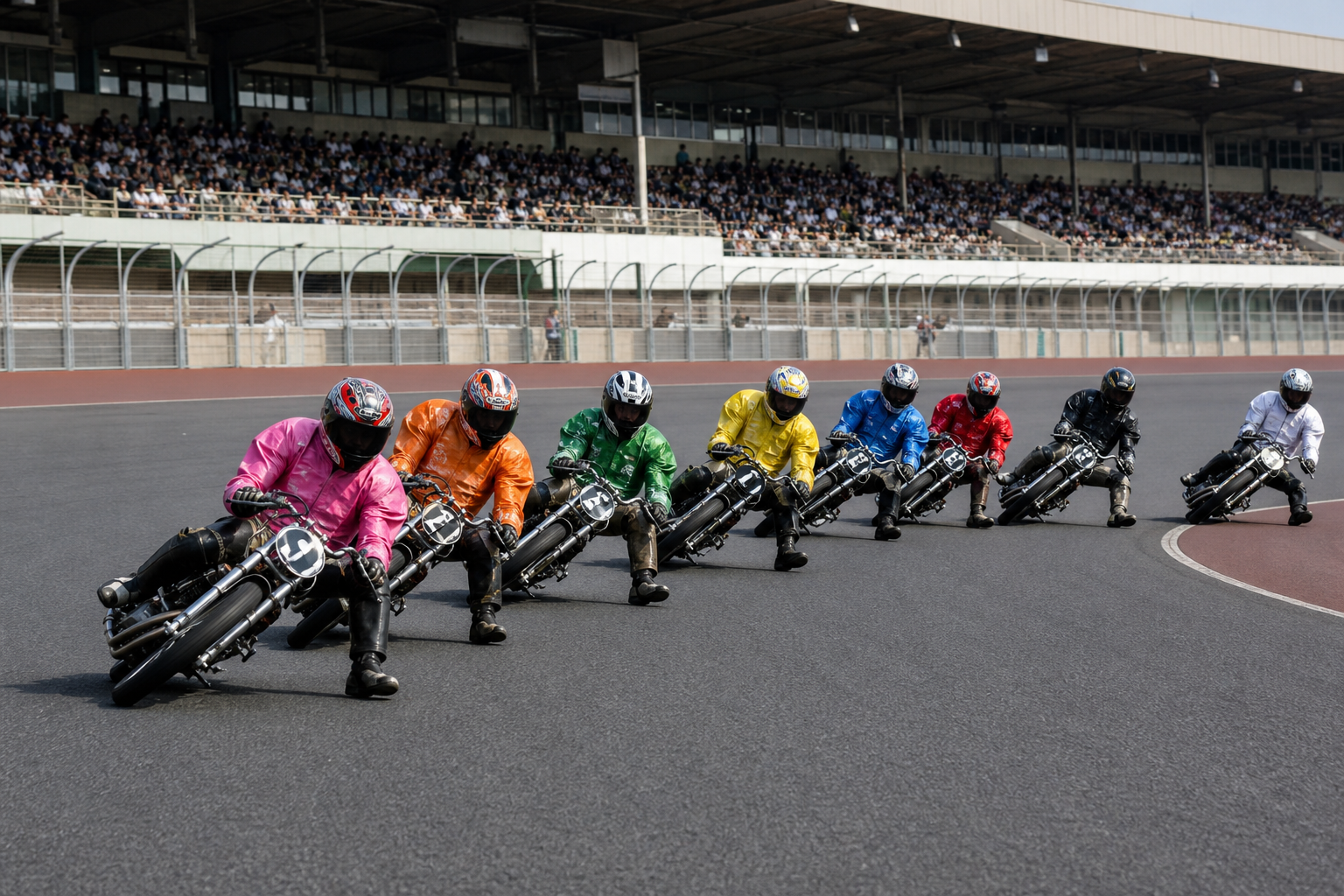
Despite its English-sounding name, Japan’s “Auto Race” is not car racing. It is a uniquely Japanese public motorcycle sport in which riders compete on minimalist machines built specifically for a paved, counterclockwise oval. The sound, staggered handicaps and extreme left-leaning posture make it unlike MotoGP, motocross or speedway.
A regulated local-government sport
Auto Race is conducted by local governments under the Small Motor Vehicle Racing Act and supervised by the Ministry of Economy, Trade and Industry. The JKA Foundation registers riders and racing machines and helps protect sporting integrity. Part of the proceeds supports local finance, mechanical industry, social welfare and other public programs.
Eight bikes, six laps and handicap racing
A standard field has eight riders. They race six laps on a 500-meter counterclockwise oval; because of the start position, the published standard race distance is 3,100 meters. Rider colors are fixed by number: 1 white, 2 black, 3 red, 4 blue, 5 yellow, 6 green, 7 orange and 8 pink.
In a handicap race, higher-rated riders start farther behind, creating a pursuit rather than one flat starting line. The trial-run time, handicap distance, recent results and dry or wet track condition all matter. Rain changes tire choice and riding style.
The machines have no brakes. This is not casual removal of a safety part: official explanations describe a purpose-built design intended to avoid sudden braking and rear-end impacts in close formation. Asymmetric handlebars, triangular-profile tires and minimal bodywork are optimized for repeated left turns.
Ticket types and buying with cash
Tickets are sold in ¥100 units. Choices include Win, Place, Exacta, Quinella, Trifecta, Trio and Wide. For a first attempt, Quinella—selecting the first two riders in either order—is easier to understand than an exact-order combination.
- Confirm the host track and race number.
- Check the trial run and handicap positions.
- Mark the ticket type, rider numbers and amount.
- Insert the card and cash into an official machine and check the paper ticket immediately.
A completed purchase cannot be cancelled. Online voting needs membership and compatible payment arrangements; an on-site official cash machine is often simpler for a short visit. A fixed ¥100–¥500 entertainment budget is enough to learn the process.
Kawaguchi Auto Race: address, access and admission
| Address | 5-21-1 Aoki, Kawaguchi, Saitama 332-0031 |
|---|---|
| Access | Free event bus from JR Nishi-Kawaguchi Station, normally about 15 minutes depending on traffic |
| Admission | General admission is free. Fifth Grandstand reserved seating is ¥1,000 on Kawaguchi home meetings |
| Opening | Varies by meeting. In the 2026 calendar, examples range from 10:00 daytime openings to 13:30 or 14:00 for major/night programs |
| Closed | No fixed weekly closing day; check the official calendar and confirm it is a spectator home meeting |
| Recommended | Trial runs, corner views, handicap starts and the Kawaguchi Auto Museum, open on Kawaguchi home-race days |
The official site warns that its large car park can fill soon after opening on home-race days. Public transport and the free bus are the practical choice.
A 90-minute first-visit plan
- Confirm “Kawaguchi home meeting” and that spectators are admitted.
- Use the race card to learn rider colors, handicap marks and trial-run time.
- Watch the trial and compare corner stability as well as raw time.
- Watch one race without buying. If you choose, try ¥100 on Quinella in the next.
- Visit the Auto Museum when it is a Kawaguchi live race day.
Age, noise protection and payouts
- People under 20 may not buy or receive Auto Race tickets.
- Engines are extremely loud. Bring earplugs or earmuffs for children and noise-sensitive visitors, and avoid prolonged exposure near the track or speakers.
- Midnight or “Night Race” programs can be spectator-free; never assume a broadcast event is open to visitors.
- Winning and refunded paper tickets have a 60-day payout period; confirm compatible facilities.
- Winnings may be taxable in Japan depending on amount and purchasing pattern.
- Set a leisure limit before arriving and do not increase it to chase a loss.
Frequently asked questions
Is this automobile racing?
No. Japanese Auto Race uses dedicated motorcycles. It is not a four-wheel car event.
Can I enter without betting?
Yes. General admission at Kawaguchi is free, so you can watch the trial runs, machines and handicap tactics purely as a sporting visit.
Do races run in the rain?
Wet-weather racing can take place with different tires, but severe weather or a safety decision can alter or cancel the program. Check the same-day notice.
Official sources: AutoRace.JP / Kawaguchi access / Facility and admission