



Information checked: August 26, 2026. Japanese curry is often thick, served with rice and familiar as home cooking, but it is not automatically mild, sweet or nutritionally simple. Recipes may contain meat stock, wheat, milk, fruit, soy sauce or fried toppings. Its appeal is adaptability: rice quantity, heat, protein and side dishes can turn the same base into very different meals.
A Japanese adaptation of Western-style curry
Curry reached Japan during the Meiji period through Western food culture, with British-influenced thickened curry becoming one route of adaptation. MAFF presents naval curry as one theory behind the spread of curry rice: it could feed groups with meat and vegetables and later traveled into home cooking. This is one historical strand, not proof that every modern recipe comes from a single naval dish.
Five useful categories
| Curry rice | Thick sauce beside or over rice; beef, pork, chicken or vegetables may be cooked into a base that is not visible |
|---|---|
| Katsu curry | Breaded fried cutlet plus curry; usually pork unless otherwise stated, with wheat, egg and frying-oil cross-contact |
| Curry udon | Udon in curry-seasoned dashi; thinner than rice curry and likely to involve wheat, soy and fish stock |
| Soup curry | Broth-like curry associated especially with Sapporo, often with large vegetables and chicken; spice and eating method vary |
| Regional styles | Examples include Yokosuka navy curry and Kanazawa-style presentations; definitions and participating restaurants differ locally |
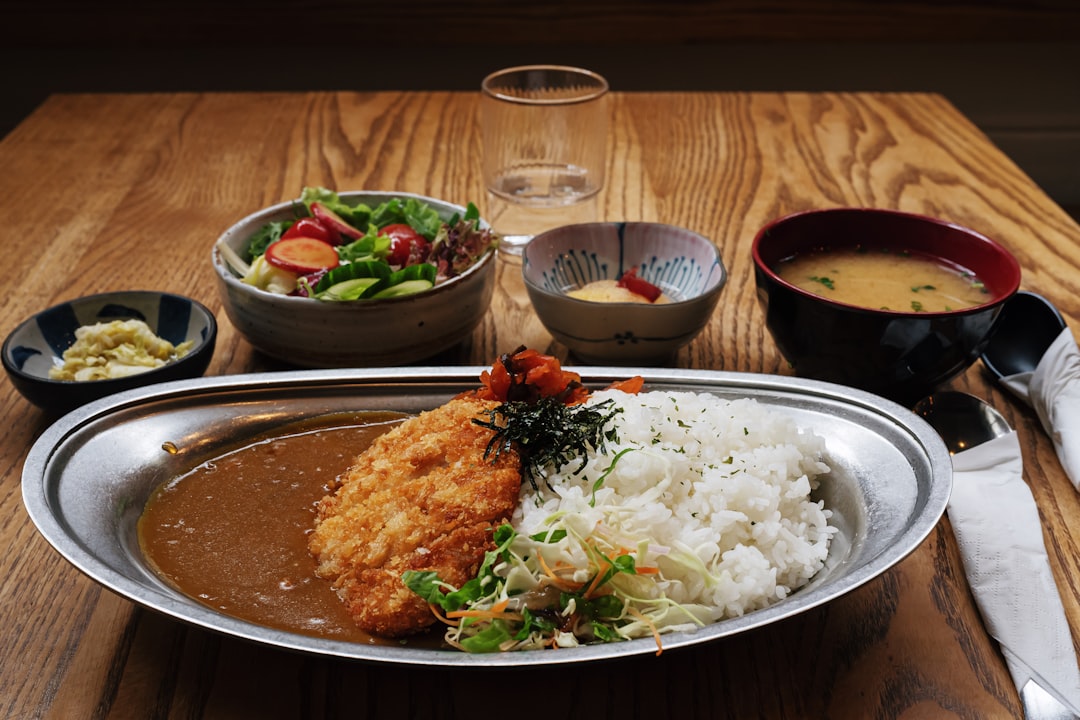
The pictured metal plate, cutlet and cabbage resemble a presentation associated with Kanazawa curry, but one photo cannot certify a restaurant’s recipe or regional membership.
Build an order in the right sequence
- Choose the base: rice, udon or soup curry.
- Select meat or a clearly identified meat-free option.
- Choose rice amount: shōmori (small), futsū (regular) or ōmori (large), if offered.
- Select spice level using the shop’s own scale; numbers are not comparable between brands.
- Add toppings only after checking whether they duplicate meat, egg, cheese or fried items already included.
- Confirm the final price before payment; extra rice, spice and toppings may each cost more.
Using a meal-ticket machine
First check whether the machine accepts cash, cards or mobile payment. Choose dine-in or takeout if asked, then the curry, size, spice and toppings. Collect both the ticket and change. Hand the ticket to staff or wait for your number. If a machine is Japanese-only, photograph the menu display and ask before pressing rather than blocking the queue while guessing.
Some restaurants take the spice choice verbally after receiving the ticket. Keep the receipt until the meal arrives.
“Mild” and “sweet” are not universal
Amakuchi means mild/sweet style, chūkara medium and karakuchi hot, but the experience depends on the shop. A sweeter sauce may still contain chili, while fruit sweetness does not remove spice. Start below your maximum tolerance because Japanese level 5 at one restaurant may be very different at another. Water does not reliably relieve chili heat; dairy may help some people but is not suitable for all diets or allergies.
Large rice portions can be substantial. Order less first where additions are available, and do not assume free refills.
Hidden ingredients and dietary restrictions
Curry roux commonly involves wheat and fat; recipes may include milk, butter, soy, apple, banana, honey, peanuts or other nuts. A vegetable topping does not make the sauce vegetarian: pork, beef, chicken, fish or Worcestershire-style sauces may be in the base. Katsu introduces wheat, egg and shared fryer risk. Curry udon usually includes wheat noodles and may use fish dashi.
For vegan, halal, gluten-free or severe allergy needs, verify the sauce itself, not only the visible topping. Japan’s Consumer Affairs Agency warns that restaurant information and cross-contact controls vary; communicate before ordering and avoid the meal if staff cannot confirm.
Frequently asked questions
Is Japanese curry the same as Indian curry?
No. Both are diverse, but Japanese curry rice often uses a thick roux-based sauce and has its own history and serving styles. Avoid treating either cuisine as one flavor.
Is curry rice eaten with chopsticks?
Usually with a spoon. Curry udon uses chopsticks and often a spoon for broth.
What are the red pickles?
Often fukujinzuke; pickled shallots called rakkyo are another accompaniment. Ingredients and allergens vary.
Official references: MAFF: Yokosuka navy curry and history / Consumer Affairs Agency: allergies when eating out