



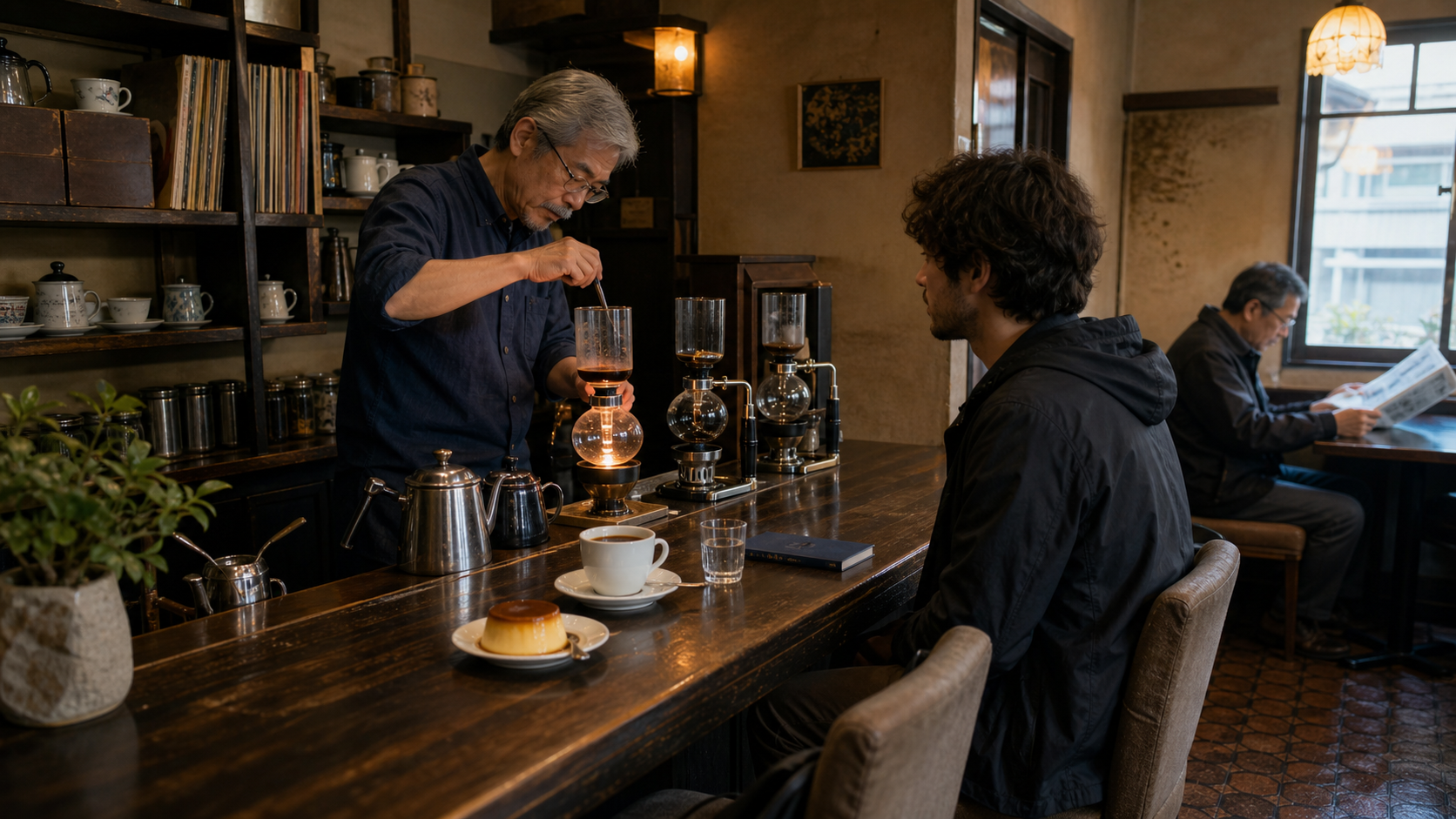
A traditional Japanese kissaten is not a film set frozen in the Showa era. It is a working café where furniture, recipes, regular customers and the owner’s rhythm may have accumulated over decades. Visiting respectfully offers more than a retro photograph: it reveals how coffee, Japanese-style Western food, music, reading and neighbourhood life met in twentieth-century cities.
1. Kissaten, jun-kissa and modern café are overlapping—not rigid—labels
Kissaten literally suggests a shop for drinking tea, but in everyday travel it often means a coffee-focused establishment with table service, light meals and a calm interior. Jun-kissa (“pure café”) historically distinguished shops centred on non-alcoholic refreshments from cafés associated with alcohol or entertainment. Today owners and media use the terms flexibly; an old shop may simply call itself a café, while a new “neo-kissaten” may deliberately reproduce retro design.
Do not judge authenticity by a dark wood interior, a siphon or a cream soda alone. The most meaningful clues are continuity: how the shop fits its neighbourhood, what regulars order, which equipment the owner actually uses and how recipes have changed or stayed stable.
2. Coffee culture crossed several eras
Coffee arrived in Japan as an imported commodity, and the All Japan Coffee Association records Kahiichakan, opened in Tokyo in 1888, as an early coffeehouse milestone. Later cafés ranged from social and cultural salons to music-listening rooms and everyday places for workers and students. After the war and through the high-growth decades, kissaten became spaces for meetings, newspapers, study, conversation and Japanese-style Western dishes.
“Showa retro” usually evokes the Showa period (1926–1989), especially postwar interiors from the 1950s to 1980s. But old age alone does not make every object historically important, and a shop renovated yesterday can still carry a genuine family business. Ask what has been preserved instead of demanding that owners perform nostalgia.
3. Choose by experience, then verify today’s conditions
| Type | Go for | Check before entering |
|---|---|---|
| Neighbourhood kissaten | Quiet coffee, toast, local daily rhythm | Smoking sign, cash, opening day, one-drink expectation |
| Jazz or music kissaten | Focused listening and specialist sound system | Conversation, phone and photography rules; possible cover/listening charge |
| Meal-focused kissaten | Napolitan, curry, sandwiches, set meals | Lunch hours, sold-out items, last order and allergens |
| Neo-kissaten | Contemporary interpretation and photogenic desserts | Reservations, queues, time limit and whether alcohol is served |
Independent shops can close temporarily, change hours or sell out without updating every map listing. Check the shop’s own recent notice where available and keep a second choice within walking distance. Do not build a fixed train reservation around one unconfirmed dessert.
4. Enter, sit and order without disrupting the room
- Read entrance notices for smoking, age, photography, cash and queue rules.
- Wait to be seated unless a sign clearly says to choose your own seat.
- Place wet umbrellas in the stand or bag provided; keep luggage out of the aisle.
- Order at least one drink per person unless the menu states another system.
- Ask about minimum order, set-only periods or table charges before settling in.
- At payment, follow the shop: some pay at the table, many at the counter near the exit.
A short greeting—konnichiwa—and sumimasen when requesting attention are enough. Calling the owner “master” is common in media but not mandatory; ordinary polite speech is safer than forcing familiarity.
5. Classic dishes are living recipes, not one national standard
| Item | What to expect | Common dietary issue |
|---|---|---|
| Blend coffee | House bean mixture; drip, siphon or other brewing method varies | Milk/cream may be served separately; sweetener optional |
| Morning set | Drink with toast, egg or salad during set hours; especially famous in Nagoya | Egg, milk, wheat; “free with drink” is not universal |
| Napolitan | Japanese-style spaghetti with a tomato-based or ketchup-forward sauce and shop-specific ingredients | Wheat, dairy, meat/processed meat; not Italian Neapolitan pasta |
| Pizza toast / sandwich | Thick toast or sandwich with filling | Wheat, milk, egg; tuna or ham may be hidden |
| Hard custard pudding / à la mode | Firm custard, sometimes with ice cream and fruit | Egg and milk; gelatin or cross-contact can vary |
| Cream soda | Flavoured soda topped with ice cream | Milk, colouring; colour is aesthetic, not a historical quality rank |
Hotel New Grand in Yokohama documents the creation and spread of its Napolitan and pudding à la mode, but everyday kissaten versions evolved into many different recipes. Napolitan is a Japanese spaghetti tradition, not a fish dish and not a claim of Italian Neapolitan authenticity.
6. One cup buys hospitality, not unlimited private office space
Many kissaten welcome reading and quiet thought, but a small shop has limited seats. During a queue or meal rush, finish within a reasonable time, order again if extending your stay, and do not spread a laptop, cables and luggage across neighbouring seats. Power outlets and Wi-Fi are not assumed services.
Prices vary too widely for one national budget. Check whether tax, a service/table charge, a music charge or a set requirement applies. Carry cash: old independent shops may not accept cards or QR payment. If the menu is handwritten or only Japanese, photograph it only after permission and use translation without holding up the counter.
7. “Retro” does not automatically mean smoking, but signs matter
Japan’s revised Health Promotion Act took full effect in 2020 and indoor dining is generally non-smoking, with regulated smoking-room and transitional exceptions. In Tokyo, restaurants must display their smoking status at the entrance. Some qualifying older small establishments may still allow smoking under an exception; people under 20 cannot enter a smoking-permitted area, even as customers or workers.
Check the entrance sign before opening the door. Ventilation or an empty room does not remove second-hand smoke. Travellers with asthma, pregnancy, children or smoke sensitivity should choose a clearly non-smoking shop and keep a backup, rather than asking a permitted shop to change its policy after entering.
8. Ask about allergies before a busy owner starts cooking
Restaurant allergy information in Japan is not the same as mandatory packaged-food labelling and voluntary practices differ. Kissaten kitchens can be small, with shared pans, tongs, grills, fryers and work surfaces. Coffee cream, bread, margarine, mayonnaise, curry roux, ham, soup stock and pudding can introduce milk, egg, wheat, soy, meat, fish or other allergens.
- Show a written allergy card in Japanese and name both the ingredient and cross-contact risk.
- Do not assume “vegetable curry” is vegetarian; roux or stock may contain animal ingredients.
- If staff cannot confirm safety, choose a sealed packaged item elsewhere rather than pressuring them to guess.
- Carry prescribed medication and know how to contact emergency services.
9. Photograph the cup only after protecting people and the shop
Ask before photographing the interior, menu, owner, regulars, records or audio equipment. A quick tabletop photo may be allowed while wide room shots are not. Avoid flash, shutter sounds in a music room, tripods, moving objects and photographing customer conversations. Do not post a recognisable regular without consent.
Conversation with the owner can be rewarding when the shop is quiet, but it is not included with the price of coffee. Ask one simple question—how long the shop has been here, or which blend is most characteristic—and accept a brief answer if they are working.
10. A practical two-hour neighbourhood plan
| Area | Access | Recommended plan |
|---|---|---|
| Jimbocho, Tokyo | Jimbocho Station (Tokyo Metro Hanzomon/Toei Mita and Shinjuku lines) | Browse one used-book street section, visit one confirmed kissaten for 45–60 minutes, then continue on foot; individual shop hours and prices vary. |
| Hongo, Tokyo | Hongo-sanchome Station (Tokyo Metro Marunouchi/Toei Oedo lines) | Combine a quiet academic neighbourhood walk with one shop; avoid treating university or residential property as a photo set. |
| Central Nagoya | Choose a shop near the station or a confirmed subway stop | Try a morning service during its stated hours, remembering that contents and included price differ by shop. |
There is no admission ticket or common closing day for a neighbourhood. Each kissaten is a private business, so verify its address, access, current hours, last order, closure day, smoking status and payment immediately before visiting. A good plan is one shop plus one nearby cultural activity—not five coffees pursued as trophies.
Official references: GO TOKYO: kissaten culture; All Japan Coffee Association; Ministry of Health: second-hand smoke rules; Consumer Affairs Agency: dining and food allergies; Hotel New Grand: documented dishes.