



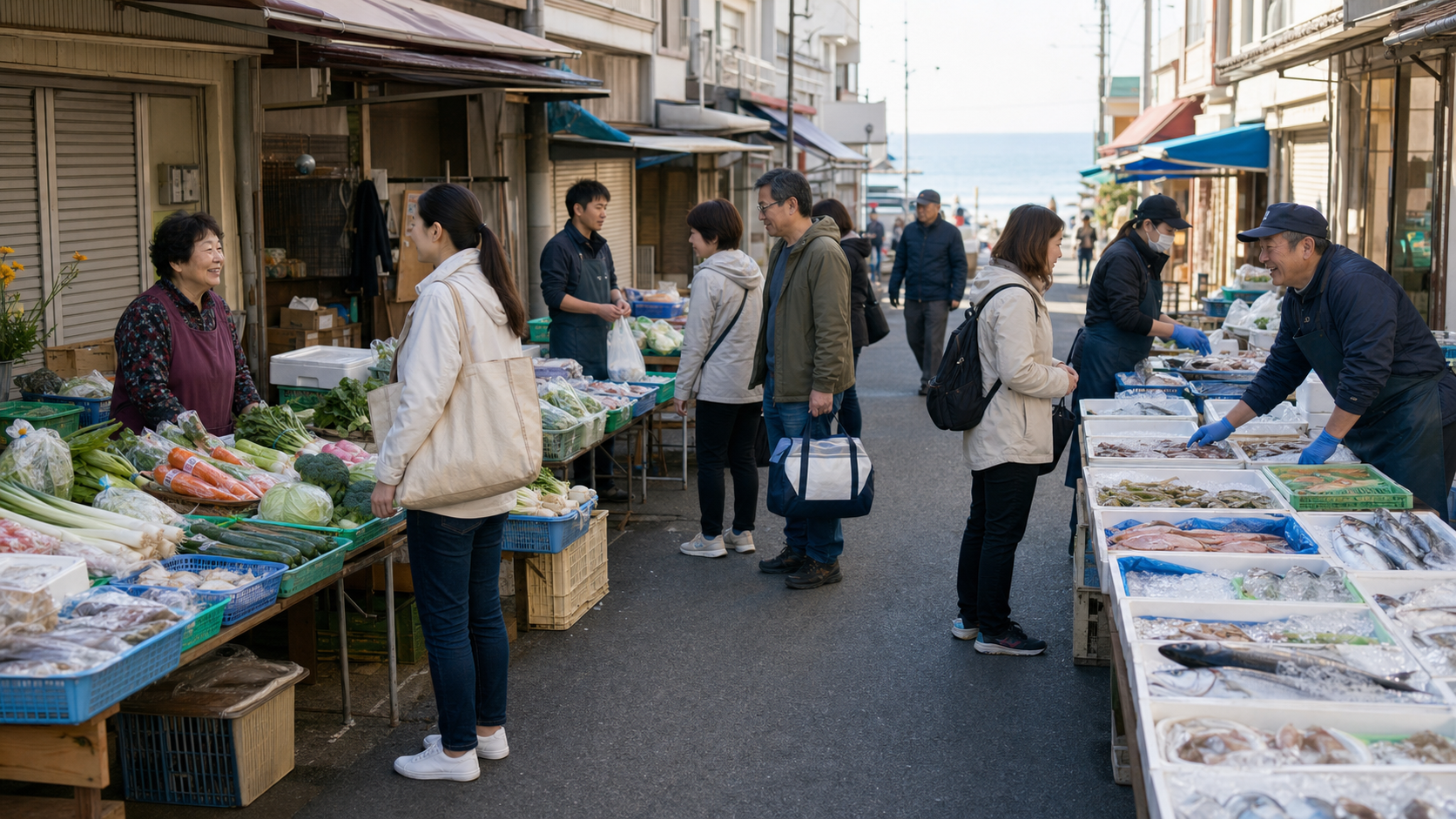
Katsuura Morning Market is not a fish-auction show built for tourists. It is a street-based seikatsu asaichi—a living market where seafood, dried fish, vegetables, rice products, pickles and crafts connect coastal and farming livelihoods. Its history is said to extend more than 430 years, but its value today lies equally in conversation with producers and in adapting an old market to present-day life.
1. Essential information: the location changes mid-month
- Venue: Shimohoncho Morning Market Street from the 1st to 15th; Nakamotocho Morning Market Street from the 16th to the last day of each month, central Katsuura, Chiba.
- Hours: approximately 6:30–11:00. Vendors may start preparing around 6:00 and close early when goods sell out or weather and supply are poor.
- Closed: every Wednesday and January 1. A Wednesday holiday may exceptionally operate; check the tourism association’s same-day notice.
- Admission: free; products and food are individually priced.
- Rail access: about 10 minutes on foot from JR Sotobo Line Katsuura Station.
- Car access: about 40 minutes from Ichihara Tsurumai IC. Use municipal parking at Tona or Idemizu, roughly five minutes on foot; do not drive into the market street.
The number and mix of stalls are not fixed. Rain may not cancel the market, but it can sharply reduce attendance. Confirm both the calendar date and the live vendor update before making a special trip.
2. A market shaped by exchange, not only seafood
The market is associated with the Tensho era and is described locally as beginning as a place where fishers and farmers exchanged marine and agricultural goods. It formerly moved among three town streets in ten-day cycles; since 1987 it has used the present half-month pattern. The familiar phrase “one of Japan’s three great morning markets” is a tourism convention shared by several sources, not a statutory national ranking.
Calling it a fishing-port market alone misses half the story. Vegetables, fruit, rice, handmade pickles, dried or processed seafood, bamboo and woodwork express connections between Katsuura’s coast and inland fields. Recent younger vendors, publications and small workshops show that tradition survives by changing, not by freezing time.
3. Choose your time by purpose
| Arrival | Best for | Trade-off |
|---|---|---|
| 6:30–7:30 | First choice of fragile or limited goods | Fewer trains and some stalls still preparing |
| 8:00–9:00 | Most balanced atmosphere and conversation | Popular goods may already be moving |
| After 9:30 | Slower walk and pairing with town sightseeing | Early closures and smaller selection |
Allow 60–90 minutes. The market is a working street, not a row of guaranteed attractions, so an enjoyable visit depends more on curiosity and conversation than checking off a fixed vendor list.
4. What to buy—and what not to assume
Season and daily catch determine the table. Ask what is local, what is processed elsewhere, how it should be cooked and how long it can travel. A fresh-looking fish is not automatically sashimi-grade, and a seller’s presence does not guarantee daily attendance. Dried fish, sealed condiments, vegetables and crafts are easier for a long itinerary than raw seafood.
Useful questions include Kore wa dō tabemasu ka? (How do you eat this?), Hozon wa reizo desu ka? (Does it require refrigeration?) and Kyō-jū ni tabeta hō ga ii desu ka? (Should I eat it today?). For gifts, ask about ingredients, storage and best-before/use-by information instead of relying on appearance.
5. Conversation, prices and payment
Producer conversation is part of the market’s cultural value. Greet the vendor, point politely, ask before touching and let a transaction finish before a long question. Prices are usually displayed or quoted per item, bundle or weight. The official Q&A allows considerate negotiation, but aggressive haggling is inappropriate; a fair exchange and useful cooking advice may be worth more than a small discount.
Carry small yen notes and coins because payment methods vary by stall. Do not assume cards, tax-free shopping, multilingual service, shipping or luggage storage. Photograph a label only after permission, and repeat the total before paying if the unit is unclear.
6. Food safety and onward travel
- In warm weather, bring an insulated bag and sufficient ice packs, as the tourism association specifically recommends.
- Ask whether seafood is raw-ready, must be cooked, has been frozen, and how long it can remain unrefrigerated. When uncertain, cook thoroughly or do not buy it for travel.
- Keep raw seafood separate from ready-to-eat food. Wash hands before eating and use only designated eating space; do not place purchases on the road.
- Fish, shellfish, soy, wheat, sesame and shared processing equipment can matter for allergies. Ask about broth, marinades and dried products too.
- Japan’s domestic sale does not mean another country permits entry. Check the destination’s animal, seafood, plant and soil quarantine rules before buying souvenirs.
7. Street-market etiquette
Keep the center lane and shop entrances open for residents, wheelchairs, strollers and vendor loading. The market street restricts ordinary vehicle entry during operation, but working vehicles may still appear. Ask before photographing a person, stall or close-up of goods; buying something does not purchase portrait rights.
Do not squeeze produce, repeatedly sample, bargain while another customer waits, or let pets approach goods displayed near ground level. Eat only where the vendor permits, carry your rubbish unless a designated bin is provided, and remember that nearby shrines and temples remain places of worship.
8. Sample plan and FAQ
Balanced morning: arrive at Katsuura Station around 7:45 → confirm the correct half-month street → browse once before buying → choose one breakfast item and one travel-safe product → ask a vendor how it is made → leave by 9:30 for the rest of Katsuura. Avoid scheduling a long refrigerated purchase before an all-day outdoor route.
Is the market open in rain?
Usually unless weather is severe, but stall numbers can fall. Check the official live update.
Can wheelchairs and strollers enter?
The market uses an ordinary public street and the official Q&A says they may enter. Surfaces, crowds and individual stall layouts still vary, so choose the quieter early period and keep turning space clear.
Is everything cheaper than a supermarket?
No. Value may come from freshness, small-batch processing, direct explanation or seasonal rarity. Compare quantity, storage and quality instead of assuming a universal bargain.
Official references: Katsuura City Tourism Association: market information; official Q&A; market history; Katsuura City. Checked August 26, 2026; verify same-day notices.