



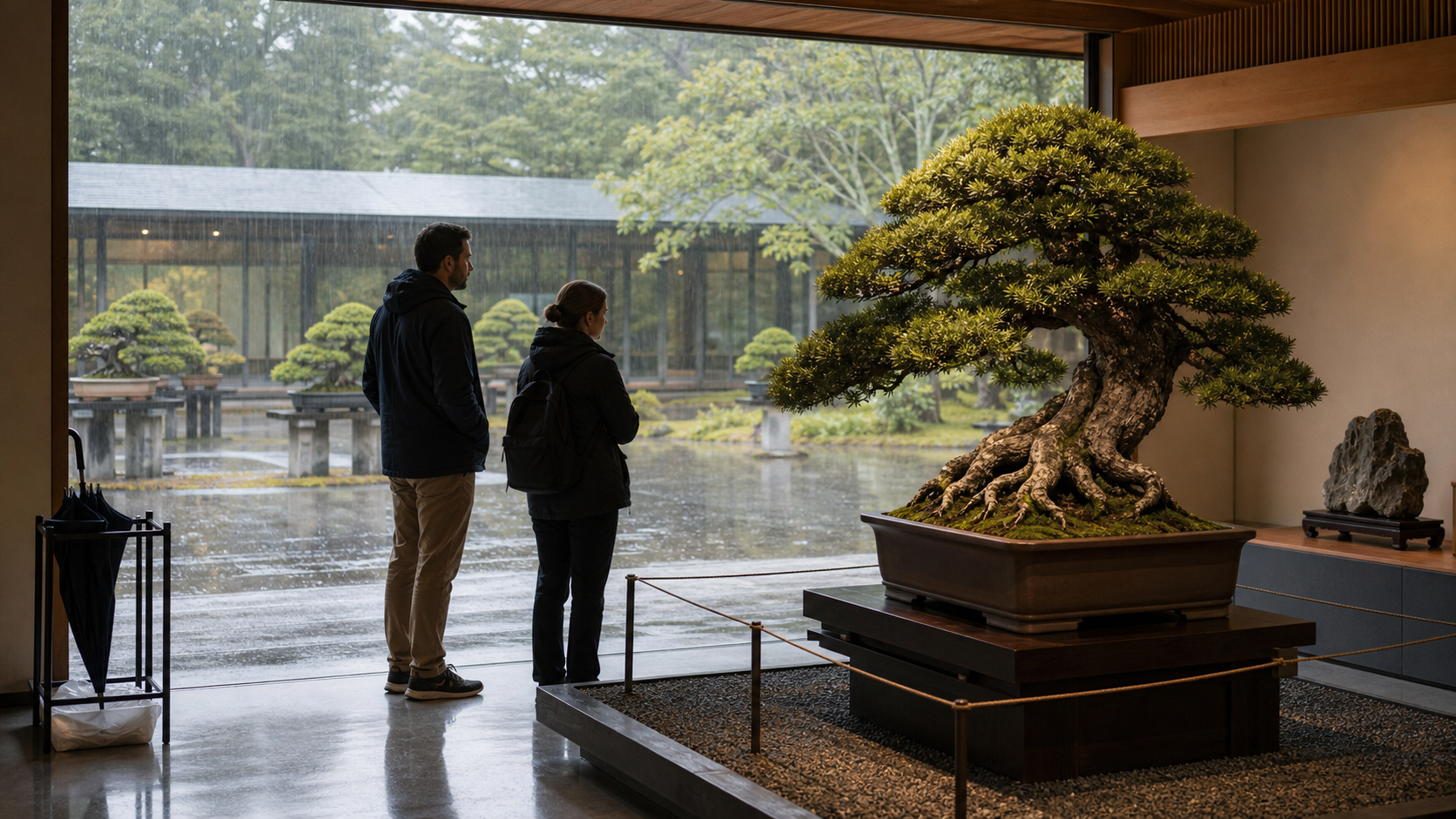
Information checked: August 26, 2026. A rainy day in Japan does not guarantee that a fashionable “bonsai café” is waiting around the corner. Such businesses are uncommon and can close or change concept. A dependable cultural plan is to begin at the Omiya Bonsai Art Museum in Saitama, add the working bonsai gardens only if weather and their individual rules allow, then finish at an ordinary café or izakaya without turning the owner or regular customers into a tourist attraction.
1. Replace the fictional “bonsai café trend” with a real cultural route
Bonsai cafés may exist as individual businesses, workshops or temporary collaborations, but they are not a standard category found throughout Tokyo and Kyoto. Do not build a trip around a generic article that provides no current shop name, address or official booking page. Verify any named business on its own site and keep a museum-based alternative.
Omiya, north of central Tokyo, offers that alternative. Its public bonsai museum explains history and aesthetics indoors, while the nearby Bonsai Village preserves a working community of specialist gardens. The day can end with tea or dinner, but the drink is a pause for reflection—not proof that “Japanese people discuss bonsai in hidden bars on rainy nights.”
2. Bonsai is living art, not a naturally miniature tree
Bonsai literally refers to planting in a container, but the art involves a long relationship among a living tree, its pot, soil, seasonal growth and human care. Pruning, wiring, repotting, watering and positioning shape the work without suspending its biological needs. Age alone does not make a good bonsai, and a small tree is not automatically a bonsai.
The museum also presents bonki pots, suiseki viewing stones, paintings and historical materials. These reveal how display works: tree, container, stand, accompanying object, empty space and the season create a temporary composition. The bonsai themselves rotate weekly because they need air, light and cultivation. That care-first schedule is a stronger lesson than the idea of a permanently frozen masterpiece.
3. Omiya Bonsai Art Museum: address, access, fee and closure
| Item | Checked information | Practical note |
|---|---|---|
| Address | 2-24-3 Toro-cho, Kita-ku, Saitama City, Saitama | Use the museum’s official map; some car-navigation data can misdirect drivers. |
| Rail access | 5-minute walk from JR Toro Station East Exit; 10-minute walk from Tobu Omiya-koen Station | Only local trains stop at Toro; rapid trains pass through. |
| Hours | March–October 9:00–16:30; November–February 9:00–16:00 | Last admission is 30 minutes before closing. |
| Closed | Thursdays except national holidays; Dec. 29–Jan. 3; possible temporary exhibition-preparation closures | Check the calendar on the morning of travel. |
| Admission | Adults ¥310; high-school/university students and ages 65+ ¥150; elementary/junior-high students ¥100 | Disability-certificate discounts apply under the museum’s stated conditions. |
Allow 90 minutes to two hours. The garden portion is outdoors, so the museum is not fully weatherproof. A light rain can deepen bark and stone colors, but strong wind, thunder, heat or cold should shorten the outdoor portion.
4. How to look: trunk, roots, branches, pot and season
Begin with the trunk line: does it rise straight, bend, lean or cascade? Then examine nebari, the visible root spread that gives a sense of stability, and the balance of branches and empty space. Deadwood features such as jin and shari may suggest weathering, but they are skilled interventions and natural processes—not signs that the tree has been neglected.
Step back to compare the pot’s color, depth and shape with the tree. Look for buds, new needles, flowers, fruit, autumn leaves or winter structure rather than expecting every visit to show a dense green crown. Do not demand a single “front”: some works reward walking around them where the path permits. The museum’s historical and household-style displays also show how a work changes when placed in a reception setting.
5. Omiya Bonsai Village: working gardens, not a theme park
The Bonsai Village developed after gardeners affected by the 1923 Great Kanto Earthquake moved from Tokyo in search of suitable land. It became a self-governed community in 1925. Several specialist gardens remain, each with its own taste, business needs, opening hours and photography rules.
There is no single village ticket or universal operating schedule. Contact each garden directly when current information is unclear, especially for a group, lesson or purchase consultation. In heavy rain, skip the garden circuit: many spaces are partly outdoors, paths can be wet, and staff must protect living stock. Never interpret an open gate as permission to enter a work or cultivation area.
6. A flexible rainy-day route
| Conditions | Recommended sequence | What to shorten or skip |
|---|---|---|
| Light rain | 09:30 museum indoor galleries → brief garden → one or two open Bonsai Village gardens → café → dinner | Keep umbrellas closed before entering tight displays; avoid muddy shortcuts. |
| Steady rain | Museum galleries and covered viewpoints → lunch/café near rail → optional second indoor cultural facility | Skip the village circuit unless individual gardens confirm suitable access. |
| Strong wind or thunder | Stay near rail and use a fully indoor alternative | Do not shelter under trees, eaves with falling risk or temporary garden structures. |
| Limited mobility | Confirm museum entrance, lift/toilet and seating → one controlled indoor visit | Do not assume wet neighborhood garden paths meet the same accessibility standard. |
Reserve the evening meal near your return line rather than far inside a residential district. Wet shoes, umbrellas and reduced visibility make repeated transfers more tiring than the map suggests.
7. Café and izakaya: choose the business, not a fantasy category
Use an ordinary café for warmth, drying time and notes. Check its exact address, current hours, last order, closing day, payment and seating. Do not expect bonsai displays, workshops or merchandise unless the business itself currently advertises them. A small potted plant does not make the shop a bonsai institution.
An izakaya is a casual drinking-and-dining venue, not necessarily a bar and not a guaranteed “hidden local experience.” Before entering, check smoking signage, stairs, seat charge or otoshi, minimum drink/order expectations, last order, cashless acceptance and whether minors can enter. Alcohol is optional; non-alcoholic drinks and a meal are valid choices. If smoke, language limits or seating do not suit you, choose another restaurant without treating refusal as a cultural failure.
8. Photography, umbrellas and neighborhood etiquette
- At the museum, the Collection Gallery, zashiki displays and selected objects cannot be photographed. Follow the sign for each area.
- Where photography is allowed, do not use flash, a tripod or selfie stick; stay at least 30 cm from bonsai and remain on the path.
- Do not touch foliage, wire, moss, pots, stands or labels. Water droplets are not an invitation to “adjust” the tree for a photo.
- At private gardens, ask before photographing. Do not capture price records, customers, workers, homes, vehicle plates or cultivation areas without permission.
- Shake and close umbrellas outside only where water will not splash people or bonsai. Use the provided stand or a bag; do not lean a wet umbrella against art.
- Keep residential lanes, gates and drainage channels clear. Speak quietly and do not wait under a private eave.
- In cafés and izakaya, ask once before photographing the counter, staff or other guests. Do not livestream conversation or turn a small shop into a set.
9. Rain, accessibility, allergies and alcohol
Use shoes with grip and carry a compact umbrella or rain jacket. Watch wet tile, metal covers, stone, moss, leaves and the gap between train and platform. During thunder, move into a substantial building and follow JMA warnings; do not continue a tree-focused walk. In summer, rain does not remove heat and humidity, so keep drinking water.
For accessibility, verify the museum’s current lift, accessible toilet, seating, assistance-dog and parking information, then treat private gardens and restaurants as separate checks. Restaurant allergy information is voluntary and cross-contact can occur; show a communication card, name the severe allergen and do not order if staff cannot confirm. Check smoking signs before entry. Anyone who does drink should eat, alternate with water, know the last train and never pressure companions to join.
10. Final checklist and official sources
- Is the museum open, and have you used a local train to Toro?
- Is the rain light enough for the outdoor garden and village paths?
- Which private garden is actually open, and does it permit photography?
- Do the café and restaurant have a real name, address and current schedule?
- Have you checked smoking, allergies, stairs, charges, payment and last order?
- Can you shorten the route and return by rail before conditions worsen?
Primary sources: Omiya Bonsai Art Museum access and admission, Omiya Bonsai Village history and garden list, museum photography rules, and the Consumer Affairs Agency food-allergy communication resources.