



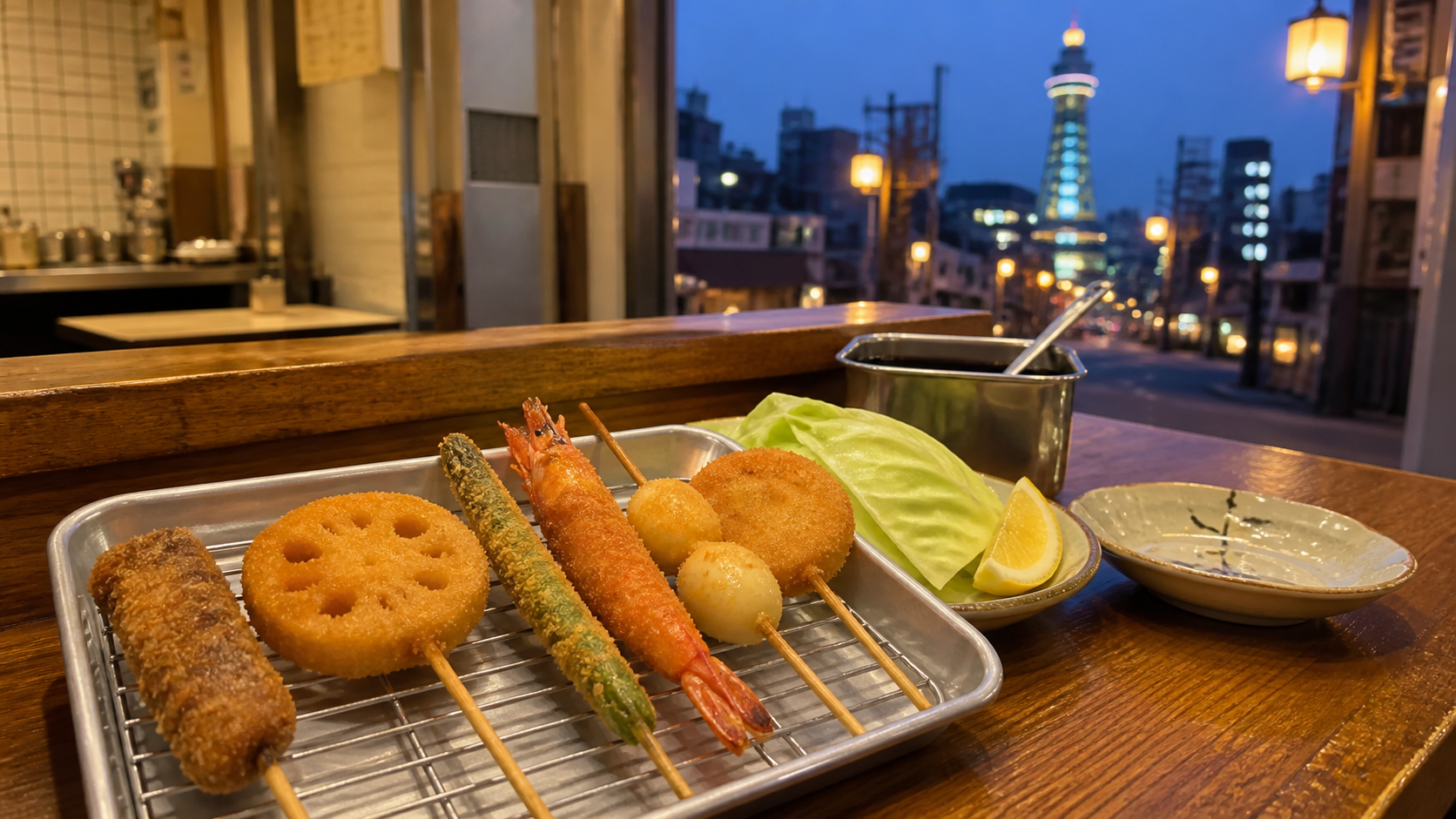
Information checked: August 26, 2026. Osaka kushikatsu is not yakitori with a different name. Ingredients are skewered, coated in light batter and breadcrumbs, then deep-fried. This guide explains what to order, how sauce rules work today, how to reach Shinsekai and Janjan Yokocho, what a realistic meal costs, and how to combine the area with Tsutenkaku without turning lunch into an all-day queue.
Kushikatsu, kushiyaki and tempura are different
| Term | Cooking method | Typical character |
|---|---|---|
| Kushikatsu | Skewered, battered, breadcrumbed and deep-fried | Crisp coating; meat, seafood, vegetables, cheese or egg |
| Kushiyaki / yakitori | Grilled over charcoal or gas | Smoky; yakitori mainly uses chicken |
| Tempura | Light flour-and-egg batter, usually without breadcrumbs | Delicate coating; not necessarily skewered |
In Osaka, “kushi-katsu” and “kushi-age” may overlap. The word katsu does not mean every skewer is pork cutlet. Ask the ingredient instead of guessing from the coating.
Why Shinsekai became the classic setting
Shinsekai developed around the 1903 National Industrial Exposition site and the first Tsutenkaku/Luna Park complex. After the war, inexpensive counter food and entertainment helped shape its working-class downtown identity. Today the district mixes long-running businesses with large tourist-oriented restaurants.
Janjan Yokocho runs about 130 metres and has roughly 50 businesses including kushikatsu and doteyaki shops, go and shogi clubs. Kushikatsu is now found throughout Osaka; eating it outside Shinsekai is not less “authentic.” Choose Shinsekai for the streetscape and history, not because every shop there is automatically superior.
Build a balanced first order
| Category | Examples | Useful note |
|---|---|---|
| Osaka classic | Beef, pork, onion | Start with two or three simple pieces to judge batter and oil |
| Vegetable | Lotus root, asparagus, shiitake, pumpkin | Some absorb more oil; “vegetable” does not mean vegan |
| Seafood | Shrimp, squid, scallop, fish | Confirm whether price is per skewer and whether seasonal |
| Rich item | Cheese, quail egg, mochi | Order later; they are filling |
| Side | Raw cabbage, doteyaki | Doteyaki is beef tendon simmered with miso and is not vegetarian |
A good first meal is five to eight skewers per person in two rounds, plus cabbage or one side dish. Ordering gradually keeps hot pieces crisp and reduces waste. Sets are convenient but may include ingredients you do not eat.
The “no double dipping” rule has context
The famous rule applied to a shared sauce container: once a bitten skewer touched it, the sauce was contaminated. Dip once before eating. Traditionally, a clean cabbage leaf could scoop extra sauce; never return a bitten cabbage leaf to a shared container.
Many shops now use individual dishes, squeeze bottles, pouring spoons or pre-sauced skewers. Follow the system in front of you rather than performing an old rule for photographs. Hold the wooden stick, bite carefully, and place used sticks in the indicated container. Do not wave hot skewers across a crowded counter.
Shinsekai and Tsutenkaku practical details
| Area | Ebisu-Higashi, Naniwa-ku, Osaka 556-0002 |
|---|---|
| Access | Immediately by Ebisucho Station; about 3 minutes from Dobutsuen-mae Station. JR Shin-Imamiya is also walkable |
| District hours | No single opening time; every restaurant and shop sets its own hours and holidays |
| Street admission | Free; food and attractions cost extra |
| Suggested food time | 60–90 minutes, preferably before the main dinner rush |
Optional Tsutenkaku stands at 1-18-6 Ebisuhigashi. The official tourism listing gives the general observatory 9:00–21:45, last entry 21:15, open year-round, adult admission ¥1,500. Special decks and activities cost separately; verify same-day information because admission systems and operating hours change.
Price units, cover charges and choosing a shop
Prices are usually per skewer, while sets are priced per assortment. A casual meal commonly lands around ¥1,500–¥3,500 per adult before heavy drinking, but premium seafood, many drinks and cover charges can raise it. Treat this as a planning range, not a posted price.
- Read the current tax-inclusive menu before sitting where possible.
- Confirm one-skewer versus set pricing and minimum order.
- Ask about seating charge, appetizer, time limit and one-drink rule.
- Check smoking policy and whether children can use the counter.
- Choose a place with a clear menu and turnover, not only the largest sign or longest queue.
Useful Japanese: Kore wa ippon no nedan desu ka? (Is this the price for one skewer?) and Osusume o gohon, niku to yasai o mazete kudasai (Five recommendations, mixing meat and vegetables, please).
Wheat, shared oil and hidden animal ingredients
Standard kushikatsu usually contains wheat; batter or coating may include egg and milk. Shared fryers can expose food to shrimp, crab, fish, meat, cheese and other allergens. Sauce commonly contains wheat and soy. “Vegetable skewer” may still use egg batter, animal stock or the same oil as meat, so it is not automatically vegan, halal or suitable for a serious allergy.
Show the Consumer Affairs Agency allergy sheet and ask about batter, sauce and fryer separately. People avoiding alcohol should also check sauces and order a soft drink without assuming a one-drink rule means alcohol. Japan prohibits drinking under age 20, and nobody should drive after drinking.
A sensible half-day and FAQ
- 14:00: arrive via Ebisucho or Dobutsuen-mae and walk Tsutenkaku Hondori.
- 14:30: visit Tsutenkaku only if the current wait fits your plan; otherwise enjoy the street view for free.
- 16:00: walk Janjan Yokocho and compare two or three menus.
- 17:00: order a small first round of kushikatsu, then add favourites.
- 18:15: leave before over-ordering; continue to Tennoji or return toward Namba.
Must I eat in Shinsekai?
No. Osaka has kushikatsu shops in Namba, Umeda, Shin-Osaka and neighbourhood districts. Shinsekai adds historic scenery.
Is cabbage always free and unlimited?
No. Service and refill policies differ. Do not assume a traditional custom is included.
Can I share a set?
Sometimes, but shops may require one order or drink per guest. Ask before ordering.
Is kushikatsu street food?
It is mainly eaten inside restaurants. Do not carry oily skewers through crowded streets unless the seller explicitly provides a takeaway eating area.
Official references: OSAKA-INFO: kushikatsu / OSAKA-INFO: Shinsekai / OSAKA-INFO: Tsutenkaku / Tsutenkaku Hondori