


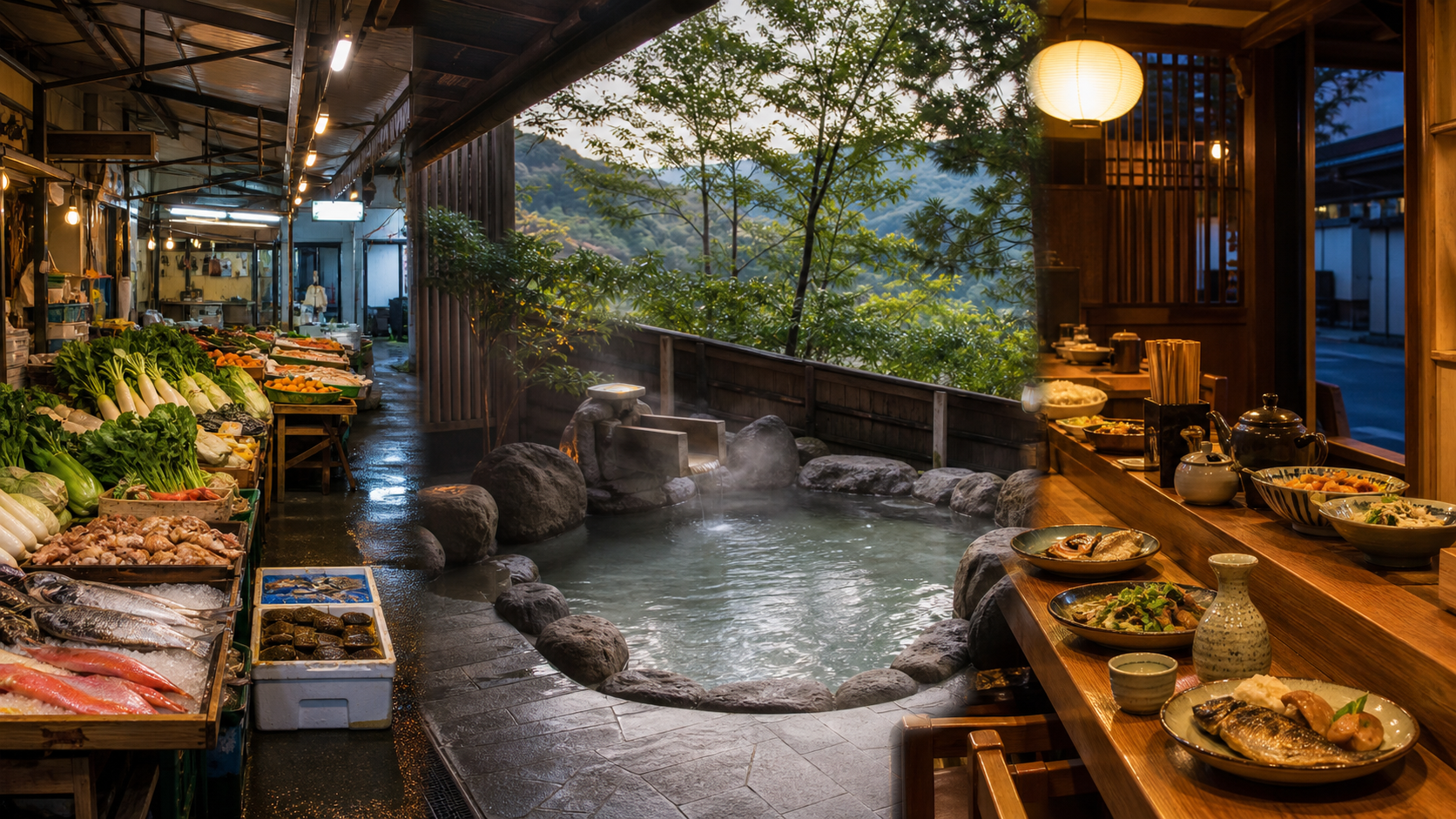
Information checked: August 26, 2026. A regional city is not automatically “the countryside.” It may be a port, castle town, hot-spring district or transport hub, each with its own working hours. This guide builds one realistic overnight stay around three everyday institutions—a morning market, an onsen and an izakaya—without treating residents as a tourist attraction.
Choose a city where the three pieces really connect
Start with the market calendar, not a famous photo. Some markets open daily, while others run only on Sundays or dates ending in particular numbers. JNTO examples range from daily Hakodate and Takayama markets to Kochi’s Sunday market and Gojome’s fixed-date market. Treat these as inspiration and confirm the operator’s current page.
A good base has accommodation within about 15 minutes of the station or bath district, an onsen accepting non-guests, and dinner reachable on foot. If the last bus leaves before dinner, the itinerary is not connected.
The information sheet every traveller should make
| Item | Confirm on the official source |
|---|---|
| Morning market | Exact address, market dates, hours, weather cancellation, eating area and cashless payment |
| Onsen | Day-use hours, admission, closed days, towel rental, tattoo policy and private-bath reservation |
| Izakaya | Opening/closed days, reservation, smoking policy, cover charge, last order and payment |
| Transport | Last bus/train, IC-card acceptance, taxi contact and luggage storage |
Save Japanese place names and screenshots offline. Holiday periods, maintenance and fishing conditions can change hours at short notice.
Arrive by mid-afternoon and solve transport first
Aim to arrive around 15:00. Leave luggage at the hotel, tourist office or station locker, then walk the route in daylight. Regional buses may be hourly and IC cards are not universal; carry small yen notes and coins. Photograph the return timetable rather than relying only on the final search result.
Choose a compact district over collecting distant “hidden gems.” Ask before photographing people, houses, fishing work or market preparation, and keep luggage out of narrow streets.
Use the onsen before dinner, not after heavy drinking
For a typical gender-separated bath, remove all clothing in the changing room, wash before entering, keep the small towel and hair out of the water, speak quietly and leave the phone outside the bathing area. Never enter when intoxicated; hydrate and follow posted health warnings.
Tattoo rules differ. Check directly before travelling; a cover sticker, tattoo-friendly facility or reservable private bath may be an option. “Day-use” hours can be much shorter than hotel bathing hours, so confirm the last admission, not only closing time.
An izakaya is dinner, not guaranteed social theatre
Pick a clearly priced venue near the hotel and reserve small popular places on weekends. An otoshi appetizer may be part of a seat charge; food and drink last orders can differ. Order two or three dishes first—grilled fish, tofu, seasonal vegetables and rice—then add more. Alcohol is optional, and Japan’s legal drinking age is 20.
Ask about dashi, sauces and shared fryers if you have allergies or dietary restrictions. A phrase card helps, but it cannot guarantee an allergen-free kitchen. Conversation with residents is welcome only when mutual and natural; do not film staff or customers without permission.
Go early, observe first and protect the food
Arrive near opening for the working atmosphere and best selection, but do not obstruct setup. Check whether prices are per item, pack or weight; ask before touching produce; and use the designated eating area. Carry a small reusable bag and take rubbish with you when bins are not provided.
For seafood, dairy or prepared foods, ask how long the item can remain unrefrigerated and buy it near departure. Shopping locally supports the community only when visitors also respect work, privacy and waste rules.
A workable 24-hour schedule and planning budget
| Time | Plan |
|---|---|
| 15:00 | Arrive, store luggage, verify the last transport |
| 16:00 | Neighbourhood walk and onsen check-in |
| 17:00 | Day-use bath; hydrate afterward |
| 19:00 | Izakaya dinner near accommodation |
| 21:00 | Return quietly; prepare cash and bag |
| 06:30 | Morning market; adjust to actual opening |
| 08:00 | Breakfast and final purchases |
| 10:00 | Check out and depart |
| Item | Planning range per person |
|---|---|
| Local transport | ¥500–¥2,000 |
| Day-use bath | ¥500–¥2,000 plus towel if required |
| Izakaya dinner | ¥2,500–¥5,000 |
| Market breakfast | ¥800–¥2,500 |
| Accommodation | Highly seasonal; compare the total including meals and bathing tax |
These are planning ranges, not quoted prices. Verify every named facility before paying.
Accessibility, weather and FAQ
Can I do this as a day trip?
Only if the market opens late enough or you can reach it on the first train. Staying overnight removes the riskiest connection and keeps spending in the community.
What if the market is cancelled?
Use a covered shopping street, local produce shop or museum listed by the official tourism office. Do not enter wholesale work areas.
What about mobility needs?
Ask about station lifts, low-floor buses, market surfaces, bathing steps, shower chairs and private baths before booking. “Accessible entrance” does not prove the bath itself is accessible.
Can children use the onsen?
Age and mixed-bathing rules vary by prefecture and facility. Confirm supervision, diaper and family-bath rules directly.
Official references: JNTO: morning markets / JNTO: onsen guide / JNTO: izakaya guide / JNTO: mindful travel