


Ryogoku is often introduced as “sumo town,” but its culture is not confined to a tournament afternoon. Museum objects, a temple where Edo-period fundraising sumo took root, a shrine linked to sumo tradition, training stables and ordinary shops all share the neighborhood. This self-guided walk helps you read those connections without turning residents or wrestlers into attractions.
1. Route at a glance
| Stop | Purpose | Typical time |
|---|---|---|
| Ryogoku Tourist Information Center | Pick up a current map and check closures | 10–15 min |
| Sumo Museum | See rotating displays of banzuke, prints and ceremonial aprons | 30–45 min |
| Eko-in | Understand the area’s Edo-period sumo history and Chikara-zuka memorial | 20–30 min |
| Nomi no Sukune Shrine | Visit a living place of worship connected with sumo | 15–20 min |
| Neighborhood streets | Notice stable architecture, shop motifs and local daily life | 30–60 min |
Allow two to three hours. The museum calendar should decide your date: it has many closures and cannot be treated as an always-open arena attraction. JR Ryogoku Station is convenient for the Kokugikan and Eko-in; Toei Oedo Line Ryogoku Station is closer to the shrine side.
2. Why Ryogoku became “sumo town”
Sumo combines competitive sport, entertainment, occupations and ritual forms with a much longer history than the present arena. Ryogoku’s especially strong connection developed through Edo-period kanjin-zumo, performances held partly to raise funds for religious institutions and public works. Eko-in became a regular venue in 1833, and the “Eko-in sumo” era continued for 76 years until the old Kokugikan opened in 1909.
This history explains why the neighborhood contains both an arena and memorial or devotional places. It does not mean every shop decoration is sacred, nor that visitors may enter a stable simply because it appears on a map.
3. Sumo Museum: begin with the objects
- Address: 1F Ryogoku Kokugikan, 1-3-28 Yokoami, Sumida-ku, Tokyo 130-0015.
- Access: about 2 minutes from JR Ryogoku Station West Exit or about 9 minutes from Toei Oedo Line Ryogoku Station A3 Exit; no visitor parking.
- Regular hours: 10:00–16:30, last entry 16:00.
- Admission: free in ordinary periods. During a Tokyo Grand Sumo tournament, an arena ticket is required and museum hours are normally 12:30–16:00.
- Closures: generally Saturdays, Sundays, national holidays and New Year, plus display changes and event-related closures. Exceptions are common, so check the date-specific official calendar.
The single 150-square-metre room uses rotating exhibitions rather than a fixed comprehensive display. Look for the relationship among banzuke ranking sheets, nishiki-e prints and kesho-mawashi ceremonial aprons. Do not assume museum entry includes access to the arena bowl. Groups over 20 should contact the museum in advance.
4. Eko-in: where neighborhood and sumo history meet
- Address: 2-8-10 Ryogoku, Sumida-ku, Tokyo 130-0026.
- Access: about 4 minutes on foot from JR Ryogoku Station.
- Admission: ordinary worship in the grounds is free; special events may use separate rules.
- Recommended visit: 20–30 minutes, outside service or memorial activity.
Eko-in was founded to memorialize people who died in the Great Fire of Meireki and came to embrace remembrance for lives without someone to mourn them. Its sumo story is therefore one chapter within a religious site, not the whole identity of the temple. The Chikara-zuka monument was erected in 1936 to console deceased sumo elders and remains a symbol of the connection. Keep voices low, do not interrupt rites and do not treat graves or memorial stones as photo props.
5. Nomi no Sukune Shrine: a small living shrine
- Address: 2-8-10 Kamezawa, Sumida-ku, Tokyo 130-0014.
- Access: about 6 minutes from Toei Oedo Line Ryogoku Station A3, 12 minutes from JR Ryogoku Station East Exit, or 15 minutes from the Kokugikan.
- Admission: free to worship.
- Time needed: about 15 minutes; there is no guaranteed staffed opening program.
The shrine venerates Nomi no Sukune, a figure associated with sumo origins in Japanese tradition. Before Tokyo tournaments, association officials attend a ceremony, and new yokozuna have performed dedication ring-entering ceremonies. Bow once at the torii if you wish, keep to the side of the approach, rinse only when a water basin is operating, offer quietly, bow twice, clap twice and bow once. These are helpful customs, not a test imposed on foreign visitors.
6. How to read the neighborhood
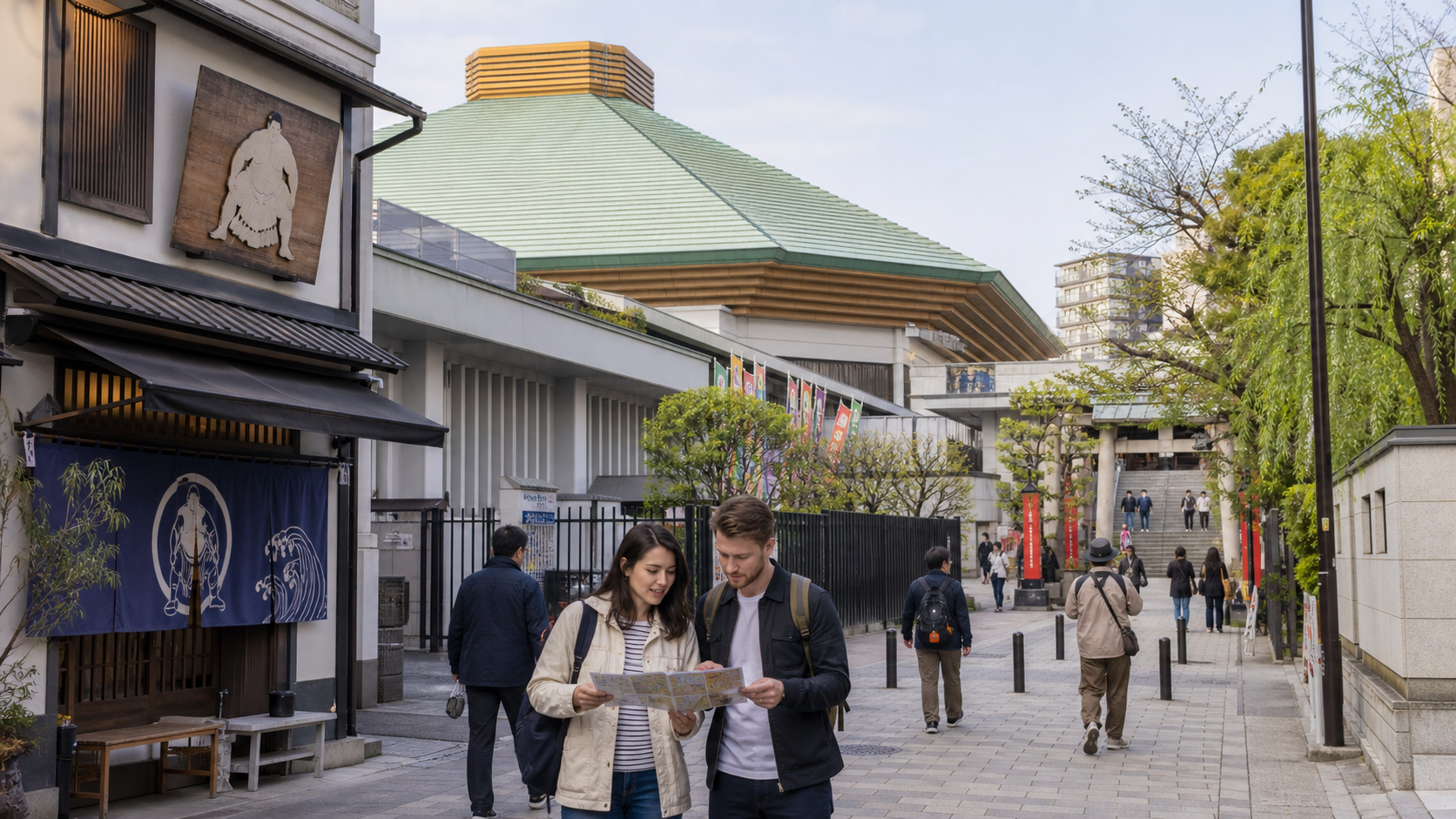
Stable nameplates, high windows, bicycles, deliveries and early activity can reveal that a sumo-beya is a workplace and home. Decorative wrestler silhouettes and food portions in shops show how the industry also supports local commerce. Start at the Ryogoku Tourist Information Center inside Ryogoku Edo Noren, directly connected to JR Ryogoku West Exit (1-3-20 Yokoami). Its published hours are 10:00–18:00, extended to 19:00 during Tokyo tournaments, with January 1–2 and irregular inspection closures.
A map is an invitation to understand the district, not permission to enter every marked building. Walk on public streets, leave doorways clear and allow residents, bicycles and deliveries to pass.
7. Photography and stable etiquette
- Never enter a stable, training room or private courtyard without an explicitly arranged visit.
- Do not photograph through windows, wait outside for wrestlers, follow them, touch them or demand a selfie. The Sumo Association specifically asks spectators not to wait around the arena for arrivals or departures during tournaments.
- Ask before photographing inside shops. At shrines and temples, obey signs and never stage poses in front of worshippers or memorials.
- If an authorized morning-practice visit is offered, follow the organizer’s rules on silence, seating, phones, food, children and early departure. Rules vary by stable.
- During a tournament, use an official ticket channel; a street walk never grants arena access.
8. Chanko and shopping without stereotypes
Chanko means food prepared and eaten in a sumo stable; chanko-nabe is its best-known form, not a magic dish that automatically creates a wrestler’s physique. Around Ryogoku, restaurants range from casual lunch sets to reservation-oriented dinners. Check the current menu, tax, seating charge, minimum order and last order rather than relying on a timeless price in a guide.
Ask about fish stock, chicken or pork, soy, wheat, sesame, egg and shared kitchens when dietary restrictions matter. Sumo-themed sweets, towels or prints can be enjoyable souvenirs, but official rank sheets and tournament goods change by season. Compare first and avoid blocking narrow storefronts while deciding.
9. Suggested itineraries and FAQ
Weekday museum route: information center → Sumo Museum → lunch → Eko-in → Nomi no Sukune Shrine. Weekend or museum-closed route: information center → Kokugikan exterior from public space → Eko-in → shrine → neighborhood shops. Confirm every opening on the morning of travel.
Can I see wrestlers training?
Not by simply walking in. Use only an official or clearly authorized reservation; absence of a prohibition sign is not consent.
Can I visit during a Tokyo tournament?
Yes, but crowds and access rules change. The museum requires a tournament ticket, and waiting for wrestlers outside is discouraged. A non-ticketed neighborhood walk remains possible where public streets are open.
Is the route step-free?
Public streets are mostly urban pavement, but shrine and temple surfaces and small-shop entrances vary. The museum is inside a major venue; contact each facility for the specific lift, wheelchair and assistance route needed on your date.
Official references: Japan Sumo Association: Sumo Museum; Nomi no Sukune Shrine; Eko-in history; Eko-in guide; Ryogoku Tourist Information Center. Information checked August 26, 2026; verify calendars before travel.