



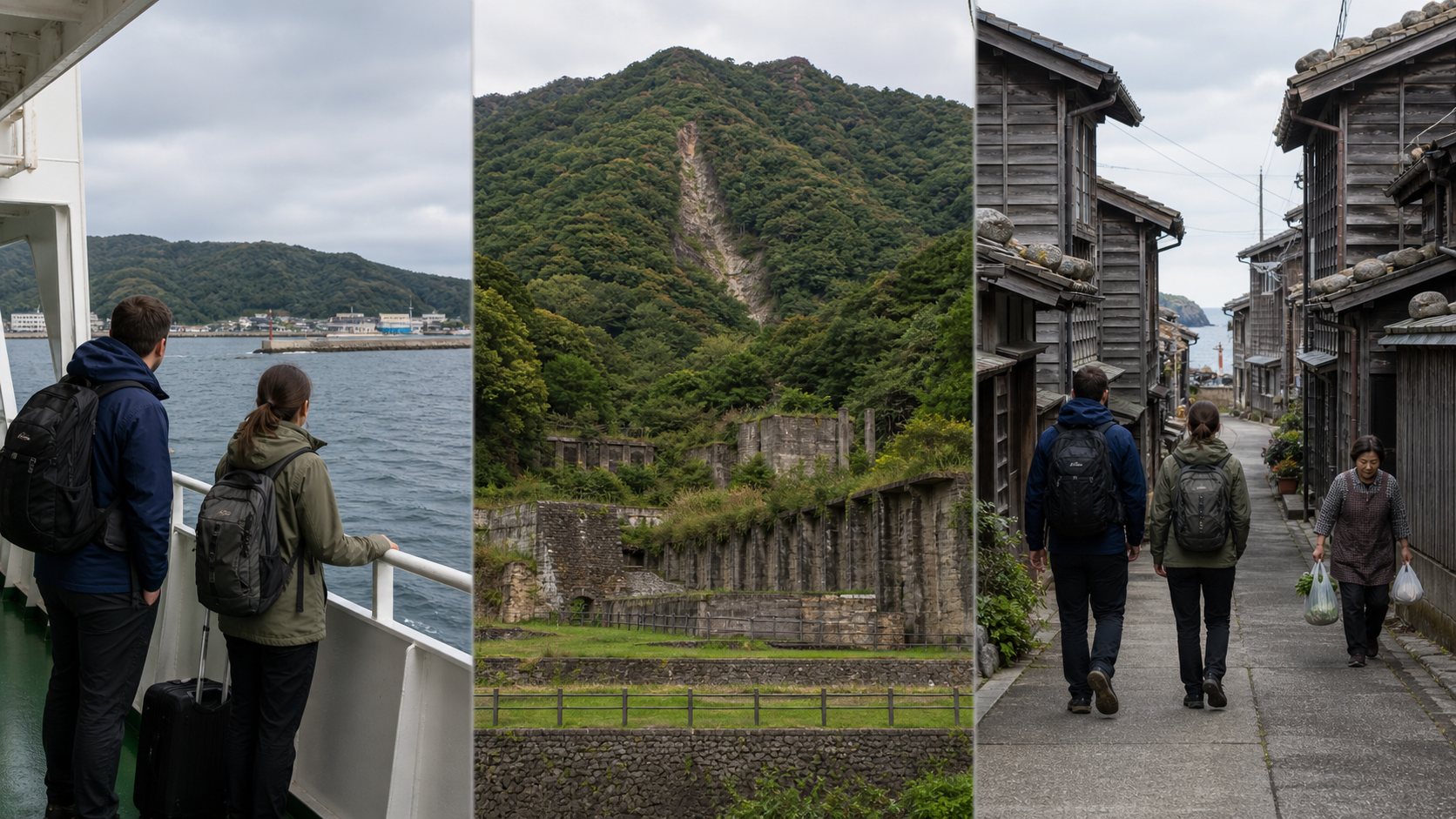
Sado is not a place to squeeze between two mainland trains. The island has roughly 280 kilometres of coastline, no railway, limited buses and two mountain ranges around a broad central plain. Its real appeal emerges when you allow at least two nights: a ferry crossing becomes part of the journey, mining history connects with rice fields and village performing arts, and the gaps between sights become time spent in a living island community.
1. Why Sado rewards a slower trip
Sado’s culture was shaped by several currents rather than by isolation alone. Exiles and intellectuals brought court culture; officials and workers connected with the mines brought samurai and urban practices; and merchants and sailors on the Kitamaebune sea route carried customs from other ports. Noh later took root not only as elite theatre but as a community art performed around village shrines. Gold and silver mining also changed settlement, forestry, farming and transport across the island.
In 2024, UNESCO inscribed the Sado Island Gold Mines, specifically the Nishimikawa placer-mining and Aikawa-Tsurushi mining areas, for evidence of unmechanised gold-production systems developed during the Edo period. That designation does not turn the whole island into one attraction. Treat rice paddies, fishing settlements, sacred spaces and ordinary homes as parts of a lived landscape, not as scenery arranged for visitors.
2. Ferry access: build in a weather margin
The most frequent gateway is Niigata Port–Ryotsu Port. The car ferry takes about 2 hours 30 minutes; the reserved-seat jetfoil about 1 hour 7 minutes. Naoetsu–Ogi car ferries take about 2 hours 40 minutes but operate seasonally, so they should never be assumed for a winter or shoulder-season plan.
Fares include a fuel adjustment that is revised periodically. For July–September 2026, for example, the Niigata–Ryotsu car-ferry adult second-class one-way fare is ¥3,570, but this is a dated planning example, not a permanent price. Check the operator’s timetable, fare period, service status and seat availability immediately before booking and again on travel day. Reserve vehicles and time-critical sailings; arrive early enough for ticketing and boarding.
Wind and waves can delay or cancel vessels. Do not place a non-changeable international flight, the last mainland train or an irreplaceable event immediately after the return crossing. In rough weather, keep one buffer night on the mainland or choose a fare and hotel arrangement that can be changed.
3. Choose one transport style before choosing sights
| Style | Best for | Important limit |
|---|---|---|
| Rental car | Two or more areas in one day, luggage, reduced walking | Reserve early; confirm licence/translation rules, insurance, fuel and narrow-road confidence |
| Local bus | Aikawa-focused slow travel with a fixed timetable | No Suica or other transport IC cards; services and connections can be sparse |
| Taxi/chartered taxi | Non-drivers, mobility needs, small groups | Pre-book long or early trips and agree on time and price |
| Bicycle/e-bike | One compact district in fair weather | Sado is too large and hilly for a casual whole-island ride |
On buses, take a numbered ticket where required and pay on exit. Carry coins or a ¥1,000 note: larger notes, foreign currency, credit cards and transport IC cards are not accepted. Current published adult bus passes are ¥2,000 for one day, ¥3,000 for two consecutive days and ¥3,500 for three, but calculate value against the journeys you can realistically make.
Drivers should refuel before remote coastal sections, avoid stopping on blind bends, and never follow an app onto an unsuitable farm or residential road. Visitors from some countries, including Taiwan, need an official Japanese translation in addition to their home licence; verify eligibility before paying for a car.
4. Read the gold-mine landscape before entering the tunnel
Begin in Aikawa at Kirarium Sado. Its films, maps and digital material explain how mining, ore processing and the town fitted together, making the later tunnel visit much more meaningful. Then continue to the Historic Site Sado Gold Mine, rather than viewing the famous split mountain only as a photograph.
The standard self-guided mine experience contrasts the hand-worked Sodayu tunnel with the later Doyu tunnel and machinery. Allow 60–90 minutes. The tunnel stays around 10°C, even in summer, so carry a layer. Sodayu has about 190 steps and is not wheelchair-accessible; Doyu has steps near the end and wheelchair users must turn back before them. Conservation work may close areas without much notice.
Avoid the old stereotype that Sado’s mine was simply a place of indiscriminate convict labour. Its labour history changed over several centuries and included miners, skilled technicians, officials, merchants and, in some periods, homeless people sent under state policy. Use the site’s interpretation and current scholarship rather than turning human hardship into entertainment.
5. Noh, onidaiko and the difference between a stage and a show
Zeami was exiled to Sado in the fifteenth century, but Noh spread widely among island communities later, supported by mine administration and village practice. More than thirty stages remain, many in shrine precincts. An empty stage is still a community and sacred asset; it is not permission to climb up, rehearse, move objects or stage a costume shoot.
Performances are seasonal and some require tickets, reservations or special transport. Onidaiko—the masked deity dance accompanied by drums—belongs to local shrine festivals and differs by settlement. Watch from the space residents indicate, do not block a procession or doorway, and ask before making close portraits. A published schedule can change with weather, community circumstances or ritual priorities.
6. Walk Shukunegi as a neighbourhood, not an open-air set
Shukunegi, about four kilometres southwest of Ogi Port, developed through shipbuilding and Kitamaebune trade. More than one hundred tightly packed plank-walled houses occupy a small inlet, and some reused shipbuilding materials. The district is nationally protected for its traditional buildings, but most houses are still private.
Use the public lanes, keep voices low, and enter only houses explicitly open to visitors. Do not peer through windows, lean equipment against walls, fly a drone, or block an alley for portraits. A tub-boat ride is an optional paid activity, not proof that every small round boat or waterfront is free to use. Check weather and operator status on the day.
7. A realistic two-night cultural route
| Time | Plan | Fallback |
|---|---|---|
| Day 1 | Arrive Ryotsu; collect car or confirm bus; visit Toki Forest Park or settle into central accommodation | If the ferry is late, skip the attraction and protect dinner/check-in |
| Day 2 | Kirarium Sado → Sado Gold Mine → Aikawa town walk; attend a confirmed performance only if schedule and return transport work | In heavy rain, spend longer indoors and omit exposed coastal stops |
| Day 3 | Shukunegi/Ogi if using a car or prearranged transport; otherwise choose one central-area cultural stop before Ryotsu departure | Move closer to Ryotsu early if wind or service disruption is forecast |
This is deliberately not a “complete island” circuit. Combining Aikawa, the far north coast and Shukunegi in one bus day is unrealistic. For a no-car trip, stay in one transport corridor, check every connection before arrival and consider a guided or chartered segment.
8. Key visitor information
| Place | Address / access | Hours, admission and recommended use |
|---|---|---|
| Kirarium Sado | 18-1 Aikawa Sanchome Hamamachi, Sado; Kirarium Sado bus stop | 8:30–17:00, exhibition entry to 16:30; closed Dec 29–Jan 3; adult ¥300. Allow 30–45 minutes before the mine. |
| Historic Site Sado Gold Mine | 1305 Shimoaikawa, Sado; about 60 min by car from Ryotsu, or current Sado Kinzan/Aikawa bus connection | Apr–Oct 8:00–17:30, last entry 16:00; Nov–Mar 8:30–17:00, last entry 15:30. Standard self-guided course: junior-high age and above ¥1,500, elementary ¥750. Allow 60–90 minutes; verify conservation closures. |
| Toki Forest Park | 383-2 Niibo Nagaune, Sado; Toki no Mori Koen bus stop | Published hours 8:30–17:00; check current closure dates and cooperation fee. Best for understanding conservation, not guaranteed wild-bird sightings. |
| Shukunegi | Shukunegi, Sado 952-0612; about 10 min by car from Ogi Port | Public lanes have no common gate fee; open houses and activities charge separately and keep their own schedules. Allow 60–90 minutes and respect residents. |
Hours and prices were checked against official sources in August 2026 and can change. Use the linked official pages, not a screenshot of this table, for the final decision.
9. Food, wildlife, photography and daily-life etiquette
- Food: Island restaurants may close early, sell out or require advance dinner booking. Tell accommodation providers about allergies and dietary needs before arrival; seafood stock does not automatically make a dish pescatarian, and soy sauce or broth may contain wheat, fish or meat.
- Toki: Never approach, feed or chase wild crested ibises. Observe quietly from a legal stopping place; do not stop a car in the road or enter paddies for a photograph.
- Waste: Carry reusable water and take rubbish to an authorised collection point. Do not leave it at a rural bus stop or shrine.
- Photography: Ask before photographing residents, working fishers, artisans or festival participants at close range. Check rules inside mines, museums, open houses and sacred precincts.
- Accommodation: Confirm check-in, dinner and bathing times. Small inns cannot always receive late arrivals caused by an overambitious route.
10. Final planning checklist and official sources
- Stay at least two nights and choose Aikawa, central Sado or Ogi as the main focus.
- Check Sado Kisen’s current timetable, fare period, availability and service status.
- Reserve the rental car, taxi, performance, guided visit and dinner where required.
- Save bus timetables offline and carry cash, rainwear, a warm mine layer and medication.
- Leave a weather buffer before an international flight or other fixed commitment.
Official references: Sado Tourism Association; Sado Kisen; Historic Site Sado Gold Mine; UNESCO — Sado Island Gold Mines.