



Information checked: August 26, 2026. Sapporo winter is more than powder snow and a famous festival. It is also a city where residents maintain streets overnight, families learn snow play in public parks, and historical buildings reveal how earlier communities lived with cold. This guide builds four practical experiences without repeating a ski-resort, clothing-only or onsen article.
Choose by date, energy and weather—not by one “must-see” list
| Experience | Best for | Time | Main constraint |
|---|---|---|---|
| Snow Festival venues | Sculpture, city atmosphere, families | 2–5 hours | Only eight scheduled days; ice and crowds |
| Takino Snow World | Tube sledding, snowshoeing, beginner snow sports | Half/full day | Weather-dependent activities and seasonal bus |
| Historical Village | Architecture, winter tools and social history | 2–3 hours | Outdoor distance, winter closing days |
| Central city snow walk | Flexible arrival/departure day | 1–3 hours | Freeze-thaw ice, falling roof snow, visibility |
Do not schedule all four in one day. Festival lighting rewards an evening return, while Takino and the Historical Village require daylight and transport margins. A blizzard day is not a chance to “see real Hokkaido”; use museums, underground passages and a short route close to the hotel.
Sapporo Snow Festival: three venues, three different purposes
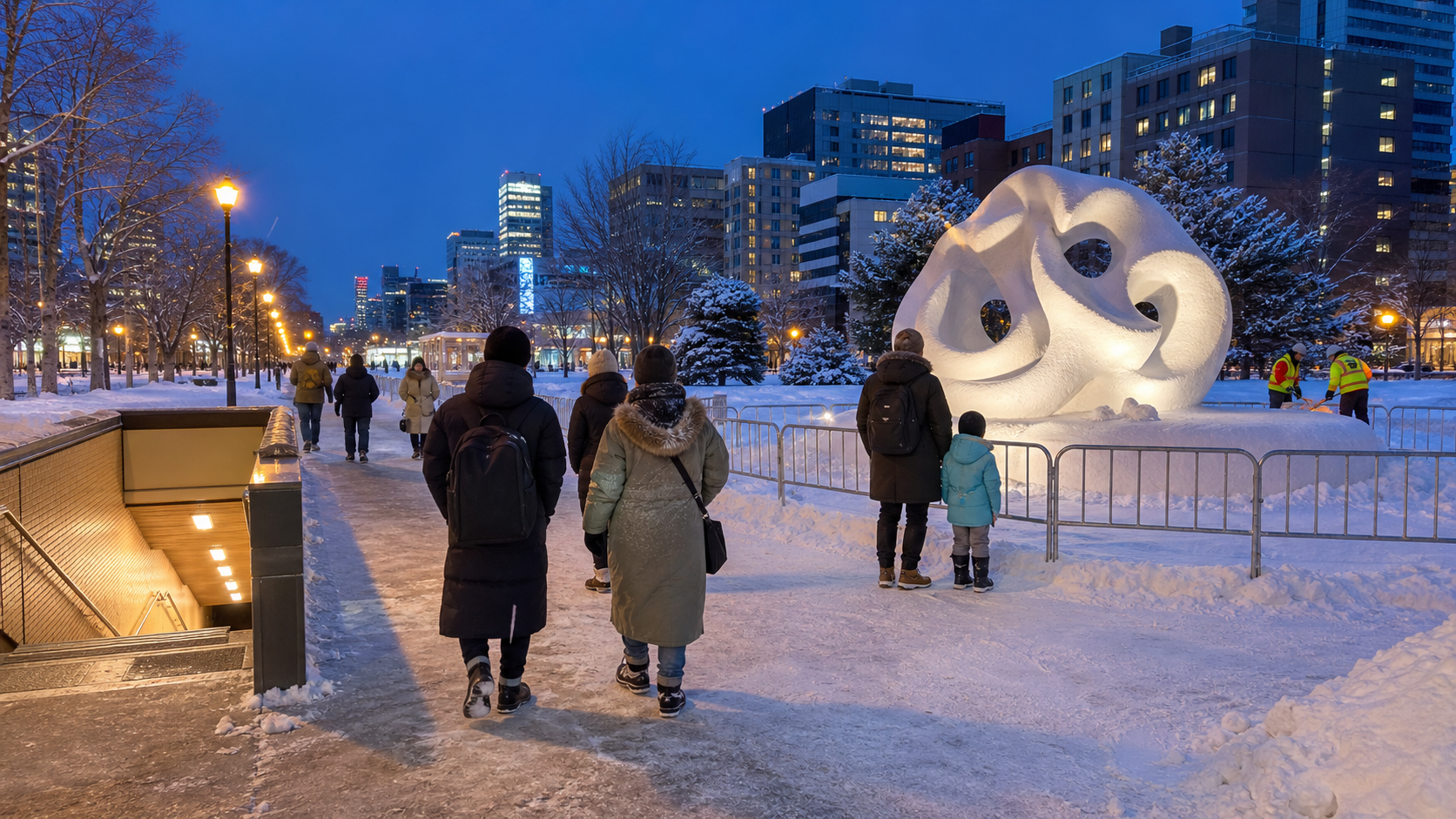
The festival began in 1950 when local junior- and senior-high-school students made six snow sculptures in Odori Park. Large professional works now share the event with citizen sculpture groups, performances and family snow play. That community layer—not size alone—makes the festival part of Sapporo’s winter identity.
- Dates: the 2026 festival ended on February 11. The next edition is scheduled for February 4–11, 2027; detailed 2027 content is due to be updated progressively, so treat it as planned until the official program is final.
- Admission: general entry to the three venue areas is normally free; individual attractions, food and transport may cost extra.
- Odori: Odori Park, Nishi 1–11 chome, Chuo-ku. Direct access from Odori subway station; sculptures and city lighting. Plan 90–150 minutes and enter from the less crowded end rather than stopping in the main flow.
- Susukino: along Ekimae-dori around Minami 4–7 jo, Chuo-ku; access from Susukino station. Ice sculptures suit a short evening walk, but surfaces around nightlife traffic can refreeze.
- Tsudome: Sapporo Community Dome, 885 Sakaemachi, Higashi-ku. In 2026 it operated 10:00–16:00, about 15 minutes on foot from Sakaemachi station with a festival shuttle. Family slides and rafting can stop accepting participants early when crowded.
Do not touch, climb or cross barriers around sculptures. Use designated photo positions briefly, keep children out of equipment queues until eligibility is confirmed, and check the same-day venue notice for wind, thaw or suspended attractions.
Takino Snow World: learn snow play in a managed park
- Address: Takino Suzuran Hillside National Park, 247 Takino, Minami-ku, Sapporo 005-0862.
- Access: by car it is roughly 35–40 minutes from central Sapporo in normal conditions. Public transport uses the Makomanai-area bus pattern, but winter operation differs from the green-season timetable; check the park’s current winter access notice and return bus before departure.
- Winter season/hours: December 23–March 31, 9:00–16:00, open daily during that period under the published park schedule; weather, snow condition and maintenance can close individual activities.
- Admission: winter park admission is free. Published parking is ¥500 per standard car. Lifts, ski rentals, clothing and some programs are separate; FY2026 detailed winter prices are scheduled for release around early December.
- Activities: tube sledding, gentle-slope skiing/snowboarding, snowshoes and cross-country skiing. Free snowshoe loans are limited and do not guarantee size or availability.
- Recommended plan: allow four to six hours. Start with the information center and one low-skill activity, warm up indoors, then add a second activity only if clothing remains dry and the last transport is secure.
A managed slope is still snow sport: observe age/height rules, use helmets where advised, leave closed forest or slope areas alone, and do not improvise a sled run near trees, roads or walking routes. Rental gear does not include instruction; book a lesson for first-time skiing.
Historical Village of Hokkaido: winter is a way to read the buildings
This 54.2-hectare open-air museum preserves and reconstructs buildings from Hokkaido dating mainly from the Meiji period to early Showa. The interpretation should not romanticize “development”: learn whose labor, migration, government policy and existing Indigenous Ainu homeland shaped modern Hokkaido, and use the museum’s current exhibits and guides rather than treating every building as one simple pioneer story.
- Address: 50-1 Konopporo, Atsubetsu-cho, Atsubetsu-ku, Sapporo 004-0006.
- Access: JR Hokkaido Bus Shin 22 from Shin-Sapporo bus terminal platform 10 (about 18 minutes) or Shinrin-koen station (about 10 minutes), alighting at Kaitaku-no-mura. Recheck winter delays.
- Admission: ¥1,000 for adults and university/high-school students; Hokkaido resident discount ¥800 with proof. Junior-high students and younger, people aged 65+, and eligible disability-certificate holders enter free under current rules.
- Winter hours/closures: October–April 9:00–16:30, last entry 16:00. Closed Mondays (next day when Monday is a holiday) and December 29–January 3; Mondays during the Sapporo Snow Festival are open.
- Winter program: the 2026 reference season offered old-style wooden sleds, bamboo skis, snow-clearing tools and horse sleighs on selected days from January 4 to March 22. Future content and operation depend on snow and must be reconfirmed.
- Recommended plan: allow 2–3 hours, choose two building groups and one winter-life theme rather than rushing all 54.2 hectares.
Historic stoves, entrances, snow-management tools and compact living spaces show adaptation to cold, but visitors should not claim they represent all Ainu or settler experience. Follow photography and building-entry rules, remove snow from footwear where directed and never lean equipment against historic fabric.
Build a surface-and-underground winter walk
Sapporo’s grid makes orientation easy, but a straight line can alternate between dry pavement, packed snow, black ice and snowbanks. Pair short surface sections with the Sapporo Station–Odori underground pedestrian space and the Aurora Town/Pole Town network toward Susukino. Underground passages are mobility infrastructure used by residents, not merely attractions.
- Start at Sapporo Station and check live weather and rail status before leaving the building.
- Walk underground toward Odori; surface briefly at a suitable exit for the Former Hokkaido Government Office area or Odori Park.
- Return underground when wind, falling snow or footing worsens; continue toward Susukino only if the return route remains simple.
- Use indoor toilets, lockers and rest stops respectfully; do not spread wet luggage across commuter flow.
The route itself is free, while observation decks, museums, food and lockers charge separately. Accessible exits differ, and a lift may be farther than the nearest stairs; use the current barrier-free map instead of assuming every exit has an elevator.
Read the street, not just the air temperature
- Walk with short steps, place the whole foot down, keep hands out of pockets and use railings. Traction aids help but do not prevent every fall, especially on exposed indoor floors.
- Around 0°C, meltwater can refreeze into hard transparent ice. Shaded intersections, bus stops, sloped entrances and painted road markings require extra time.
- Avoid eaves and the edge of snow-laden roofs when temperatures rise; falling snow and ice can strike the sidewalk.
- During blowing snow or heavy snowfall, shorten the plan and avoid unnecessary driving. If a vehicle is stranded, keep the exhaust outlet clear of snow to reduce carbon-monoxide risk.
- Never stand in the road for a snow photo or enter snow-removal work zones. Snowplows have large blind spots.
Airport and city transport need disruption margin
Do not retain the old article’s fixed “37 minutes/¥1,150” airport promise. JR rapid services, buses and fares can change, and snow or wind can disrupt both. On arrival day, check JR Hokkaido and New Chitose Airport operations, keep essential medicine and one warm layer in hand luggage, and avoid a non-refundable event booking immediately after the planned landing.
Subway travel is often useful in snow, but a one-day pass is not automatically cheaper: compare the current product price with the number of rides and eligible day. For Takino and the Historical Village, plan the last bus first. A taxi is not guaranteed during storms or festival peaks.
Enjoy snow without making extra work for residents
- Leave a path at residential entrances, tactile paving, bus stops and snow-removal piles; do not build snowmen from snow needed for access.
- Do not move private-property snow into the road. Sapporo explicitly prohibits putting site snow onto roads because it obstructs traffic and creates hazards.
- Shake snow from coats and close umbrellas before entering shops; place wet traction devices where staff direct so they do not damage floors.
- Ask before photographing snow-clearing workers or residents. Their work is essential infrastructure, not a performance.
- Support local food without turning a winter guide into a list of supposedly timeless famous shops. Check current menus, tax, reservations, last order and allergy information directly.
Three realistic winter itineraries
Festival day
Morning at Tsudome, afternoon rest, early evening Odori, then a short Susukino ice walk. Reverse or shorten this when crowds, children or wind demand it.
Snow-play day outside festival dates
Depart early for Takino, choose one instruction-supported sport plus snowshoe or tube sled, return before the final bus and eat near your hotel rather than adding a distant onsen.
History and flexible city day
Spend 2–3 hours at the Historical Village in daylight, return to Shin-Sapporo, then use the underground central route. In poor weather, pair the village only if buses are reliable; otherwise choose indoor city museums.
FAQ
Is the Snow Festival open all winter?
No. It is an eight-day event. February 4–11, 2027 is currently scheduled; verify the final program before booking.
Can I experience snow in Sapporo in December or March?
Often, but depth and surface quality vary. Takino’s published winter season is December 23–March 31, with individual activities dependent on conditions.
Are ordinary sneakers enough?
Smooth soles are a poor choice. Use winter footwear with traction, but still slow down because no sole removes all ice risk.
Should I rent a car?
Not for a first urban snow trip unless you are trained and comfortable with winter driving. Rail, subway and buses cover these plans, subject to disruption.
Primary sources: Snow Festival 2026 result and 2027 schedule / Festival venues / Takino Snow World / Historical Village visitor guide / Sapporo winter visitor safety / Sapporo winter rules.