



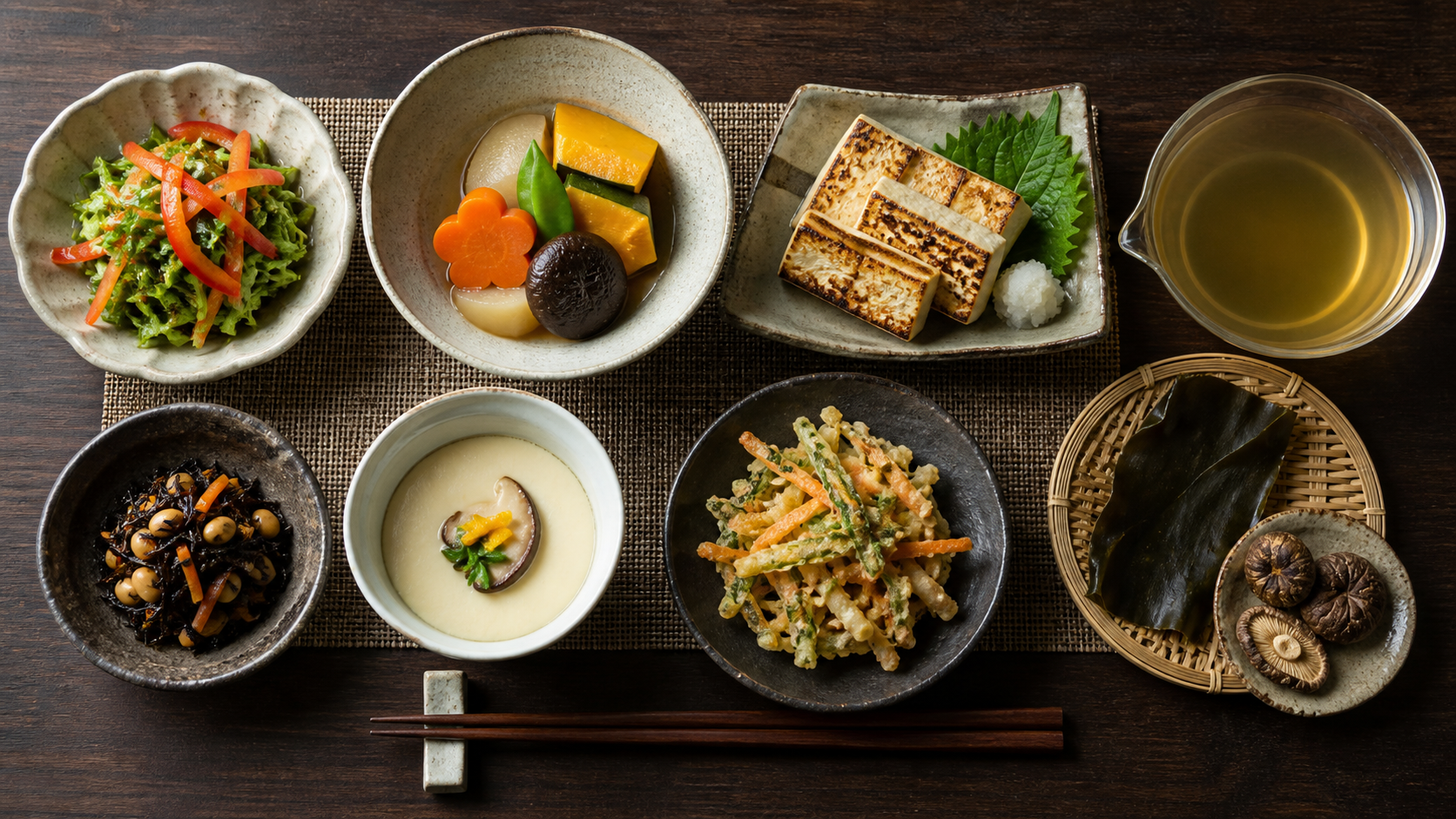
Information checked: August 26, 2026. Shojin ryori is Buddhist-derived cuisine shaped by non-violence, discipline and attention to ingredients. It is often plant-based, but a menu label alone is not a medical allergy guarantee or universal vegan certification. This cultural guide explains how flavour is built without animal stock and how to ask the right questions. For current Shigetsu prices and access, use our separate Tenryu-ji practical guide.
The word describes effort, not just prohibition
Shojin carries the sense of diligent practice or devotion. Buddhist cooks developed meals that avoid taking animal life and treat preparing, serving and eating food as part of training. The cuisine came to Japan with Buddhist teachings from China and was adapted to local grains, soy foods, vegetables, mountain plants and seaweed.
The guiding idea is not “remove meat and leave side dishes.” It is to use the whole ingredient carefully, reduce waste, notice season and balance nourishment. Temple traditions differ by sect, region and purpose, so there is no single national recipe that every shojin meal must follow.
Shojin ryori, vegetarian and vegan overlap—but are not identical labels
| Term | Usually means | What to verify in Japan |
|---|---|---|
| Shojin ryori | Buddhist-derived cuisine commonly avoiding animal products | Actual stock, seasoning, alcohol, pungent alliums and shared equipment |
| Vegetarian | No meat or fish, with definitions varying | Fish dashi, egg, dairy, gelatin and bonito garnish |
| Vegan | No animal-derived ingredients | Honey, fish stock, dairy/egg, shared equipment and restaurant’s definition |
| Gokun-free | Avoidance of pungent plants under a particular Buddhist interpretation | Garlic, onion, leek, chive and related plants; lists vary |
Kyoto’s official travel guide warns that some businesses described around vegetarian or shojin dining may use fish-based broth. A temple that explicitly states “no animal-derived ingredients” provides stronger evidence, but serious allergies still require direct confirmation.
Five tastes, five colors and five methods are a lens—not a rigid temple rule
Japan’s Ministry of Agriculture presents gomi, goshiki, goho as fundamentals of Japanese cuisine generally. The old article incorrectly listed “five methods” twice and replaced umami with a garbled word. The accurate framework is:
| Framework | Five elements | How it appears in shojin cuisine |
|---|---|---|
| Five tastes | Sweet, sour, salty, bitter, umami | Pumpkin sweetness, vinegar acidity, salt/miso, mountain-vegetable bitterness, kombu/shiitake umami |
| Five colors | Red, yellow, green/blue, white, black | Carrot, squash, greens, tofu/daikon, seaweed/black sesame/mushroom |
| Five methods | Cut/raw preparation, simmer, grill, steam, deep-fry | Dressed vegetables, nimono, grilled tofu, steamed dumpling, vegetable fritter |
A particular meal need not display all fifteen items. Use the framework to notice balance and technique, not to grade spiritual authenticity from a photograph.
Kombu and dried shiitake build depth without bonito
Dashi is the foundation of many Japanese dishes. Standard restaurant dashi often contains katsuobushi (dried bonito), so “vegetable dish” is not enough evidence. Plant-based shojin dashi can combine glutamate-rich kombu with guanylate-rich dried shiitake; soaking and gentle heating extract flavour without animal ingredients.
Miso and soy sauce add fermentation, salt and aroma; toasted sesame, walnuts, yuzu, sansho and charred surfaces add contrast. Soy sauce commonly contains wheat, and miso varieties can contain different grains, so plant-based does not mean gluten-free.
What may appear on the tray
| Dish or ingredient | Cultural/culinary role | Allergy note |
|---|---|---|
| Goma-dofu | Sesame paste set with kudzu; called tofu though usually not soybean tofu | Sesame |
| Yuba | Film lifted from heated soy milk, valued for delicate texture | Soy |
| Koya-dofu | Freeze-dried tofu that absorbs seasoned broth | Soy; broth must be checked |
| Fu | Wheat gluten used fresh, dried or grilled | Wheat/gluten |
| Nimono | Seasonal roots and vegetables simmered to hold dashi | Stock, soy and wheat |
| Shira-ae | Vegetables dressed with mashed tofu and sesame | Soy, sesame |
| Mountain plants | Bitterness and seasonality | Species-specific allergy; preparation varies |
| Rice and pickles | Staple and contrast; waste-conscious use of vegetables | Pickling liquid and cross-contact |
Choose by evidence and purpose, not by the word “temple”
| Experience | Good for | Check before booking |
|---|---|---|
| Temple-operated restaurant | Clear cultural setting and published courses | Garden admission, hours, reservation confirmation, seating |
| Shojin specialist restaurant | Focused cuisine without a temple visit | Whether all courses are animal-free; current address and prices |
| Shukubo temple stay | Meal connected to lodging and morning practice | Meal plan, alcohol rules, bath/toilet, curfew, language and access |
| Vegan restaurant | Clear modern dietary commitment | It may not teach Buddhist food culture; certification and cross-contact |
Reserve specialist and temple meals in advance. Record the exact address, nearest station/bus stop, lunch start, closed day, course price, extra admission, payment, cancellation and allergy response. A historical story is not a substitute for these travel facts.
Eat with attention, and communicate medical needs early
Arrive on time, wear clean socks where shoes are removed, keep voices low, and ask before photographing rooms or staff. Do not rearrange every bowl for social media. Eat at a comfortable pace, but avoid leaving food merely because unfamiliar vegetables look difficult; ask what they are.
For severe allergies, send the Japanese ingredient name before booking and ask whether cross-contact can be controlled. Soy, sesame and wheat are especially common. If the answer is vague, choose another venue with a documented allergy process. Religious or ethical requirements—vegan, halal, no alcohol, no gokun—should be listed separately instead of compressed into “vegetarian.”
Common myths and FAQ
Is all shojin ryori vegan?
Traditional temple cuisine is commonly animal-free, but restaurant usage and broth practices vary. Verify the actual establishment and course.
Does it always exclude onion and garlic?
Many Buddhist traditions avoid pungent plants, but the exact list and modern application vary. Ask if this matters to you.
Is it always healthy or low-calorie?
No. Frying, sesame paste, salt, sugar and large rice portions can be part of the meal. “Plant-based” is not a nutrition prescription.
Is it kaiseki?
No. Both can use seasonal multi-dish presentation, but their historical purposes differ. Shojin is rooted in Buddhist food practice; kaiseki has tea-ceremony and restaurant lineages.
Why can a simple vegetable taste deep?
Layered plant dashi, fermentation, drying, roasting and texture create depth. Absence of meat does not mean absence of technique.
Can children participate?
Often, but long quiet courses, floor seating and unfamiliar textures may be difficult. Confirm age, chair, children’s meal and cancellation policy.
Official references: Kyoto City Official Travel Guide: shojin and dietary needs / MAFF: five tastes, colors and methods / JNTO: temple stays and shojin meals / MAFF: Kyoto food culture