



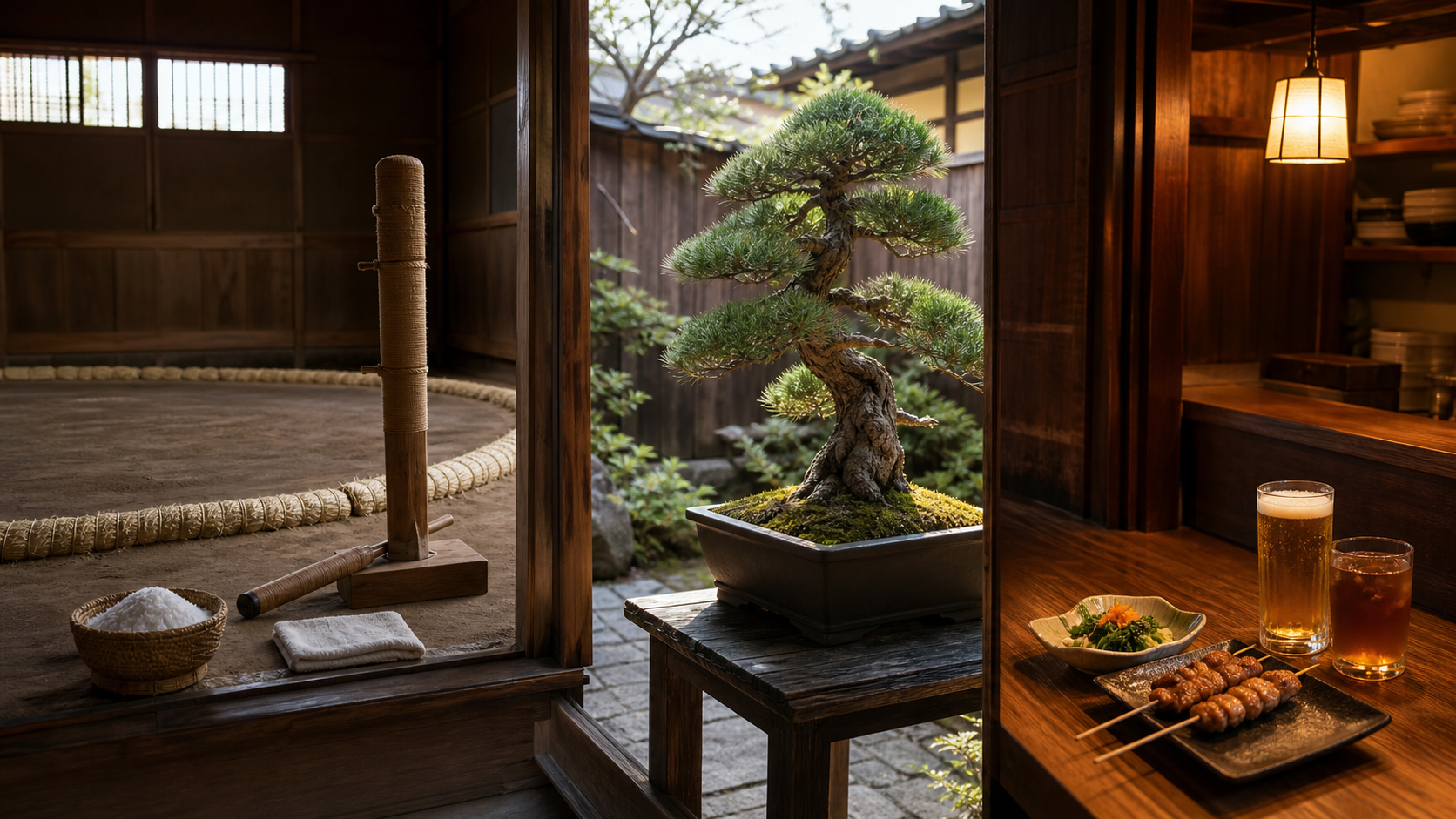
Information checked: August 26, 2026. The original version of this itinerary put bonsai first and sumo practice later, but stable training normally happens in the morning. A workable day starts with a pre-booked sumo visit in eastern Tokyo, continues to Shunkaen Bonsai Museum in Edogawa, and ends at an izakaya near your final station. This guide separates guaranteed bookings from optional stops and includes travel buffers, costs, etiquette and rainy-day alternatives.
Three cultures, one theme: disciplined repetition
Sumo, bonsai and izakaya may look unrelated. Their connection is daily practice. A wrestler repeats shiko, sliding footwork and thrusting drills; a bonsai grower makes small decisions over decades; an izakaya kitchen coordinates many small orders at speed. The route works best as observation rather than a checklist of “Japanese things.”
| Time | Plan | Status |
|---|---|---|
| 7:30–10:30 | Organized sumo stable visit in Ryogoku or another east-Tokyo district | Advance booking essential; exact stable and time vary |
| 10:30–12:00 | Travel and early lunch | Keep a 30-minute delay buffer |
| 13:00–15:30 | Shunkaen Bonsai Museum; workshop only if pre-booked | Closed Mondays except public holidays |
| 17:00 onward | Izakaya near Koiwa, Ryogoku or your hotel route | Reserve for groups or weekends |
Morning: training is not a tourist performance
GO TOKYO recommends watching stable practice through an organized tour. A sumo-beya is a training and living organization, not a museum with fixed walk-in hours. Practice can be cancelled or moved for tournaments, regional tours, injuries and stable schedules. Never arrive unannounced at a stable listed by the Japan Sumo Association.
Expect an early meeting, quiet observation and strict instructions. Lower-ranked wrestlers often train first, followed by senior wrestlers when present. Shiko is not just leg lifting: it builds balance, lower-body strength and control. The clay dohyo is treated as a purified work space; salt and ritual gestures connect modern sport to ceremonial tradition.
| Booking | Use a tour or a stable-authorized reservation; confirm meeting point, language, cancellation and whether training is guaranteed |
|---|---|
| Duration | Often 60–120 minutes, but the organizer’s schedule controls |
| Photography | Only when permitted; no flash, shutter sounds, moving seats or commercial use |
| Behaviour | Remain silent, do not eat, drink, stretch legs toward the dohyo or leave mid-session unless instructed |
Afternoon: Shunkaen Bonsai Museum
| Address | 1-29-16 Niihori, Edogawa City, Tokyo 132-0001 |
|---|---|
| Hours | 10:00–17:00; last entry 30 minutes before closing |
| Closed | Mondays (open if Monday is a public holiday), New Year holidays, and announced special closures including July 6–8 in the current GO TOKYO listing |
| Access | Use a local bus from JR Koiwa Station South Exit or Toei Shinjuku Line Mizue Station; the listed bus stop is about 1 minute on foot. Check a live route planner for the day’s bus |
| Workshop | GO TOKYO lists a guided bonsai workshop at ¥8,000 cash, including admission and materials; arrange in advance |
| Ordinary admission | Confirm the current museum-only fee directly; do not confuse it with the workshop price |
Bonsai is not simply a naturally tiny tree. Growers use pruning, wiring, repotting, watering and seasonal placement to express an old landscape in living material. Look at trunk taper, surface roots, empty space and the direction of branches. Do not touch foliage, wire, pots or moss, and never rotate a display without permission.
The realistic east-Tokyo route
Ryogoku and Shunkaen are both in eastern Tokyo but not next door. Allow roughly 60–90 minutes door to door once transfers, the local bus and a missed connection are included. Use the actual stable meeting point—not “Ryogoku” in general—as the route origin.
- Finish the booked sumo visit and use the restroom before leaving.
- Eat a light early lunch near Ryogoku or a transfer station; do not rely on a workshop to include food.
- Route toward JR Koiwa or Toei Mizue, then use the live bus result to the museum.
- Arrive at least two hours before closing if you want an unhurried garden visit.
- Afterward, choose dinner on the line back to your hotel instead of crossing Tokyo again.
Do not schedule this plan on a normal Monday. During January, May or September Tokyo tournaments, stable access may change; consider a tournament day at Ryogoku Kokugikan as a different full-day plan rather than squeezing it into this route.
Evening: choose an izakaya by logistics, not fame
An izakaya is a shared-dish drinking-and-dining format, not necessarily a bar that requires alcohol. Pick a clearly priced place near Koiwa, Ryogoku or your accommodation. After an early morning, a 60–90 minute dinner is more realistic than a distant “hidden gem.”
| Check before sitting | Why |
|---|---|
| Smoking / non-smoking | Policies and separated areas differ |
| Seat charge or otoshi | A small appetizer may form part of the cover charge |
| One-drink rule and time limit | A soft drink is normally acceptable; confirm the system |
| Last order | Food and drinks may have different cutoffs |
| Allergens | Dashi, sauces and shared fryers contain ingredients not visible |
Order two or three dishes first—such as grilled fish or yakitori, tofu, seasonal vegetables and rice—then add more. Say arukōru wa nomimasen if you do not drink alcohol. Japan prohibits drinking under age 20, and there is no obligation to match other guests drink for drink.
Budget and reservation checklist
| Item | Planning range |
|---|---|
| Sumo observation | Varies widely by authorized tour; check inclusions and refund terms |
| Local transport | Allow about ¥1,000–¥2,000 for rail and buses depending on origin and hotel |
| Bonsai workshop | ¥8,000 cash including materials and admission, per current GO TOKYO listing |
| Museum-only visit | Confirm current admission directly |
| Izakaya dinner | Roughly ¥2,500–¥5,000 per adult depending on drinks and cover charge |
Reserve the sumo component first because it determines the date and meeting point. Then verify that Shunkaen is open. Book the bonsai workshop only if the timing includes its full duration; otherwise choose museum observation. Finally reserve dinner only for a large group, Friday/Saturday evening or a specific non-smoking requirement.
Respect, clothing and accessibility
Wear quiet, modest clothing for stable observation and socks without holes if shoes must be removed. Avoid strong perfume. Follow the organizer on seating, phones and departure. Wrestlers are working; do not request photos, autographs or conversation unless invited.
At the bonsai museum, paths, thresholds and garden surfaces may be uneven. Contact the facility about wheelchair routes, seating and workshop adaptations. Summer heat and rain affect an outdoor garden, while the sumo visit may require floor sitting. Tell the tour operator about mobility needs before paying.
At the izakaya, keep bags out of aisles, ask before filming staff, share dishes with serving utensils where provided, and pay at the counter if directed. Tipping is not customary.
Fallback plans and FAQ
If sumo practice is unavailable
Use the official Japan Sumo Association calendar. A Tokyo tournament, a provincial tour or a publicly announced training event is a separate experience with its own tickets and schedule. In Ryogoku, build a museum-and-neighbourhood morning rather than visiting a stable uninvited.
If Shunkaen is closed
Do not substitute a florist and call it a museum. Keep the day in Ryogoku with the Sumida Hokusai Museum or another verified east-Tokyo cultural site, then plan bonsai on a different open day.
Can children join?
Age limits and the ability to sit quietly vary by sumo organizer and workshop. Confirm before booking; do not assume a family can enter because the museum itself admits visitors.
Can this be done with a Japan Rail Pass?
Only JR segments are potentially covered. Toei subway and local buses require separate valid fare unless another pass applies.
Is a chanko lunch required?
No. Chanko is a broad category of communal dishes eaten in stables, not one compulsory tourist meal. A light lunch makes the afternoon route easier.
Official references: GO TOKYO: Ryogoku / Japan Sumo Association: stable guide / GO TOKYO: Shunkaen workshop / Shunkaen official site