



Checked: August 26, 2026. Ukiyo-e did not simply “mirror Edo life.” It selected, advertised and reshaped what urban customers wanted to see: kabuki stars, famous courtesans, fashion, jokes, products, travel and scandal. This media-literacy guide helps you read actor prints and beauty images without mistaking publicity for neutral reality, then gives two practical Tokyo research stops.
Ukiyo-e was commercial popular media
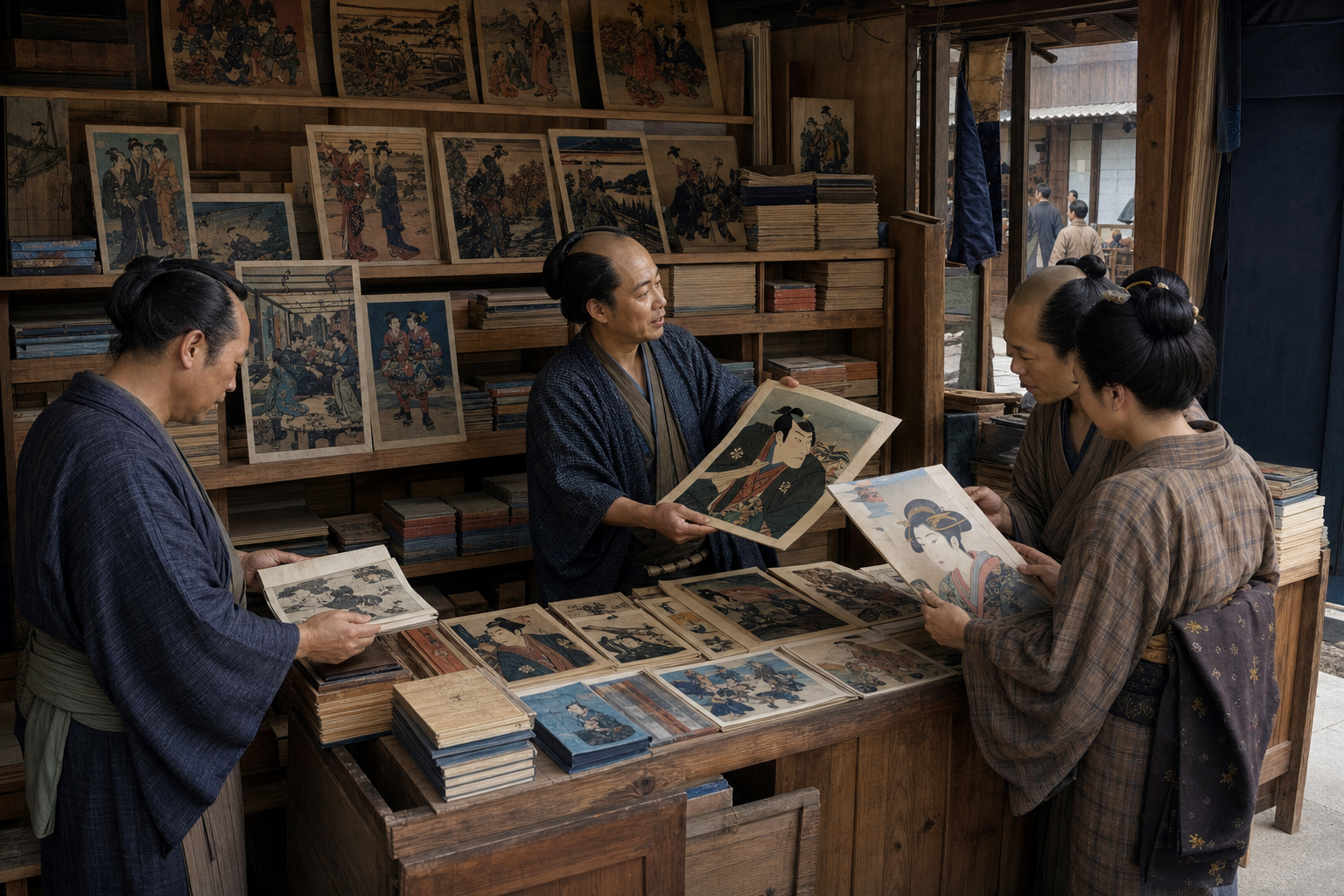
A publisher could commission a design, finance blocks and printing, and distribute impressions through shops. Subjects changed with urban demand. Many prints were affordable relative to unique paintings, but price and audience varied; “mass-produced” does not mean everyone owned every image. Ask who paid, who was being promoted, what event or fashion made the design timely, and what information the publisher expected customers to recognize.
Actor prints promoted both role and celebrity
Yakusha-e can show a named kabuki actor in a role, emphasizing a crest, facial expression, pose, costume or famous stage moment. Sharaku’s portraits are compelling partly because personality and performance overlap. Do not assume the depicted scene accurately reconstructs a stage set or costume on one date. Search the full museum record for actor, role, play, theatre, performance month, publisher and seals; a short modern caption may omit uncertainty.
Beauty images are constructed ideals, not a census of women
Bijin-ga represented courtesans, entertainers and women in everyday-looking settings, but idealized proportions, poses and fashions followed artistic and commercial conventions. The licensed pleasure quarters involved hierarchy, contracts, debt, labour and constrained lives. Calling every figure a “geisha,” “princess” or freely glamorous influencer erases those differences. Look for hairstyle, garment, setting, accompanying text and curatorial identification before naming status.
Clothes, shop signs and objects can work like product placement
| Visual clue | Media question |
|---|---|
| Actor crest or distinctive makeup | How would a fan identify the performer and role? |
| Textile pattern, hair ornament or cosmetic | Is it general fashion, a coded identity or a promoted commodity? |
| Restaurant, tea house or shop name | Is the place documented, fictionalized, sponsored or part of a series convention? |
| Publisher seal and price context | Who financed and distributed the image, and for which audience? |
| Repeated series border or title cartouche | How did serial branding encourage collecting? |
Visual presence does not automatically prove a paid advertisement. Use collection catalogues and scholarship before making a sponsorship claim.
Parody and quotation rewarded informed viewers
Prints could transpose a classical poem, famous tale or kabuki scene into contemporary clothing and pleasure-quarter settings. This mitate-like play depends on recognition: the joke exists between the source and the new image. If a scene looks puzzling, search the full title and series before declaring it “surreal.” A mirror, screen, letter or seasonal plant may structure a literary reference as well as decorate the composition.
What survives was also shaped by regulation
Edo publishing was not a completely free marketplace. Approval marks, bans, sumptuary rules and political pressure changed over time. Artists and publishers used substitution, historical settings and visual puns, but not every hidden-looking symbol is resistance. Identify the date and specific regulation before claiming censorship. Absence is also hard to interpret: marginalized work and ordinary lives may have left fewer commercially preserved images.
Tokyo National Museum: compare rotating originals and fashion
Address: 13-9 Ueno Park, Taito, Tokyo. Access: about 10 minutes from JR Ueno Park Exit or JR Uguisudani South Exit. Hours: 9:30–17:00, generally to 20:00 Fri/Sat and some holiday Sundays; last admission 30 minutes before closing. Admission: collection exhibition adult ¥1,000, university ¥500; under 18 and 70+ free with proof. Closed Mondays or the following weekday after a Monday holiday, year-end and specified maintenance days. Ukiyo-e in Honkan rotates frequently and is not guaranteed every day; check the weekly list and partial room closures. Suitcases are not allowed from August 2026. Official visit information
Waseda Theatre Museum: connect prints to performance history
Address: 1-6-1 Nishi-Waseda, Shinjuku, Tokyo. Access: about 7 minutes from Tokyo Metro Waseda Station, 5 minutes from Toden Waseda, or 2 minutes from the Sodai-seimon bus stop. Admission: free. Main exhibition rooms normally open 10:00–17:00, to 19:00 Tuesdays and Fridays, and open weekends; university closures and exhibition schedules vary. There is no visitor parking. Collections cover Japanese and international theatre, but specific actor prints are not guaranteed on view. Use current exhibition pages and the online database rather than treating it as a permanent ukiyo-e gallery. Official museum information
A ten-minute media-reading worksheet
| Minute | Action |
|---|---|
| 0–2 | Record title, series, artist, publisher, date, medium and collection. |
| 2–4 | Identify performer, role, social status or commodity only from evidence. |
| 4–6 | Trace gaze, cropping, text blocks, crests and repeated branding. |
| 6–8 | Ask what the idealized image promotes and what labour or constraint it omits. |
| 8–10 | Compare one second impression or related work; write one uncertainty. |
Acknowledging uncertainty is stronger than inventing a neat story. Museum databases may revise titles, identities and dates as research develops.
Enjoy the image without turning people into stereotypes
A kabuki print is not permission to imitate sacred or gendered performance traditions carelessly; a beauty print is not evidence that all Edo women dressed or lived that way. Avoid using “geisha” for every woman, sexualizing unidentified figures, or presenting the pleasure quarters as consequence-free luxury. In galleries, follow image-specific photography rules and do not photograph visitors. When reusing digital images, follow the collection’s licence and credit requirements—public-domain artwork and museum scan can have different conditions.
Ukiyo-e is a mirror with an editor, advertiser and customer standing behind it. Reading those forces does not diminish its beauty; it reveals how sophisticated Edo visual culture was.