



Checked: August 26, 2026. Ukiyo-e is not one fixed style and not only Hokusai’s Great Wave. It grew as painting and commercial print culture in Edo-period cities, covering actors, fashion, famous places, travel, warriors, ghosts and ordinary life. This guide shows you how to read one print, understand the artist–carver–printer–publisher team, visit two useful Tokyo facilities and buy a clearly described souvenir.
Ukiyo-e was urban popular media, not a single “traditional look”
Many woodblock prints could circulate in multiple impressions, bringing kabuki stars, courtesans, landscapes, fashions and news-like subjects to paying customers. The “floating world” referred especially to changing urban pleasure and fashion. Ukiyo-e also includes hand-painted works. It reflects commercial choices and censorship as well as artistic invention, so one print is evidence of a social system—not a transparent photograph of all Edo life.
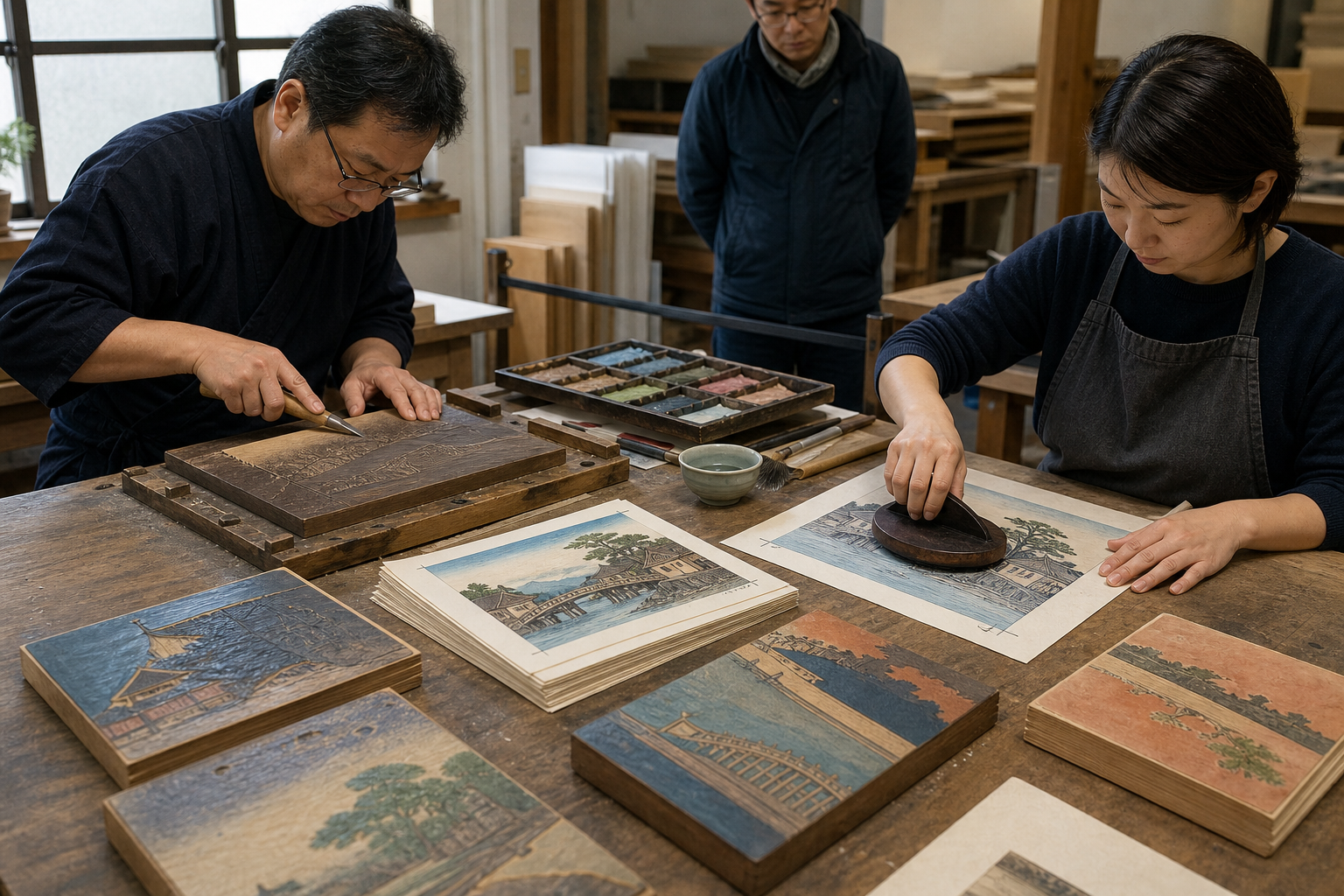
One print joined four kinds of skilled work
| Role | Contribution |
|---|---|
| Eshi, artist | Designed figures, composition and colour instructions. |
| Horishi, carver | Cut the key block and colour blocks, preserving extremely fine lines. |
| Surishi, printer | Applied water-based pigments and pressed handmade washi with a baren, one colour at a time. |
| Hanmoto, publisher | Commissioned, financed, coordinated, marketed and distributed the edition. |
The Adachi Foundation notes the use of mountain-cherry blocks, handmade washi and water-based pigments. Registration marks helped align successive colours. Do not call the artist the sole “maker” when labels also name publisher, carver or printer.
Original impression, later printing and reproduction are different claims
- Hand painting: drawn directly on paper or silk; usually a unique object.
- Edo-period woodblock impression: printed from a historical set of blocks; edition, state, trimming, fading and repair affect study and value.
- Later impression: printed later from surviving or recut blocks; “original design” does not necessarily mean first printing.
- Traditional modern reproduction: newly carved and hand-printed with traditional materials; valuable for understanding craft, but not an Edo original.
- Mechanical reproduction: poster, postcard or inkjet image; a legitimate souvenir when labelled and priced honestly.
Read a print through subject, sightline, colour, marks and condition
- Subject: actor print, beauty, famous place, warrior, satire or supernatural story?
- Sightline: how do roads, roofs, waves and gestures lead your eye?
- Colour: look closely for boundaries between separately printed layers and effects such as gradation.
- Marks: artist signature, publisher seal and censorship/date marks may sit at the edge; begin with the museum label.
- Condition: fading, cropping, folds and repair can reveal an object’s history, not just “damage.”
Compare different impressions when possible. Screen colour, later printing and light exposure can make the same design look surprisingly different.
Ota Memorial Museum: see rotating original works in Harajuku
Address: 1-10-10 Jingumae, Shibuya, Tokyo. Access: about 5 minutes from JR Harajuku Station Omotesando Exit or 3 minutes from Meiji-jingumae Station Exit 5. The specialist collection holds about 12,000 works and changes displays roughly monthly; there is no permanent display of one famous print. Standard hours are 10:30–17:30, last entry 17:00, with exhibition-change and other closing days. Admission varies by exhibition. The museum says ordinary individual reservation is generally unnecessary, groups of 10+ should contact it, and ticket/shop payment is currently cash only. There is no lift; wheelchair users can visit the ground floor only. Check the official calendar and visitor information.
Adachi showroom: understand how the image is printed
Address: 3-13-17 Shimoochiai, Shinjuku, Tokyo. Access: about 10 minutes from JR Mejiro Station or 3 minutes from the Shimo-ochiai 3-chome bus stop. The free permanent showroom presents tools, materials, stages of production, supervised reproductions and contemporary prints. Standard hours are weekdays 10:00–18:00 and Saturdays 10:00–17:00; closed Sundays, Mondays, national holidays and year-end holidays. One parking space is listed, so public transport is safer. Demonstrations are separate events: 2026 sessions require advance application, use a lottery, have limited capacity and Japanese commentary. Check the official showroom page and event schedule.
A practical Tokyo half day
| Time | Plan |
|---|---|
| 10:30–12:00 | Ota Museum: choose three prints and compare subject, registration and condition. |
| 12:00–13:00 | Lunch near Harajuku; do not assume museum re-entry. |
| 13:00–14:00 | JR Yamanote Line to Mejiro plus walk; allow weather buffer. |
| 14:00–15:00 | Adachi showroom: follow design, carving and printing in sequence. |
| After 15:00 | Buy a catalogue or clearly labelled reproduction; record maker and date. |
Do not run this route on Sunday or Monday because Adachi is normally closed; Ota also closes between exhibitions. Choose one facility if access, fatigue or the current calendar makes two unrealistic.
Low light and changing exhibits protect the works
Ukiyo-e is light-sensitive, so dim galleries and rotations are conservation measures. A famous design seen online may not be on view. Follow room- and object-specific photography signs; permission in one area does not cover another. No flash, tripods, touching cases or leaning close with bags. Keep conversation and audio quiet. Ask about lockers, step-free routes and toilets before arrival rather than assuming a small specialist museum has full access.
Ask four questions before buying
- Is it an Edo-period impression, a later impression, a traditionally made modern reproduction or a mechanical copy?
- Was it carved and hand-printed colour by colour?
- Who produced it, on what paper and with what pigments?
- Does it include title, artist, publisher/producer, condition, provenance and return terms?
“Authentic,” “original” and “handmade” are incomplete without a precise noun. High-value historical prints require specialist examination of edition, state, fading, trimming and repair; a photograph cannot authenticate them. For a first purchase, a museum catalogue, postcard or clearly documented modern woodblock reproduction is easier to understand and transport.
An old artwork does not make every digital image free to reuse
The underlying work, museum photograph, scan, database and website terms can have different legal or contractual conditions. Check the institution’s image-use page before copying a web image into a blog, video, product or AI dataset, and request permission where required. Record creator, title, date, collection, image source and licence. The same respect applies in galleries: owning a ticket or souvenir does not grant publication or commercial-use rights.
Ukiyo-e becomes richer when you stop hunting only for famous icons. Read the print as a collaboration among design, carving, printing and publishing, then connect its subject to the urban lives and travel culture of its time.