



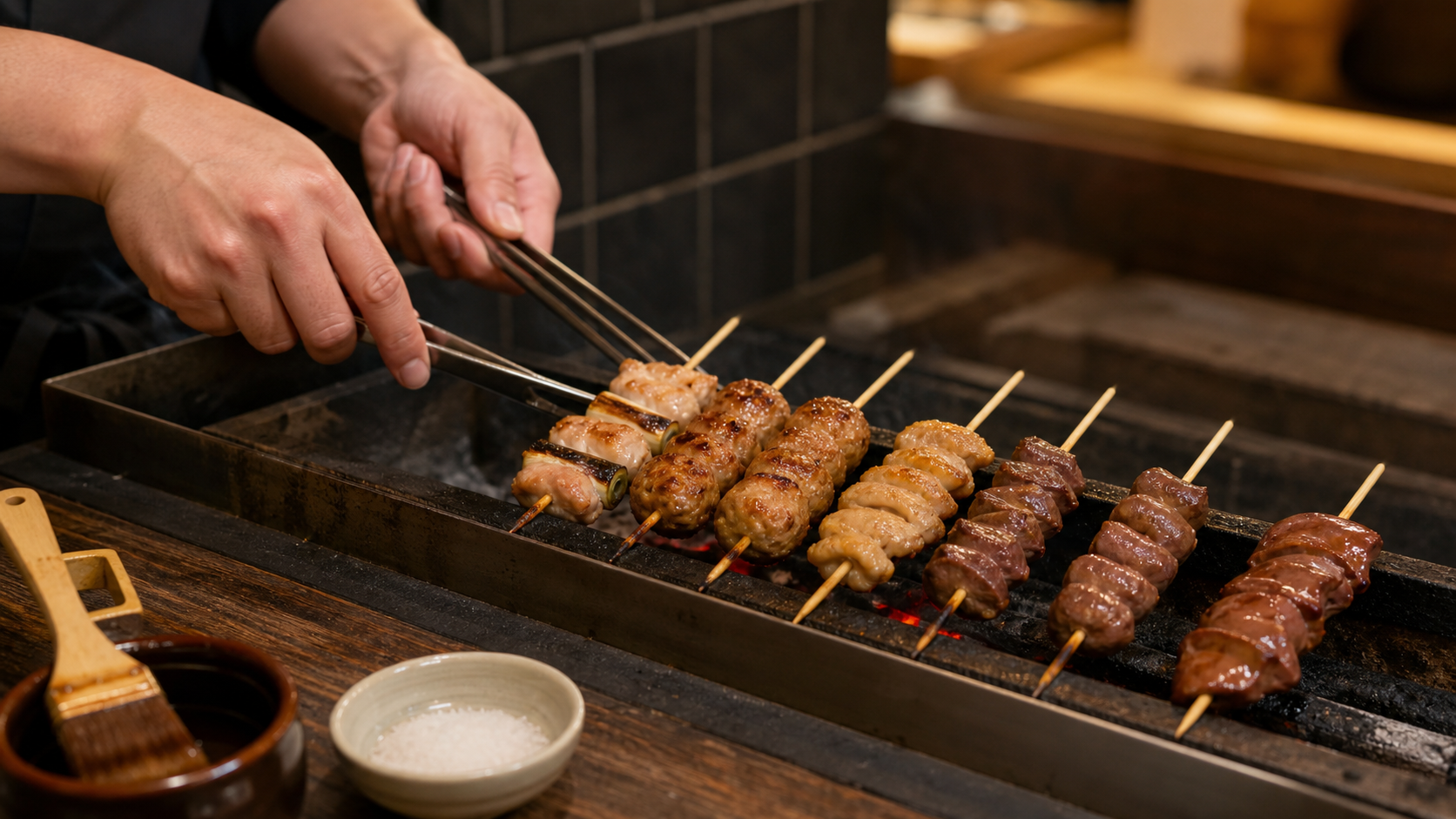
Information checked: August 26, 2026. Yakitori is chicken grilled on skewers—not a synonym for every Japanese skewer. Its depth comes from using different parts of one bird, matching each to salt or tare, and controlling distance, rotation and resting over the fire. This guide helps you read a yakitori menu, build an order from mild to rich, understand price units, request fully cooked chicken and manage allergies without assuming beer is required.
Yakitori is the chicken branch of kushiyaki
Kushiyaki broadly means grilled skewers; yakitori focuses on chicken. A shop may also sell vegetables, pork yakiton or other skewers, but those items do not become chicken because they share a grill. Kushikatsu is breaded and deep-fried, so it is a different Osaka tradition.
The Ministry of Agriculture describes yakitori as a popular food that makes use of meat, skin, organs, cartilage and other parts. This “whole-bird” approach is not automatically zero-waste, but it reflects respect for varied textures rather than treating chicken as one uniform fillet.
A practical chicken-cut glossary
| Japanese | Part / texture | Good first seasoning |
|---|---|---|
| Momo | Thigh; juicy, substantial | Shio or tare |
| Negima | Chicken pieces alternating with long onion | Either |
| Tsukune | Seasoned minced-chicken meatball | Tare; egg dip may be offered |
| Seseri | Neck; springy and savoury | Shio |
| Kawa | Skin; fatty, soft or crisp by shop style | Shio or tare |
| Sunagimo | Gizzard; crisp, lean bite | Shio |
| Hatsu | Heart; firm but tender | Shio or tare |
| Rebā | Liver; rich, soft when fully cooked | Tare |
| Nankotsu | Cartilage; crunchy | Shio |
| Bonjiri | Tail; very juicy and fatty | Shio |
| Tebasaki | Wing tip; skin, meat and bone | Shio |
| Sasami | Tenderloin; lean | Shio; request fully cooked |
Names and butchery differ by region and shop. Rare parts can sell out because each bird yields little. Ask rather than assuming the English translation matches the exact cut.
Shio and tare are not a quality ranking
Shio is salt seasoning; tare is typically a soy-based sweet-savoury glaze. Salt makes the cut and smoke easier to compare, while tare complements fatty skin, liver and meatballs. Neither is inherently more authentic. A chef-selected course may choose for you.
| Ask | Meaning |
|---|---|
| Shio to tare, dochira ga osusume desu ka? | Which do you recommend, salt or tare? |
| Omakase de gohon onegai shimasu. | Five chef-selected skewers, please. |
| Karai chōmiryō wa arimasu ka? | Is there a spicy condiment? |
Condiments may include shichimi, sansho, yuzu kosho or mustard. Try a bite before adding them; strong seasoning can hide the cook’s intended balance.
The grill is managed in zones
Charcoal can add aroma, but the craft is not the word “binchotan” on a sign. The cook adjusts skewer height, heat zone, rotation, airflow, salt timing, tare layers and resting. Skin needs fat rendering; lean breast needs protection from drying; meatballs and organs require their own timing.
Counter seats reveal this work, but do not reach over the counter or film continuously. Dramatic flames usually mean dripping fat has ignited; controlled heat and frequent small movements matter more than spectacle.
Order from mild to rich
- Start with two familiar pieces: negima and momo or sasami.
- Add one textural cut: sunagimo, seseri or nankotsu.
- Try tsukune, kawa or liver later because flavours are richer.
- Add a vegetable, grated daikon, pickles or salad for contrast.
- Finish with rice, chicken soup or soboro rice if offered.
Order three to five skewers first, then add more. Confirm whether a menu price is for one skewer, two skewers or a set. Omakase means selection by the cook; it does not automatically mean unlimited food or a fixed luxury course. Tell the shop about disliked or unsafe cuts before ordering.
From standing counters to reservation courses
| Format | Planning budget | What to check |
|---|---|---|
| Casual chain / standing shop | About ¥2,000–¥4,000 | Per-skewer unit, cover, smoking |
| Neighbourhood specialist | About ¥3,500–¥7,000 | Minimum order, drinks, reservation |
| Chef-led course | Often ¥7,000 and above | Course length, cancellation fee, additions |
These are planning ranges, not posted prices. Old fixed-price claims about chains become inaccurate quickly. Check the branch’s current tax-inclusive menu. A seat charge or otoshi can apply; alcohol is never culturally compulsory.
Chicken must be cooked through
Japan’s Ministry of Health warns that Campylobacter food poisoning is frequently linked to raw or undercooked chicken; “fresh” is not proof of safety. Ask yoku yakete kudasai (please cook it thoroughly). This is especially important for sasami and liver. A pink-looking centre should be raised with staff rather than treated as a prestige style.
Tare commonly contains soy and wheat; tsukune may contain egg; side sauces can contain sesame, dairy or alcohol. Shared grills, brushes and utensils create cross-contact. Use the Consumer Affairs Agency allergy sheet and ask about both the skewer and seasoning. A vegetable skewer cooked on the same grill is not automatically vegan or halal.
Counter etiquette and FAQ
Arrive on time, avoid strong perfume, keep bags out of aisles and photograph only with permission. Eat skewers while hot, place used sticks where directed and do not wave them across the counter. Tipping is not customary.
Do I pull all pieces off the skewer?
Eating from the skewer is normal. For sharing, use a clean utensil rather than communal biting.
Must yakitori use charcoal?
No legal definition requires charcoal. Gas and electric grills can produce good results; technique and ingredient handling matter.
Is every yakitori shop non-smoking?
No. Confirm the whole venue’s policy, especially in small establishments permitted under specific rules.
Can children eat there?
It depends on seating, smoke policy, course rules and opening hours. Ask the specific shop.
What is the best first set?
Negima, momo, sunagimo, tsukune and one vegetable offer a useful progression without requiring rare organs.
Official references: MAFF: yakitori cuts / MAFF: grilled chicken / MHLW: Campylobacter Q&A / Consumer Affairs Agency allergy sheet