

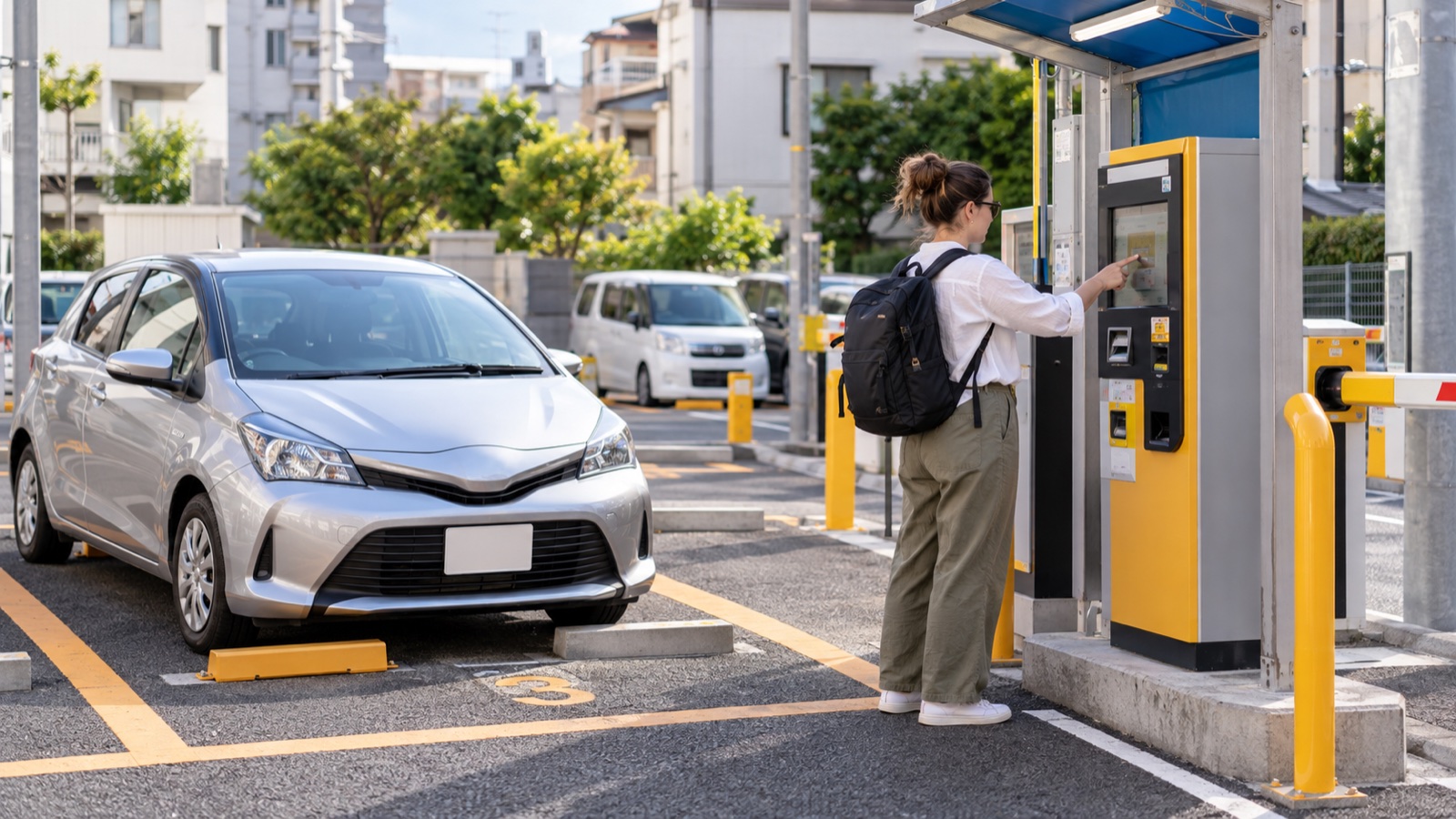
Japan’s coin parking lots are convenient, but the price board can be harder to understand than the payment machine. “Maximum fee” may apply only for a set period, until midnight, or only during daytime hours. This guide explains how to choose a lot, park, pay and avoid an expensive surprise.
Before entering: read the entire price board
- Base rate: a charge for each stated block of minutes.
- Maximum fee: a cap with conditions, not always a 24-hour flat rate.
- Time band: daytime and overnight prices may differ.
- Days: weekday, weekend and event-day rules can be different.
- Vehicle limits: check height, width, length and weight before entering.
- Payment: never assume every machine accepts cards or large banknotes.
Three common parking systems
Wheel-lock or flap system
Park fully inside the marked bay. A plate may rise beneath the vehicle after a short delay. At departure, enter the bay number, verify the displayed vehicle or time, pay, and confirm the plate is fully down before moving.
Gate and ticket system
Take a ticket at entry and keep it safe. At exit, insert the ticket and pay, or use a pre-payment machine when signs instruct you to do so. Do not follow another car through the gate.
Camera or license-plate system
There may be no ticket or lock plate. At the machine, enter part or all of the plate number and select the correct vehicle image. Payment requirements vary, so follow that lot’s instructions.
How maximum fees work
Times, a major parking operator, describes three common caps: a maximum for a fixed number of hours after entry, a cap within a named time band, and a cap valid only until midnight. These produce very different totals. Also check whether the cap repeats; never infer repetition from the word “maximum” alone.
Example: “maximum until 24:00” can reset when the date changes, even if you arrived late at night. “Night maximum” may cover only the displayed overnight hours, after which daytime charging starts.
Step-by-step payment
- Photograph the rate board and your bay number after parking.
- At departure, enter the bay or plate number, or insert the ticket.
- Confirm that the displayed parking start time and amount look plausible.
- Apply a shop or hotel validation coupon before paying when applicable.
- Pay with an accepted method and take the receipt.
- Check that the lock plate or barrier has released, then leave within the stated grace period.
Payment and cash precautions
Some lots accept credit cards, electronic money or QR payment; others accept only specific coins and notes. Times explicitly notes that payment methods vary by facility. Carry smaller cash and check the operator’s current lot page before relying on cashless payment.
If the machine or lock plate does not work
Do not drive over a raised plate or force a barrier. Call the support number printed on the machine, note the lot name and bay number, and use a translation app if necessary. If you selected the wrong bay, stop before paying and contact support. Keep any receipt or “deposit slip” produced by a faulty machine.
Rental-car checklist
- Check the car’s exact height, especially with roof boxes.
- Photograph the parked car and bay before leaving.
- Do not leave the parking ticket in direct sunlight on the dashboard if it can fade or warp.
- Return before the rental deadline; parking congestion is not normally an excuse for late return.
- Never park on the street unless signs clearly permit it. JNTO warns that penalties may apply outside designated spaces.
Useful Japanese terms
- 空 (aki): spaces available.
- 満 (man): full.
- 最大料金 (saidai ryōkin): maximum fee.
- 繰り返し適用 (kurikaeshi tekiyō): repeated application.
- 車室番号 (shashitsu bangō): parking-space number.
- 精算 (seisan): payment/settlement.
FAQ
Does “coin parking” mean coins only?
No. It is a general term for short-term paid parking; accepted payment depends on the facility.
Can I leave a car for several days?
Not without checking the terms. Many operators set a maximum continuous stay or require advance contact.
What if the lot is full?
Continue to another legal facility. Never wait where you block traffic, pedestrians or the lot entrance.
Related guides
Sources checked October 31, 2026: JNTO car-rental guidance, Times hourly-parking instructions, Times maximum-fee explanation, and Times payment-method guidance. Rates and equipment vary by lot; the on-site terms control.