
- 中文
- English
- 한국어
日本的七夕(たなばた / Tanabata)是每年7月7日举行的夏季传统节日,充满浪漫与祈愿的色彩。源自中国牛郎织女的传说,在日本奈良时代传入后,与日本本土的「棚机(たなばた)」神事相结合,发展出独一无二的日本七夕文化。
织女与牛郎的传说
七夕的故事源于织女星(Vega,天琴座最亮的星)和牛郎星(Altair,天鹰座最亮的星)的爱情传说。织女是天帝的女儿,擅长织布;牛郎是勤劳的放牛青年。两人结婚后沉迷于爱情,荒废了各自的工作。天帝大怒,用银河将二人隔开,只允许他们每年农历七月初七相会一次。据说如果七夕当天下雨,河水上涨二人无法相见,那雨水便是织女的眼泪。
在短册上写下心愿
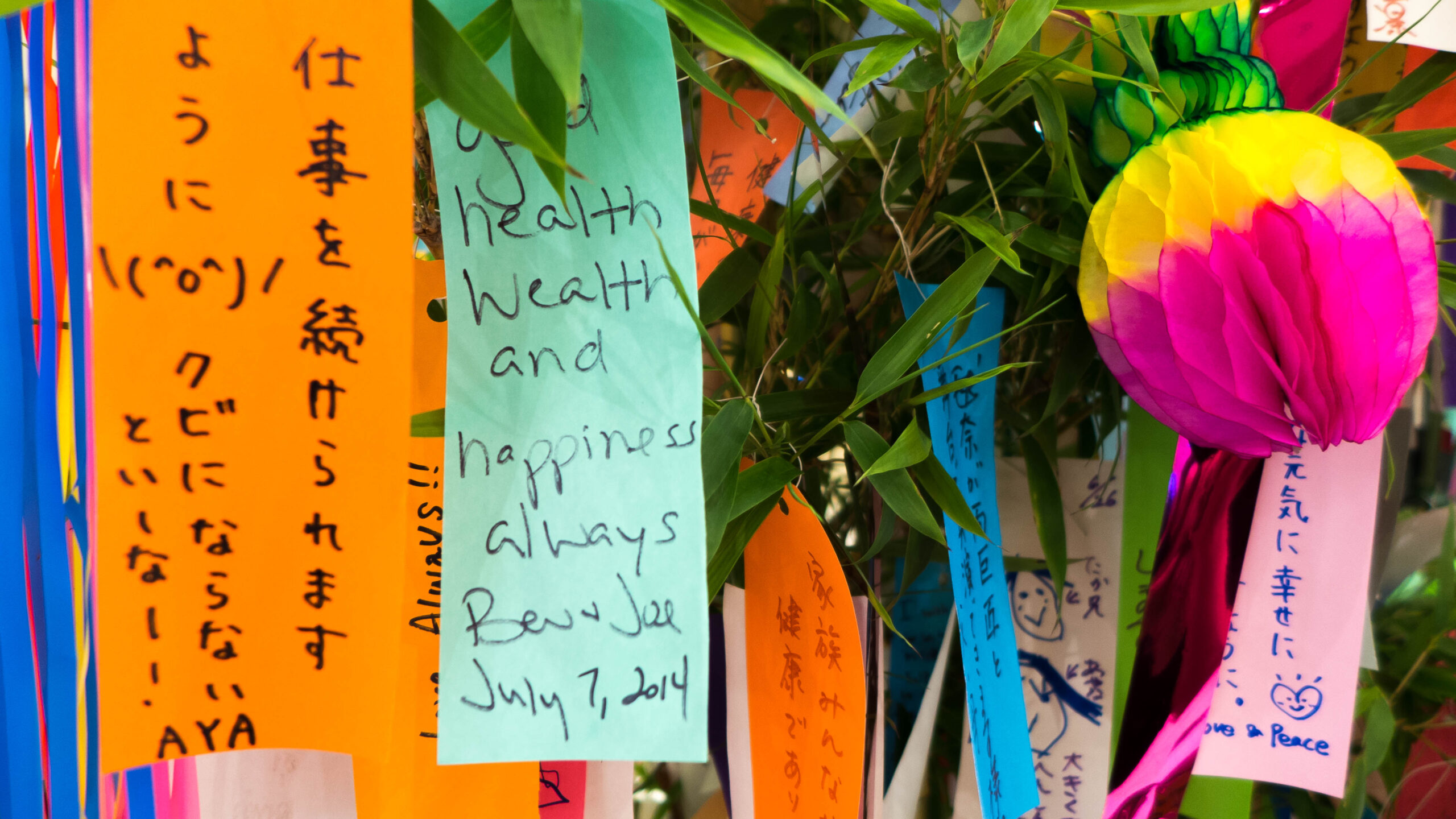
日本七夕最具代表性的习俗,就是在五色短册(长条彩纸)上写下心愿,挂在竹枝上装饰。五种颜色(青、红、黄、白、黑)源自中国阴阳五行学说,分别代表「仁、礼、信、义、智」。到了江户时代,这一习俗在普通百姓中普及,人们以此祈求书法和学问的进步。如今,人们会在短册上写下「考试合格」「恋爱成就」「家人健康」等各种各样的愿望。竹子笔直向上生长,被视为能将心愿传递到天上的媒介。
七夕装饰的讲究
除了短册,七夕装饰还包括纸衣(象征织女的织线和裁缝技艺的精进)、折纸鹤(祈求长寿)、投网(祈求渔业丰收)、纸钱(祈求商业繁荣)、灯笼(照亮心愿)和流苏(象征织女的丝线)。这些装饰统称为「七夕饰り」,每一样都有独特的寓意。
日本三大七夕祭典
仙台七夕祭(宫城县·8月6日~8日)是日本规模最大的七夕庆典。商店街上装饰着高达5米的巨型竹饰,色彩斑斓的七饰在风中摇曳,每年吸引约200万游客。
湘南平塚七夕祭(神奈川县·7月初)是关东最大级别的七夕祭,整条商店街挂满华丽的吹流装饰,还有数百个美食摊位和传统表演。
安城七夕祭(爱知县·8月初)以「愿望」为主题,市内各处设有专门的许愿地点,活动形式独特有趣。
七夕的现代过法
在现代日本,七夕是学校和幼儿园里孩子们写短册、装饰竹枝的重要活动。超市和商场也会在七夕前后设置大型七夕装饰。家庭中还有吃素面(そうめん)的传统,据说源自中国「索饼」的食用习惯,寓意驱除病魔、健康长寿。
七夕之夜,如果天气晴朗,不妨抬头寻找天上的银河。织女星(Vega)和牛郎星(Altair)在远离城市灯光的地方用肉眼就能清楚看到。如果你正在日本旅行,不妨找一株七夕竹,写下你的愿望,感受这份独特的日本夏日风情。
Japan’s Tanabata (たなばた/Tanabata) is a traditional summer festival held on July 7 every year, full of romance and prayer.Originating from the Chinese legend of the Cowherd and the Weaver Girl, after being introduced to Japan in the Nara period, it was combined with the Japanese native “Tanaki (たなばた)” myth to develop a unique Japanese Tanabata culture.
The Legend of the Weaver Girl and the Cowherd
The story of Chinese Valentine’s Day originates from the love legend between Vega (the brightest star in Lyra) and Altair (the brightest star in Aquila).The Weaver Girl is the daughter of the Emperor of Heaven and is good at weaving; the Cowherd is a hard-working young man herding cattle.After getting married, the two became obsessed with love and neglected their respective jobs.The Emperor of Heaven was furious and separated the two people with the Milky Way, allowing them to meet only once a year on the seventh day of the seventh lunar month.It is said that if it rains on Chinese Valentine’s Day and the river rises and the two are unable to see each other, the rain will be the tears of the Weaver Girl.
Write down your wishes in the short book
The most representative custom of Japan’s Tanabata is to write down your wishes on a five-color short book (long strip of colored paper) and hang it on a bamboo branch for decoration.The five colors (green, red, yellow, white, and black) are derived from the Chinese theory of Yin and Yang and the Five Elements, which respectively represent “benevolence, propriety, faith, righteousness, and wisdom.”By the Edo period, this custom became popular among ordinary people, and people used it to pray for the advancement of calligraphy and learning.Nowadays, people write down various wishes in short books such as “passing the exam”, “success in love”, and “health of the family”.Bamboo grows straight upward and is regarded as a medium that can convey wishes to the sky.
The specialties of Chinese Valentine’s Day decoration
In addition to short books, Chinese Valentine’s Day decorations also include paper clothes (symbolizing the Weaver Girl’s weaving thread and improvement in tailoring skills), origami cranes (to pray for longevity), cast nets (to pray for a good fishery harvest), paper money (to pray for business prosperity), lanterns (to illuminate wishes), and tassels (to symbolize the Weaver Girl’s silk thread).These decorations are collectively called “Tanabata decorations”, and each one has a unique meaning.
Three major Tanabata festivals in Japan
Sendai Tanabata Festival (Miyagi Prefecture, August 6th to 8th) is the largest Tanabata festival in Japan.The shopping street is decorated with giant bamboo ornaments that are 5 meters high. The seven colorful ornaments sway in the wind, attracting about 2 million tourists every year. Shonan Hiratsuka Tanabata Festival (Kanagawa Prefecture, early July) is the largest Tanabata festival in Kanto. The entire shopping street is decorated with gorgeous blowing decorations, and there are hundreds of food stalls and traditional performances. Anjo Tanabata Festival (Aichi Prefecture, early August) has the theme of “wishes”. There are special wish-making locations throughout the city, and the event format is unique and interesting.Modern ways to celebrate Chinese Valentine’s Day
In modern Japan, Tanabata is an important event in schools and kindergartens where children write short books and decorate bamboo branches.Supermarkets and shopping malls will also set up large-scale Chinese Valentine’s Day decorations around the Chinese Valentine’s Day.There is also a tradition of eating vegetarian noodles (そうめん) in the family. It is said that it comes from the Chinese eating habit of “suobing”, which means to ward off diseases and achieve health and longevity.
On the night of Chinese Valentine’s Day, if the weather is clear, you might as well look up and look for the Milky Way in the sky.Vega and Altair are clearly visible to the naked eye far away from city lights.If you are traveling in Japan, you might as well find a Tanabata bamboo, write down your wishes, and feel this unique Japanese summer style.
일본의 칠석(たなばた/칠석)은 매년 7월 7일에 열리는 전통 여름 축제로 낭만과 기도가 가득합니다.중국의 견우와 직녀 전설에서 출발하여 나라 시대에 일본에 전래된 후 일본 고유의 ‘다나키(타나바타)’ 신화와 결합하여 일본 고유의 칠석 문화를 발전시켰습니다.
직공 소녀와 견우의 전설
중국 발렌타인데이 이야기는 베가(거문고자리의 가장 밝은 별)와 알타이르(독수리자리의 가장 밝은 별) 사이의 사랑 전설에서 유래합니다.베틀 소녀는 천제의 딸로 베를 짜는 데 능숙하다. Cowherd는 소떼를 몰고 열심히 일하는 청년입니다.결혼 후 두 사람은 사랑에 집착하며 각자의 일을 소홀히 했다.천황은 노하여 두 사람을 은하수로 갈라놓고 1년에 한 번 음력 칠월칠일에만 만날 수 있도록 허락하였다.중국 밸런타인데이에 비가 내려 강물이 차올라 두 사람이 서로를 볼 수 없게 된다면 그 비가 직녀의 눈물이 될 것이라고 한다.
짧은 책에 소원을 적어보세요
일본 칠석의 가장 대표적인 풍습은 오색의 짧은 책(긴 색종이)에 소원을 적어 대나무 가지에 걸어 장식하는 것입니다.오방색(녹, 적, 황, 백, 흑)은 중국의 음양오행설에서 유래한 것으로 각각 ‘인(仁), 예(禮), 신의(信), 의(信), 지혜(智)’를 상징한다.에도 시대에는 이 풍습이 서민들 사이에서 유행하여 서예와 학문의 발전을 기원하는 데 사용되었습니다.요즘 사람들은 짧은 책에 ‘시험 합격’, ‘연애 성공’, ‘가정의 건강’ 등 다양한 소원을 적는다.대나무는 곧게 자라서 하늘에 소원을 전하는 매개체로 여겨진다.
중국 발렌타인 데이 장식의 특징
짧은 책 외에도 중국 발렌타인 데이 장식에는 종이옷(직녀의 실 짜기와 재봉 기술 향상을 상징), 종이학(장수를 기원함), 그물(풍년을 기원함), 지폐(장사 번영을 기원함), 등불(소원을 비춰준다), 술(직녀의 명주실을 상징함) 등도 포함됩니다.이러한 장식을 통칭하여 “칠석 장식”이라고 하며 각각 고유한 의미를 가지고 있습니다.
일본 3대 칠석축제
센다이 칠석 축제(미야기현, 8월 6일~8일)는 일본 최대 규모의 칠석 축제입니다.상점가는 높이 5m에 달하는 거대한 대나무 장식품으로 장식되어 있습니다. 일곱 개의 화려한 장식이 바람에 흔들리며 매년 약 200만 명의 관광객을 끌어 모으고 있습니다. 쇼난 히라츠카 다나바타 축제(가나가와현, 7월 초)는 간토 최대의 칠석 축제입니다. 상점가 전체가 화려한 불 장식으로 장식되어 있으며, 수백 개의 음식 노점과 전통 공연이 펼쳐집니다. 안조 칠석 축제(아이치현, 8월 초)는 ‘소원’을 주제로 합니다. 도시 곳곳에는 특별한 소원을 빌 수 있는 장소가 있으며, 행사 형식도 독특하고 흥미롭습니다.중국 발렌타인데이를 현대적으로 축하하는 방법
현대 일본에서 칠석은 학교나 유치원에서 어린이들이 짧은 책을 쓰고 대나무 가지를 장식하는 중요한 행사입니다.슈퍼마켓과 쇼핑몰에도 중국 발렌타인데이를 전후해 대규모 중국 발렌타인데이 장식이 설치될 예정이다.가족끼리 채식 국수(そуめん)를 먹는 전통도 있습니다. 질병을 예방하고 건강과 장수를 이룬다는 뜻의 중국 식습관 ‘수오빙’에서 유래했다고 합니다.
중국 발렌타인데이 밤, 날씨가 맑으면 하늘에 떠 있는 은하수를 올려다보는 것도 좋을 것 같습니다.베가와 알테어는 도시의 불빛에서 멀리 떨어진 곳에서도 육안으로 선명하게 보입니다.일본을 여행한다면 칠석 대나무를 찾아 소원을 적어보며 일본 특유의 여름 스타일을 느껴보는 것도 좋을 것 같습니다.