



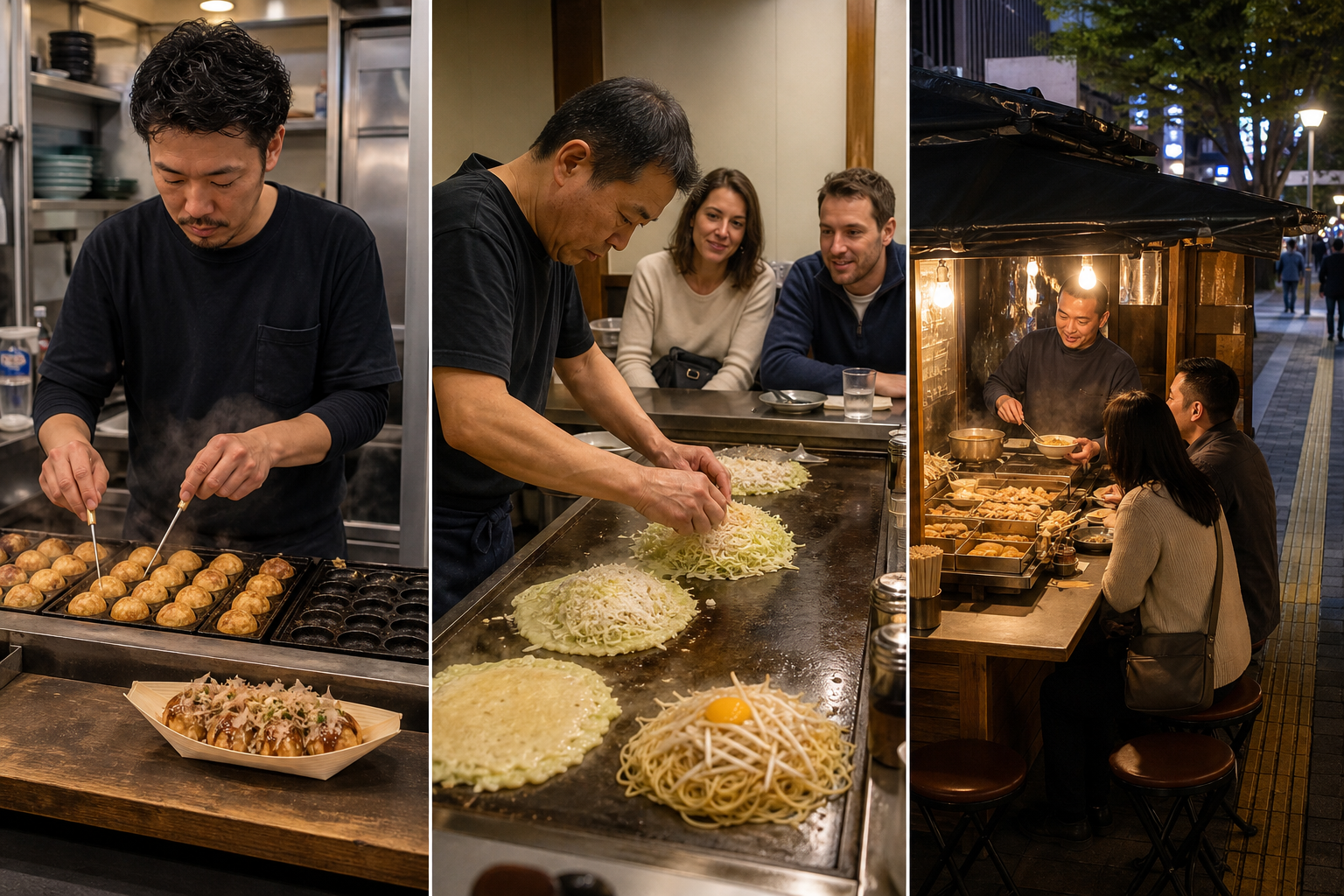
Japanese “street food” is not one business model. Osaka takoyaki is often bought at a storefront and eaten in a designated place; Hiroshima okonomiyaki is a full meal around a specialist griddle; Fukuoka yatai are tiny night restaurants where guests are seated, order and pay. Festival booths and temple-town sweets operate differently again. Using official information checked through 26 August 2026, this guide explains culture, location, current operating boundaries, ordering, allergies, hygiene and etiquette.
Separate four eating contexts instead of calling everything street food
| Context | Examples | Basic behaviour |
|---|---|---|
| Storefront takeaway | Takoyaki, taiyaki, dango | Find order/pickup points and eat at the shop or designated place |
| Specialist restaurant | Hiroshima okonomiyaki | Wait to be seated, eat from griddle/plate, confirm payment |
| Urban yatai | Fukuoka stalls | Ask for a seat and order a dish and drink |
| Temporary booth | Festival yakisoba, candy apple | Event/date-specific; keep worship and crowd routes clear |
“Tabearuki” can mean sampling food from several businesses or literally eating while walking. The second is not uniformly illegal, but stopping safely makes sense around crowds, skewers, hot liquid and merchandise.
Osaka takoyaki: taste dashi culture—and respect the heat
Takoyaki combines dashi-seasoned wheat batter and octopus in a hemispherical iron mould. Osaka’s official tourism guide traces precursors through choboyaki and radioyaki and explains how postwar sauce, mayonnaise, green laver and bonito-flake toppings spread. A firm-looking outside can hide a dangerously hot, soft centre: open one and release steam.
- Representative area: Dotonbori/Namba, reached from Osaka Metro Namba or Nippombashi and JR Namba. The public district has no admission or closure; every shop sets its own hours and price.
- Order: state quantity and whether sauce, mayonnaise, aonori or bonito flakes are wanted. Some batches are pre-seasoned and cannot be changed.
- Eat: use the counter, inside or designated zone. Never walk through a crowd holding toothpicks upward.
“Every Osaka household owns a takoyaki pan” is affectionate exaggeration. The cultural point is not cheap flour alone but dashi, griddle skill and a dish developed in both home and shop settings.
Hiroshima okonomiyaki: a layered griddle meal, not merely stall food
A representative Hiroshima method layers cabbage, bean sprouts, spring onion and pork over a thin crepe, then combines soba or udon and egg. This differs from the broadly mixed Kansai method, although every shop and locality varies. In Hiroshima, simply saying Hiroshima okonomiyaki is more natural than defining it as an inferior “style.”
- Okonomi-mura: Shintenchi Plaza floors 2–4, 5-13 Shintenchi, Naka-ku, Hiroshima; about three minutes from Hatchobori tram stop. Twenty-three shops; hours, holidays and prices vary.
- Ekimae Hiroba: Full Focus Building 6F, 10-1 Matsubara-cho, Minami-ku; about three minutes from JR Hiroshima south exit. Official example 10:00–23:00, only some stores 10:00–11:00, generally year-round; recheck individual operation.
- Order: start from meat-egg-soba/udon, then select noodle and extras. Follow the shop on griddle versus plate; keep children away from hot spatulas.
Postwar stalls gathering in Shintenchi Square led toward today’s Okonomi-mura. Read the dish not as a “flour pancake” but as ingredients built into a meal through local recovery history and griddle craft.
Fukuoka yatai: tiny seated night restaurants, not loose pavement vending
Fukuoka yatai are assembled in permitted sidewalk/park spaces and operate under city water, power and hygiene arrangements. The official city guide describes roughly 100 stalls across Tenjin, Nakasu, Nagahama and elsewhere. Menus extend beyond ramen to oden, yakitori, yaki-ramen, gyoza and international food.
- Hours: some open about 18:00, most 18:30–19:00, and many close around midnight. No common fixed holiday; rain, wind and individual conditions cause sudden closure.
- Access: use Tenjin/Tenjin-minami for Tenjin, Nakasu-Kawabata for Nakasu and Akasaka as one approach to Nagahama; locate the exact active stall on the official map/live information.
- Cost: no admission. Before sitting, check menu price, appetizer/cover, minimum order and payment. Many are cash-led, so carry small yen notes/coins.
- Facilities: yatai have no toilet. Go first or ask the owner for the nearest one. Leave luggage at hotel/locker.
Tell staff the party size and wait for a seat. A drink and dish per person is polite; do not linger after eating in roughly ten-seat spaces. Standing outside to drink is prohibited. Close conversation is an attraction, but intrusive questions, noise and intoxication are not “authentic yatai culture.”
Festivals, markets and temple towns use different dates and shared space
Festival booths exist only on event dates, and vendors, dishes and prices change each year. Worshippers, shoppers, deliveries and residents share narrow approaches and markets. Do not carry food into worship halls; eat in the stated area and keep queues, tactile paving and entrances open.
Dango, senbei, ningyoyaki and taiyaki may connect to temple-town culture, but an old-looking storefront does not prove local production, traditional method or freshness. Check demonstration, ingredients, expiry and takeaway conditions.
Check queue and seating first; price and conditions before ordering
- Identify the queue end, order point, pickup point and seating instruction.
- Read price, quantity, minimum order, cover and cash/card/QR before committing.
- State toppings or dietary constraints before cooking and accept when modification is impossible.
- Wait where names/numbers are called without blocking another business.
- At a stall/restaurant, confirm prepay versus pay-on-exit and keep bills separate.
- Hitotsu kudasai — One, please.
- Nedan wa ikura desu ka — How much is it?
- Tamago / komugi / ebi wa haitteimasu ka — Does it contain egg/wheat/shrimp?
- Dashi wa sakana desu ka — Is the stock fish-based?
Show a short sentence or allergy card and wait for an answer rather than thrusting a translation screen into the cooking area. “Without mayonnaise” removes a topping, not necessarily egg, dashi, sauce or shared-griddle contact.
Walking, rubbish and skewers depend on the actual circulation
- Follow “do not eat while walking,” “eat here” or shop-front signs.
- Stop safely for hot liquid, sauce or skewers.
- Ask whether the seller takes the container back; never use another shop’s or vending-machine bin.
- If there is no collection, seal it and carry it to proper accommodation sorting.
- Do not use private steps, shop chairs, shrine basins or tactile paving as a dining place.
Few public bins do not permit arbitrary disposal. Ask before accepting the container and the end of the meal becomes easier.
Allergies, vegetarian and religious diets go beyond visible toppings
| Food | Often missed |
|---|---|
| Takoyaki | Wheat, egg, octopus, dashi, sauce, mayonnaise, shared tools |
| Okonomiyaki | Wheat, egg, pork, fish stock, noodle, sauce, shared griddle/spatula |
| Oden/ramen | Fish/meat stock, soy/wheat, processed fish, alcohol ingredients |
| Sweets | Wheat, egg, dairy, sesame, peanut, production line |
Small stalls may lack packaged-food labels or dedicated tools. Removing meat may leave fish dashi, lard, egg and a shared griddle. Do not infer halal certification or vegan suitability from appearance; state the actual standard and choose a labelled alternative when staff cannot answer confidently.
Plan for heat, hygiene, alcohol, children and access
- Split takoyaki to cool; keep hands and sleeves from iron, oil and steam.
- Eat promptly and do not carry cooked food for hours in summer; avoid uncertain smell, temperature or storage.
- Do not expect raw food at a yatai; Fukuoka’s official guide says stalls do not serve it.
- After alcohol, do not drive or cycle; secure water and the return route and follow age checks.
- With children, choose an early quiet time and assess iron, skewers, queue, late night, smoke and allergens.
Wheelchair and stroller users should ask about counter height, seat width, queue, toilet and retreat space as well as steps. A roughly ten-seat yatai cannot all offer identical access.
Build a half-day or evening by changing context, not maximizing volume
- Osaka: choose one Namba/Dotonbori shop, cool and eat in its designated area; assess portion before another flour dish.
- Hiroshima: give lunch or dinner to one okonomiyaki restaurant and read griddle craft and local history as a complete meal.
- Fukuoka: prepare toilet and cash around 18:00, visit an active stall alone or in two/three, order, avoid lingering, and choose a second only by capacity and condition.
- Festival: verify official event hours, return transport, eating zone and waste before arriving; avoid the crowd peak.
The value is not merely eating cheaply in quantity. Dashi differences, the closeness of a griddle, sharing limited seats and the rhythm of festival and temple-town time reveal how a city and community work through a small dish.
Primary official sources: Osaka Official Tourism takoyaki guide, Hiroshima official okonomiyaki guide and Fukuoka City official yatai guide. Operating examples checked 26 August 2026.