



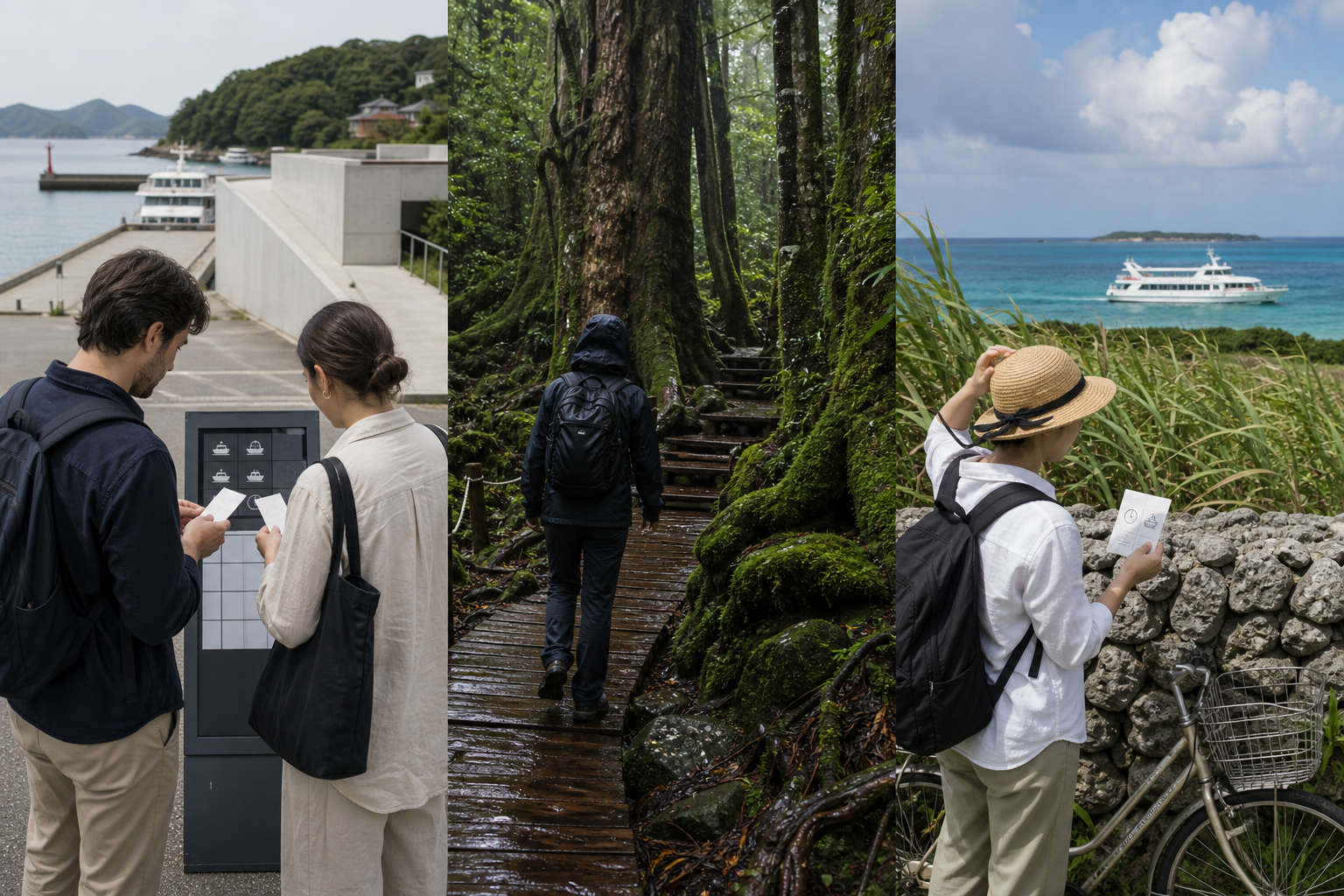
Japan has 14,125 islands under the Geospatial Information Authority’s stated counting conditions, but they do not share one travel method. Naoshima means ferry plus timed art admission; Yakushima combines air or sea arrival with mountain access; Hateruma requires an Ishigaki connection and an exposed-sea fast ferry. Based on official information checked 26 August 2026, this guide compares not only scenery but return risk, current cost examples, closures, lodging, food and medical limits.
Naoshima, Yakushima and Hateruma require three different trip designs
| Island | Core value | Minimum planning | Useful stay |
|---|---|---|---|
| Naoshima, Kagawa | Contemporary art, architecture and inhabited Setouchi landscape | Boat, art calendar, timed tickets, local bus | One night spreads districts and reveals morning/evening |
| Yakushima, Kagoshima | Vegetation from coast to high mountain, old sugi and rain forest | Arrival, ability-matched trail, trailhead transport, rain gear, hike plan | Three or more nights provide weather flexibility |
| Hateruma, Taketomi, Okinawa | Japan’s southernmost inhabited-island village, sugar cane, sea and night sky | Ishigaki buffer, fast ferry, pickup, meals, bicycle | One night reduces final-ferry dependence |
Yakushima’s World Natural Heritage property covers 10,747 hectares—about 21% of the island—not every road and settlement. Hateruma is Japan’s southernmost inhabited island, not the southernmost Japanese territory. Naoshima is also a living island, not one museum campus. These distinctions help visitors read local life rather than treat it as a theme park.
Naoshima: organise reservation time, district and final boat—not artwork count
Miyanoura is the main port. The ferry from Takamatsu takes roughly 60 minutes; Uno–Miyanoura roughly 20. Some passenger boats and ferries use different piers. Uno Station is about three minutes on foot from Uno Port and Takamatsu Station about five minutes from Takamatsu Port. Schedules and fares change, so use the official access page to reach the actual operator.
- Chichu Art Museum: 3449-1 Naoshima, Kagawa 761-3110. Normally 10:00–17:00, last admission 16:00; closed Monday, or next day when Monday is a holiday. Timed reservation required. On the check date, weekday online/on-site adult admission was ¥2,500/¥2,800 and weekend/holiday ¥2,700/¥3,000; 15 and under free. No walk-up sale when online tickets sell out.
- Art House Project: dispersed among old houses and sacred places in Honmura. Hours include different breaks and slots; generally closed Monday. Five-site ticket example: online ¥1,200/on-site ¥1,400; Minamidera and Kinza have separate ticket/reservation conditions.
- Movement: the town bus links Miyanoura and Tsutsuji-so, then museum-area travel is walking or the free shuttle. Cycling is prohibited in some areas, hills and heat are real, and capacity is limited.
Tadao Ando’s mostly subterranean Chichu uses natural light to change the relationship between work, architecture and time. Photography, phones and food are restricted inside, while outdoor works may close for weather or maintenance. Do not rely on “Monday” alone: check the date-specific open-days calendar.
Yakushima: do not equate a Jomon Sugi hike with a short forest walk
Yakushima Airport has direct services from Kagoshima, Fukuoka and Osaka Itami, while fast boats and a ferry run from Kagoshima. The airport, Miyanoura Port and Anbo Port are separate arrival points. Confirm where a lodge or rental-car company will meet the booked service.
| Experience | Decision | Transport/cost boundary |
|---|---|---|
| Shiratani Unsuikyo | Several walks and hikes; swollen streams can make crossings impassable | Bus or car from Miyanoura side; current cooperation request example ¥500 for high-school age and above |
| Yakusugi Land | Short prepared paths and longer mountain routes; the name is not a difficulty rating | Bus/car from Anbo side; verify operating day, return and cooperation fee |
| Jomon Sugi | Normally a long, early-start mountain hike—not a 30-minute sight | During the restriction period, transfer at Yakusugi Museum to the Arakawa mountain bus; pre-check ticket, contribution and regulation |
The mountain conservation contribution request is ¥1,000 for a day entry and ¥2,000 for an overnight mountain entry for junior-high age and above. Submit a hiking plan; carry separate jacket/trousers, boots, warmth, light, map, food and a portable toilet. Official guidance says check trails, cancel for bad weather, remain on path, collect no plants and feed no macaque or deer.
Hateruma: decide the return to Ishigaki before chasing blue water
Fast boats from Ishigaki Port Remote Island Terminal take roughly 60–100 minutes. The exposed route can be rough, and a scheduled service may become conditional, undecided or cancelled. The Anei example checked 26 August 2026 was adult ¥4,990 one way/¥9,670 return and primary child ¥2,500/¥4,850, including a variable fuel adjustment. Treat these as dated examples, not permanent prices.
- Nishi Beach: public white-sand coast with no admission or weekly closure, but that does not guarantee swimming. Check wind, tide, waves, jellyfish, supervision/rescue and shower/toilet status.
- Takanazaki: exposed cliff landscape with southernmost monuments; no admission or weekly closure. Keep well back from edges in wind and surf.
- Stars: moon, cloud, humidity, season and artificial light change visibility; the Southern Cross is not visible all year or all night. Taketomi Town currently describes the Starry Sky Observation Tower as closed, so do not build a trip around facility entry.
Rental bicycles and lodge pickups around the port are limited. Sugar-cane fields are workplaces; coral walls and fukugi windbreaks are part of inhabited landscape. Avoid loud village nights, close photography into homes and unlit cycling.
A disruption-resistant itinerary plans what happens after leaving the island first
- Return to a mainland/major-island base the day before an international flight or irreplaceable train.
- Save an earlier sailing as well as the last, plus operator change contacts.
- If buying separate one-ways, learn what one cancelled sector allows you to change or refund.
- Ask island and gateway lodging about contact deadlines and disruption cancellation terms.
- Read different risks: fog/wind for Naoshima, mountain rain/road for Yakushima, open-sea waves for Hateruma.
Reaching an island does not guarantee leaving on schedule. When conditions are deteriorating, moving to an earlier return is a planned success, not a failed holiday.
Check accessibility across port, attraction, trailhead and coast separately
Naoshima’s renovated houses can contain steps and narrow areas; strollers cannot enter some galleries. Chichu lists loan wheelchairs and multipurpose toilets, but ferry, bus and slopes remain separate checks. Yakushima’s ports and airport are far apart and buses are limited. Even a more accessible nature site changes with rain, gradient, surface and toilet status.
For Hateruma, distinguish fast-boat motion, gangway, pickup vehicle, bicycle and dark/rough roads. A wheelchair, cane, infant, pregnancy, sensory needs or susceptibility to motion sickness should be described concretely to the operator, lodging and facility so boarding help and fallback time can be confirmed.
Do not wait until island arrival to find a bed, dinner or cash
- Confirm arrival port/service, pickup, dinner time, curfew and cancellation/extra-night response with lodging.
- Ask whether the plan includes meals, next-morning bento, and which dining days are closed.
- For allergies, vegetarian or religious needs, explain required ingredients, stock and shared-equipment boundaries; “available” need not mean a dedicated kitchen or zero cross-contact.
- Carry a reasonable split amount of cash for ATM downtime, cash-only businesses or network failure.
- Bring water and a light backup from the gateway without emptying small island-shop stock.
Meals and pickups at small lodgings depend on limited staff and island logistics. Early notice of delay and avoiding no-shows are part of sustainable island travel.
Read life behind nature, culture and photographs
- In Honmura, keep entrances, lanes and cemeteries clear; distinguish artworks from private property and obey gallery photo/tripod/drone rules.
- On Yakushima, stay on trail, protect moss and roots, clean seeds from gear, use rubber pole tips and never feed wildlife.
- On Hateruma, do not enter farms, utaki sacred places, ritual areas or homes; obtain consent for close portraits.
- Take no coral, sand, stone, plant or animal; use the stated waste system or carry it away.
- Cooperate with water conservation and avoid noise or strong night lighting.
Naoshima’s art is tied to housing and regional history; Yakushima forest to conservation and mountain reverence; Hateruma scenery to farming, wind protection and ancestor rites. Refusing to reduce them to photogenic backdrops creates the deeper visit.
Do not assume mainland-speed medicine, communication or rescue
Carry prescribed medicine, insurance details, emergency contacts, power and offline mapping. For life-threatening illness, injury or fire call 119; for crime/incident call 110. Discuss motion-sickness medicine and activity suitability with a pharmacist or clinician when pregnancy, illness or other medicines are relevant.
Yakushima mountains can be cold, wet and out of signal when settlements are sunny. On Hateruma, use WBGT, shade, water and skin protection and avoid forcing a swim or cliff visit. Naoshima also involves exposed walking, summer heat, hills and winter sea wind. Island clinics and weather-dependent off-island evacuation have limits.
Final checks at booking, the previous day and the morning
- Booking: place arrival, return, lodging, pickup, meals, local movement and timed entry on one timeline.
- One week: recheck closures, roads/trails, bus restrictions, insurance, medicine, cash and equipment.
- Previous day: read warnings, waves, wind and rain; retain the option not to cross.
- Morning: check operator and attraction separately; select the earlier-return/shortened version.
- On island: if delay, fatigue, heat, rising water or sea deterioration appears, abandon one sight and protect the return.
The value of island travel is not the number of attractions conquered. When reservation and buffer come first, there is room to understand light and architecture on Naoshima, rain and vertical forest on Yakushima, and wind and village rhythm on Hateruma.
Primary official sources: GSI island count, Benesse Art Site Naoshima, Yakushima Town, Yakushima World Heritage Conservation Center, Taketomi Town Tourism Association and Anei ferry information. Checked 26 August 2026.