


A Kanto festival should not be chosen only by its journey time from Tokyo. Summer dance and fireworks, giant Edo-town floats, musical encounters between floats and a winter night procession demand different arrival times, clothing and exit plans. Official information was rechecked on 26 August 2026 so you can compare Mito, Sawara, Kawagoe and Chichibu as real trips.
Which 2026 festival fits your trip?
| Festival | Confirmed 2026 dates | Best for | Main gateway |
|---|---|---|---|
| Mito Komon | Fireworks 25 July; main festival 1–2 August (finished) | Community dance, lanterns and fireworks | JR Mito Station north exit |
| Sawara Grand Festival | Summer 10–12 July (finished); autumn 9–11 October | Giant-figure floats in an Edo merchant town | JR Sawara Station |
| Kawagoe Festival | 17–18 October | Musical float encounters called hikkawase | Hon-Kawagoe, Kawagoeshi or Kawagoe |
| Chichibu Night Festival | 2 December eve; 3 December main festival | Winter-night kasaboko and yatai procession | Chichibu, Ohanabatake or Seibu-Chichibu |
“Free” means no general admission gate; it does not secure a place. Chasing only the climax increases crowd and return-transport risk. On a first visit, arrive in daylight, identify toilets and exits, then choose one evening highlight.
Dashi, yatai, kasaboko and mikoshi are not interchangeable
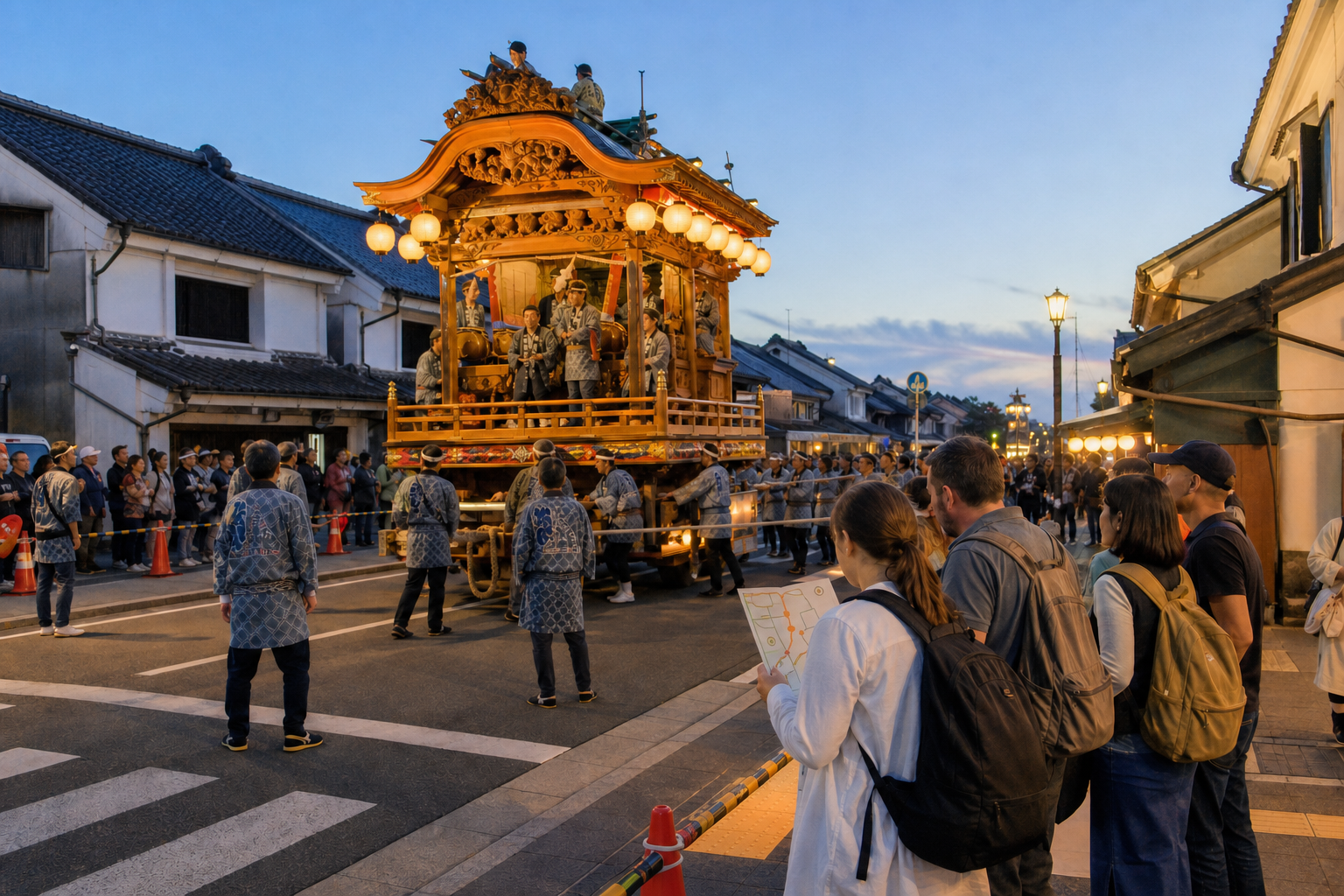
A mikoshi is a portable palanquin for a deity’s procession. Dashi, yatai and kasaboko are locally distinct wheeled or pulled structures carrying sculpture, music and performance. Do not label every one a “portable shrine.” The float traditions of Sawara, Kawagoe and Chichibu are nationally designated Important Intangible Folk Cultural Properties and components of UNESCO’s Yama, Hoko, Yatai float-festival element.
Heritage here is not only a beautiful object. It includes neighbourhood cooperation, repair crafts, musical repertoires and the knowledge used to steer a massive float. Watch wheel teams at corners, signals from the roof, changes in hayashi music and greetings at neighbourhood boundaries. The event is both sacred observance and local self-organisation, not merely a tourist show.
Mito Komon Festival: fireworks and main festival are separate
- 2026: Kairakuen Fireworks, 25 July 19:30–20:30 (26 July rain date); main festival, 1 August 11:00–21:00 and 2 August 11:00–20:00. Finished.
- Venue: fireworks at Lake Senba; main festival on National Route 50 from Mito Station north exit to Daikumachi intersection.
- Access: JR Mito Station. Walking distance to Lake Senba depends on the viewing zone.
- Cost/closure: ordinary main-festival street viewing is generally free; fireworks reserved seats are separate. There is no weekly closure—the event exists only on its dates.
- Official: Mito Komon Festival
The old article incorrectly promised a combined historical parade and fireworks spectacle. The present event centres on citizen dance, lantern/float activity and a city-centre celebration. Plan the fireworks and main festival as different days.
Sawara Grand Festival: annual summer and autumn events in different districts
- 2026: summer 10–12 July (finished); autumn 9–11 October. The city’s general guide states 10:00–22:00 and operation in rain, although float figures may be covered.
- Venue: summer Yasaka Shrine festival in Honjuku east of the Ono River; autumn Suwa Shrine festival in Shinjuku west of it.
- Access: JR Narita Line Sawara Station; the city gives about 110 minutes from Tokyo by rapid service. Festival streets are walkable from the station.
- Cost/closure: street viewing is free; transport, food and Suigo Sawara Float Museum are separate.
- Official: Katori City
Ten summer and fourteen autumn floats cover different areas. The old article’s “main festival every other year” claim was false. Read the giant figures, Sawara-bayashi music, controlled turns in narrow streets and merchant-town landscape as one culture. Daylight shows carving detail; evening reveals sound and lantern atmosphere. Do not attempt to chase every float.
Kawagoe Festival: hikkawase is a musical exchange, not a collision
- 2026: Saturday 17 and Sunday 18 October; recheck the year’s detailed programme and restriction map.
- Venue: central Kawagoe, including the warehouse district; the festival grows from Kawagoe Hikawa Shrine’s annual observance.
- Access: Seibu Hon-Kawagoe, Tobu Kawagoeshi/Kawagoe or JR Kawagoe. Choose according to viewing and exit route.
- Cost/closure: street viewing is free; the festival museum, transport, food and special products are separate.
- Official: Kawagoe Festival
When floats meet, musicians and dancers face one another and exchange hayashi while lanterns are raised. This hikkawase is not a fight or float crash. Stay behind stewards, never enter the intersection, and observe music, dance and steering as one action. Visit by day for carvings; choose daytime only if dense night crowds are unsuitable.
Chichibu Night Festival: decide your winter return before the climax
- 2026: Wednesday 2 December evening observance and Thursday 3 December main festival. Dates are fixed annually; verify the 2026 procession, fireworks, restrictions and reserved seats.
- Venue: Chichibu Shrine and central Chichibu; two kasaboko and four yatai move through the ritual area.
- Access: Chichibu Railway Chichibu/Ohanabatake or Seibu Railway Seibu-Chichibu. The similarly located stations belong to different operators.
- Cost/closure: general street viewing is free; reserved viewing, transport and food are extra.
- Official: Chichibu Tourism Navi
Targeting only the largest spectacle can leave you behind one-way controls or station queues. Select the return railway and station first, with at least one earlier fallback. December nights require warm layers, gloves, walking shoes and spare phone power. Avoid tripods in pedestrian flow and alcohol-impaired crowd travel.
Build a Tokyo day trip around an exit, not the last train
- Mark viewing point, toilet, rest area and exit station on the official map.
- Do not assume inbound and outbound stations must match; Kawagoe and Chichibu have multiple operators.
- Expect bus stops and taxi ranks to move under road controls and allow extra walking.
- Make a service before the last train your primary plan; carry IC-card balance, cash and an offline alternative.
- For an overnight stay, confirm a walkable post-restriction route and check-in deadline, not merely “near the venue.”
Tokyo journey times vary by origin, service and wait. On the festival day, railway and organiser notices outrank a route app’s ordinary-day estimate.
Viewing and photography without stopping the festival
- Keep procession lanes, ropes, wheels, intersections, shop/home entrances and tactile paving clear.
- Do not join pullers or carriers without invitation; never touch costume or float.
- Check current rules for flash, tripod, selfie stick and drone; if permission is unclear, do not use it.
- Ask before close portraits, especially children or resting participants; prioritise quiet during rites.
- Use designated waste points and never turn private land or a shop doorway into a free seat.
A safer photograph comes from choosing a background and waiting behind the boundary, not stepping ahead of a moving float. Follow stewards immediately.
Summer heat, winter cold, children and accessible viewing
For Mito or Sawara in summer, check WBGT and heat alerts; preselect shade/air conditioning, water and an exit time. Yukata can enrich the experience but is not heat-protective clothing. Chichibu needs cold-weather and possibly slippery-ground planning. “Held in rain” does not guarantee every component runs unchanged.
For children, set early limits for noise, darkness, waiting and toilets; do not block others with prolonged shoulder carrying. Wheelchair, stroller or sensory-access users should ask about the year’s accessible areas, temporary toilets, surfaces and detours. A nearby station does not prove a step-free route through a dense crowd.
Final checklist
- Recheck official status, times, rain decision, restrictions and reserved-seat need.
- Save the map and share entry/exit stations, meeting point, toilet and rest location.
- Carry cash, valid ticket/IC card, water, seasonal protection, power and personal medicine.
- Choose one priority and one substitute; do not make “see everything” the condition for success.
- Agree that anyone can stop the group for crowding, health, weather or disruption.
A festival’s value is more than spectacle. Sound, craft, neighbourhood roles and sacred observance maintained all year become visible in the street for a short time. Arriving a little early and leaving a little early often reveals more of that living system.
Official sources: Mito, Katori City, Kawagoe, Chichibu. Checked 26 August 2026.