



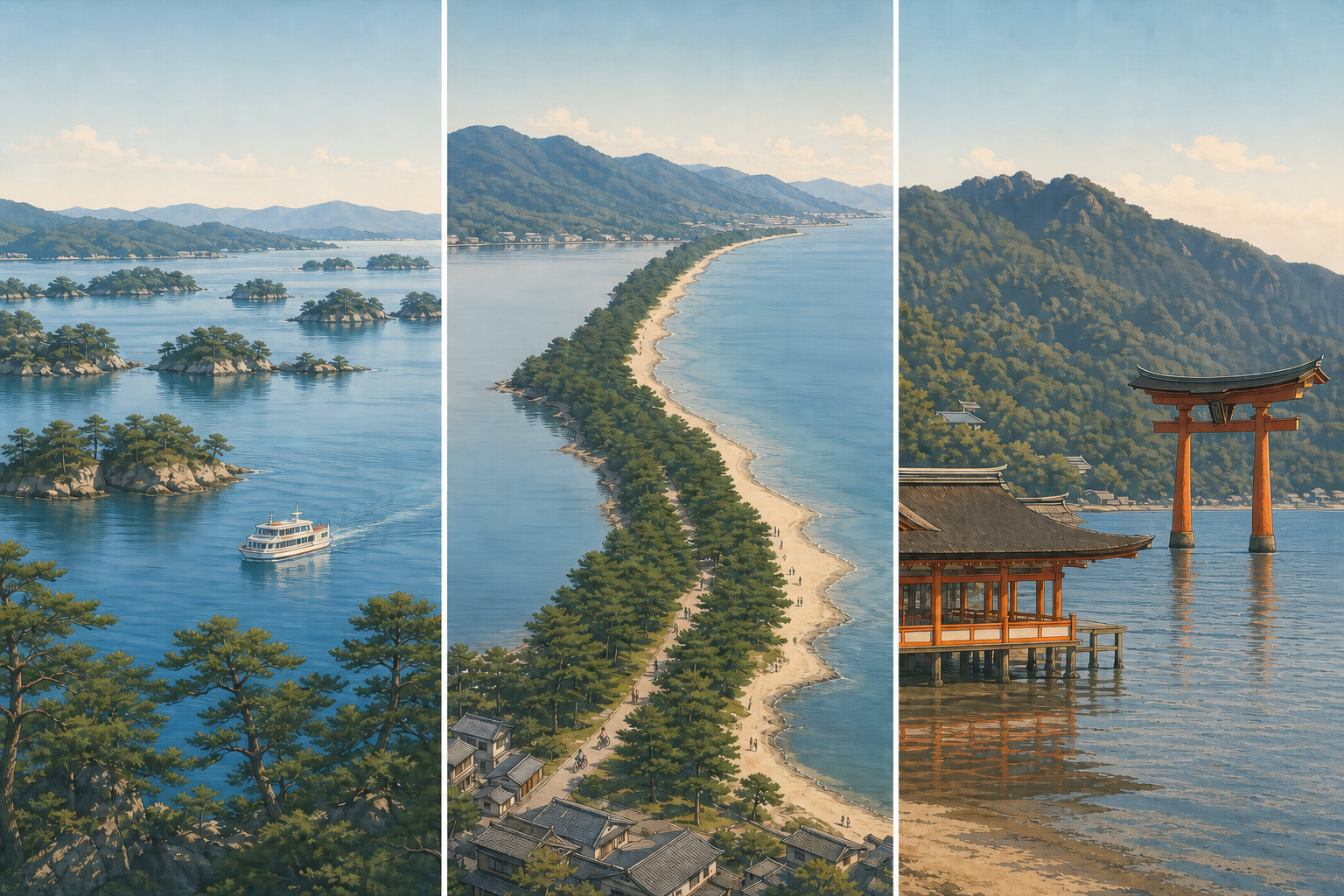
Japan’s official Three Scenic Views are Matsushima, Amanohashidate and Miyajima. There is no official “Four Scenic Views” list created by adding Mount Fuji, as the old article implied. Their shared language is blue sea and green pine, but each must be read differently: layered islands, a pine-covered sandbar, or a tidal sacred landscape. This guide adds the stations, current sample prices, opening limits, tides and realistic routes needed to visit them.
What are Japan’s Three Scenic Views—and why not Mount Fuji?
The official Three Scenic Views association traces the grouping to early-Edo Confucian scholar Hayashi Shunsai, who identified Matsushima, Amanohashidate and Itsukushima/Miyajima as exceptional landscapes in Nihon Kokujisekikō. The label later became a tourism identity, but each place has deeper histories of poetry, painting, pilgrimage, shrine/temple visits and modern travel.
Mount Fuji is a World Cultural Heritage site and Japan’s best-known mountain, but it belongs to a different cultural and heritage framework. Calling it a formal fourth view misleads international readers. The Three Views are not single camera spots either: Matsushima is read by moving around a bay, Amanohashidate from above and within the sandbar, and Miyajima through tide and sacred architecture.
At a glance: which view fits you?
| Place | Core way to see it | Main gateway | Minimum time | Main variable |
|---|---|---|---|---|
| Matsushima, Miyagi | Layered islands from shore and boat | JR Matsushima-Kaigan | Half day | Wind/wave cruise cancellation |
| Amanohashidate, Kyoto | Viewpoint plus 3.6 km sandbar | Kyoto Tango Railway Amanohashidate | Half/full day | Limited transport, lift inspection |
| Miyajima, Hiroshima | Shrine and torii changing with tide | Miyajimaguchi plus ferry | Half day/overnight | Tide, deer, final ferry |
These are not three Tokyo day trips. Add Matsushima to Sendai, Amanohashidate to northern Kyoto and Miyajima to Hiroshima. A national Three Views journey needs several days plus long-distance transfers; collecting them as stamps misses the local culture that made the label meaningful.
Matsushima: watch islands overlap, not one static panorama
- Area: Matsushima, Matsushima Town, Miyagi; tourist office at 98-1 Chōnai.
- Access: JR Senseki Line from Sendai to Matsushima-Kaigan, official estimate about 40 minutes. JR Tohoku Line Matsushima Station is a different station 15–20 minutes’ walk from the waterfront.
- Landscape cost/closure: public waterfront walking is free with no single weekly closure. Boats, temples and facilities are separate.
- Current examples: 50-minute Niohmaru cruise, adult ¥1,500 and primary-school child ¥750; Zuiganji, adult ¥1,000 and elementary/junior-high child ¥500.
- Hours: published Niohmaru pattern is hourly 09:00–16:00, with winter/weather cancellations. Zuiganji opens 08:30; seasonal closing ranges 15:30–17:00, last entry 30 minutes before.
- Official: tourism association, cruise, Zuiganji
Recommended sequence: Matsushima-Kaigan Station → Zuiganji → Godaido waterfront → bay cruise → shore walk. Confirm boats first; if cancelled, deepen the land route with Zuiganji, Entsuin or Kanrantei. Matsushima becomes legible as the boat makes islands overlap, separate and change pine silhouettes.
Amanohashidate: understand the landform from above, then enter it
- Area: Monju to Fuchu, Miyazu, Kyoto; a sandbar about 3.6 km across Miyazu Bay.
- Access: Kyoto Tango Railway Amanohashidate Station. Limited-express and highway-bus patterns from Kyoto/Osaka vary by date; search the operator. The southern end is walkable from the station.
- Landscape cost/closure: walking the sandbar is free and generally always accessible; obey storms, beach zoning and pine-conservation work.
- Current example: Amanohashidate View Land return lift/monorail plus admission, adult ¥1,000 and primary-school child ¥500. Entry is not available on foot or by car.
- Hours: seasonal; a published summer example is 08:30–18:30. Recheck inspection days, last ticket and attraction closing.
- Official: tourism association, View Land
Recommended sequence: station → Chionji → View Land’s southern “flying-dragon” view → walk/cycle the sandbar → optional boat or bus to Fuchu → Kasamatsu Park’s northern “rising-dragon” view. Replace one 3.6 km direction with bicycle, boat or bus if needed. Do matanozoki only on a designated stable platform, never near an edge or in moving crowds.
Miyajima: read shrine and torii through changing tide
- Address: Itsukushima Shrine, 1-1 Miyajima-chō, Hatsukaichi, Hiroshima.
- Access: JR or Hiroden to Miyajimaguchi, about 10 minutes by ferry; allow roughly 15 minutes on foot from Miyajima pier to the shrine.
- Transport example: JR West Miyajima Ferry ordinary fare adult ¥180 one way, child ¥90; the ¥100 Miyajima Visitor Tax is additional on entry, subject to exemptions.
- Shrine price: adult ¥300, high school ¥200, elementary/junior high ¥100; shrine/treasure-hall adult combination ¥500.
- Hours/closure: open year-round, normally from 06:30; seasonal closing 17:00–18:30, with special New Year hours. Recheck final entry and ritual restrictions.
- Official: tourism association, shrine, ferry
Recommended sequence: check the tide before arrival and place the shrine visit and torii observation at different water levels. High tide reveals the floating architectural composition; low tide exposes terrain and the torii base, but mud, shells, returning water and restrictions matter. Continue shrine → Machiya Street → Daishoin; add Mount Misen only with time, weather and fitness. An overnight stay reveals quieter morning/evening and a second tide.
Clear sky is not the only answer: light, tide and season
- Matsushima: oblique morning/evening light and mist create island depth; use land viewpoints in strong wind or waves.
- Amanohashidate: haze, backlight, snow and lift operation affect the high view; the sandbar brings sea wind, heat and thunder exposure.
- Miyajima: check tide before sunrise/sunset. Walking to the torii depends on water level, ground and restrictions, not the words “low tide” alone.
No reflection or perfect postcard is guaranteed. Check live camera, weather, tide and operations that morning. On cloudier days, shift attention to temple/shrine architecture and town history instead of treating landscape travel as a weather lottery.
How to place the Three Views into a real Japan itinerary
| Base | Practical fit | Why stay |
|---|---|---|
| Sendai | Matsushima half/full day; verify any Shiogama cruise separately | Bay at quiet hours, unhurried temples |
| Northern Kyoto | Amanohashidate full day; calculate Ine transport separately | Relieves limited train/bus pressure |
| Hiroshima | Miyajima half/full day; do not overpack with Peace Park | Two tides, quiet hours, Mount Misen |
For all three in one trip, treat Sendai–northern Kyoto–Hiroshima transfers, luggage, reservations and check-in as real itinerary days. A national JR Pass is not automatically cheaper, and Kyoto Tango Railway, visitor tax, boats and viewpoints add non-JR costs.
Protect the worship, daily life and ecology in front of the view
- At temples/shrines, follow quiet, route and no-photo rules; a goshuin is proof of worship, not a souvenir stamp.
- Do not feed Miyajima deer; secure paper, food and bags. Do not touch, chase or surround deer for selfies.
- Protect Amanohashidate pine roots and conservation zones; follow cycle/walk separation and leave no waste.
- Never land on Matsushima islets without permission; follow the operator’s current wildlife-feeding rules.
- Check permission for drones, tripods and commercial shoots; never block routes, tactile paving or a shrine/temple axis.
Safety, children and accessibility are segment-specific
Ask whether each station, boat, viewpoint, temple, sandbar segment and shrine route works—not whether an entire scenic area is “accessible.” Niohmaru has priority wheelchair seating on level one but stairs to level two. Zuiganji officially limits wheelchair-accessible viewing to its museum. Confirm View Land boarding conditions. For Miyajima, check ferry route, shrine corridors, tidal ground and ropeway separately.
Adults must manage children near water, decks, bicycles, lifts and deer. Check summer WBGT, winter ice/early darkness and typhoon/high-wind cancellation. No photograph justifies crossing a closure.
Choose your view and use the final checklist
- Island depth plus Zen temple: Matsushima, easy to anchor in Sendai with land backup.
- Landform from above and within: Amanohashidate, for walkers/cyclists with time in northern Kyoto.
- Tide, worship and overnight change: Miyajima, for travellers willing to schedule around water.
- Check same-day weather, tide, cruise/ropeway inspection and shrine/temple opening.
- Budget free landscapes separately from paid facilities and carry workable payment.
- Save gateway station, final transport, luggage, toilet, rest and backup plan.
- Do not call Fuji a fourth member; respect the distinct historical frameworks.
- Observe landform, culture and time instead of demanding one perfect photograph.
Official sources: Japan’s Three Scenic Views Association and the tourism/facility pages linked in each section. Checked 26 August 2026.