



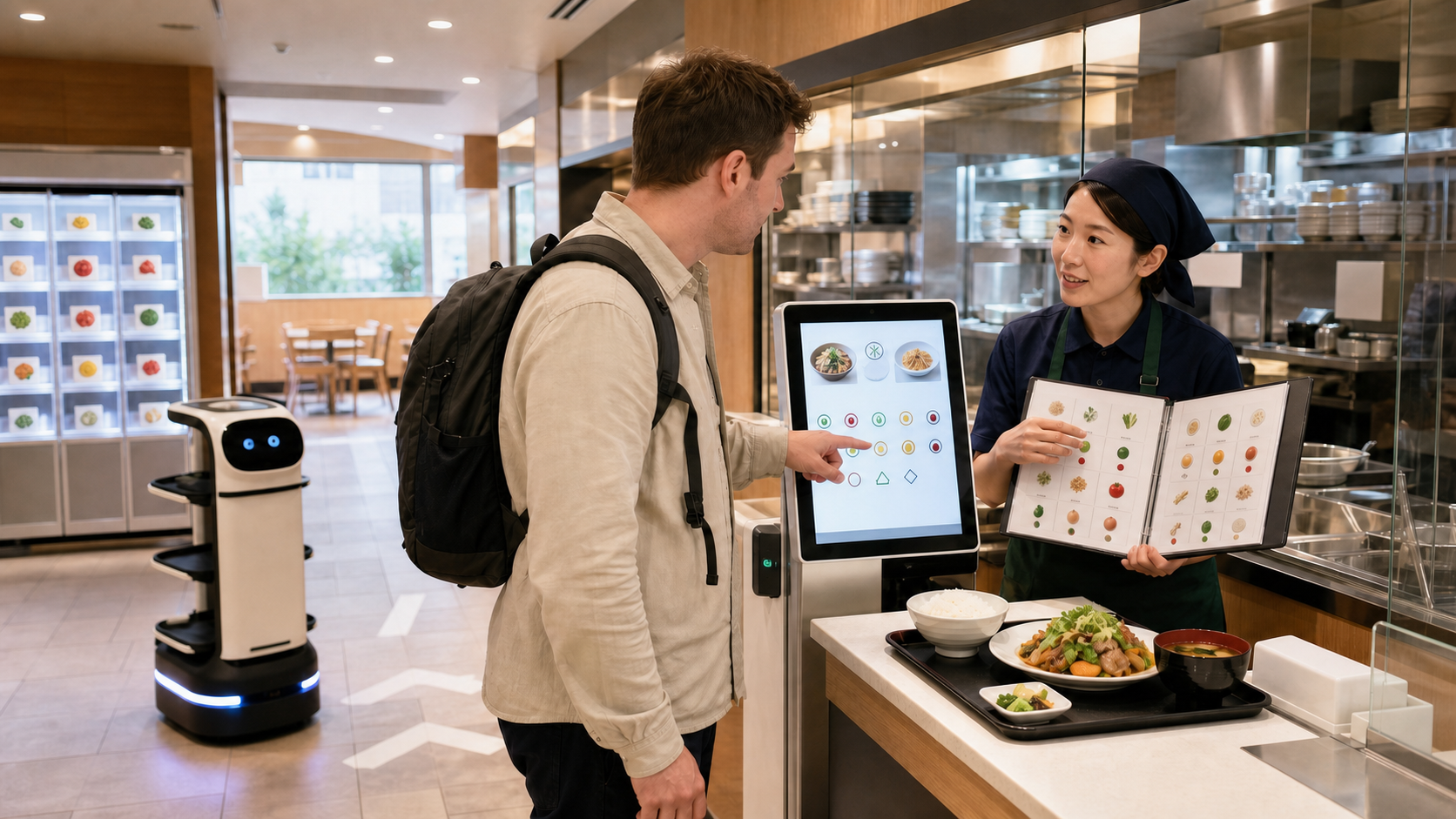
Information checked: August 26, 2026. Food tech in Japan is not one futuristic restaurant. It includes ordinary tools travelers already encounter—ordering kiosks, kitchen data systems, serving robots, rapid freezing, packaging and cold-chain control—alongside commercially available plant-based foods and research-stage fields such as cell-cultured meat. This guide separates what you can use now from what remains a pilot, and explains why automation never proves that a meal is allergy-safe, vegan, halal or suitable for a medical diet.
First ask: available now, limited pilot, or research?
| Level | Examples | What a traveler should assume |
|---|---|---|
| Common commercial use | Ticket kiosks, QR/tablet menus, kitchen displays, conveyor systems, serving robots, frozen meals, temperature-controlled lockers | You may encounter them, but not at every branch or in every language. |
| Commercial but limited | Special rapid-freezing services, demand forecasting, dynamic discounting, traceability displays, certified plant-based products | Availability and evidence depend on the company, store and product. |
| Research, pilot or rulemaking | Cell-cultured meat, personalized nutrition trials, experimental ingredients | Do not interpret a press release or exhibition sample as general restaurant availability. |
Japan’s Ministry of Agriculture, Forestry and Fisheries (MAFF) Food Tech Public-Private Council discusses fields ranging from alternative protein and freshness preservation to food loss and health. Membership or participation does not itself certify that a product is safe, sustainable or commercially available.
Ordering kiosks reduce some barriers and create new ones
A kiosk may show photos, stock status, customizations and several languages while sending the order directly to a kitchen display. It can reduce pronunciation anxiety and transcription errors. Yet translated menus can omit garnish, broth, sauce, shared-oil or cross-contact details; an icon may describe an ingredient category without guaranteeing absence.
- Select the language before building the basket; changing later can reset it.
- Check eat-in versus takeaway, quantity, size, set contents and spice level.
- Read the final confirmation screen and keep the receipt or order number.
- If an allergy, religious requirement or medical diet matters, stop and ask a person before payment. Do not rely only on a machine translation.
- If the terminal is cashless-only or rejects a foreign card, ask for another register rather than repeatedly blocking the queue.
Common Japanese includes 店内 (eat in), 持ち帰り (takeaway), 売り切れ (sold out), 呼出番号 (collection number), 注文確定 (confirm order) and 取消 (cancel). A screen that returns to the start does not prove payment failed—check the receipt, card notice or staff before ordering twice.
A serving robot is logistics, not a waiter with ingredient knowledge
Serving robots typically move trays between a kitchen and assigned tables. They can reduce repetitive carrying and support staff during busy periods, but people still cook, load, clean, handle exceptions and help guests. Keep bags, chairs and children out of the marked route; take only your table’s dishes and press a completion button only if instructed.
Do not ask the robot to solve an allergen question, and do not move, ride, obstruct or film it while blocking an aisle. If the wrong dish arrives, leave it untouched and call staff. Automation can improve consistency in delivery while cross-contact, recipe changes and human loading remain possible.
The less visible innovation may matter more: cold, oxygen and time
Rapid freezing, vacuum or modified-atmosphere packaging, insulated logistics, temperature sensors and chilled pickup lockers can extend quality or make regional food travel farther. The useful question is not “Was technology used?” but “What temperature, packaging and time conditions must the customer maintain?”
- Frozen is not shelf-stable. Keep the stated frozen temperature and do not refreeze a thawed product unless the maker explicitly permits it.
- Vacuum-packed is not sterile. Follow refrigeration, heating and use-by instructions.
- A locker is not permanent storage. Collect within the stated window and move perishables promptly to suitable refrigeration.
- Longer quality is not unlimited safety. Distinguish shōhi kigen (消費期限, use-by/safety-oriented) from shōmi kigen (賞味期限, best-before/quality-oriented) and obey storage conditions.
For a flight, ask whether a product may travel at room temperature, how long the cold pack is designed to work, whether airline dry-ice rules apply and whether the destination permits the animal or plant product. Packaging technology does not override quarantine.
“Soy meat” does not automatically mean vegan
Japan has JAS standards for soy-meat food products and for vegetarian/vegan-suitable processed foods and food-service management. The soy-meat standard distinguishes a category without animal ingredients from “prepared soy-meat food,” which may permit egg, milk and animal-derived seasonings within its rules. A product described casually as daizu mīto may also contain other meat unless its label and certification establish otherwise.
Read the entire ingredient and allergen panel. Check broth, gelatin, lard, fish extract, bonito stock, egg, milk, honey, cooking alcohol and shared fryers according to your needs. “Plant-based,” “healthy,” “sustainable,” “soy” and a leaf icon are not interchangeable with vegan certification, halal certification or allergy safety.
Cultivated meat: an important topic, not a normal menu choice
Japan’s public-private food-tech work and health authorities have been examining manufacturing safety, labeling, consumer communication and coexistence with existing agriculture for cell-cultured meat. That wording matters: discussion of industrialization and safety requirements is evidence of an evolving field, not proof of broad authorization or restaurant sale.
If a display says “cultivated,” “cell-based” or “future protein,” determine whether it is an edible commercial product, a research sample, a concept model or a conventional plant-based imitation. Never taste an unofficial demonstration material. A claim that cells avoid slaughter does not by itself answer growth-medium inputs, energy use, allergens, nutrition, price or regulation.
Technology can reduce food loss—but only measured outcomes prove it
Forecasting can adjust orders, sensors can detect temperature excursions, special freezing can preserve surplus, apps can match discounted food with buyers, and processing can turn off-spec produce into powder or ingredients. These can help, but a screen or “AI” label does not prove less waste.
Look for a baseline, measurement period, scope and destination: kilograms of edible food avoided, not merely total trash shifted to another stream. Ask whether discounting prevented disposal, whether processing used additional energy, what happened to residues and whether packaging increased. Buy what you will actually eat; purchasing an unwanted “food-loss rescue” item still wastes resources.
A five-question test for any food-tech claim
- Problem: Which specific problem—labor, safety, access, freshness, waste, nutrition or convenience—is addressed?
- Boundary: Is the claim about one store, one process, one pilot or the whole supply chain?
- Evidence: Is there measured before/after data, third-party certification or only promotional language?
- Trade-off: What energy, packaging, data, maintenance, training or new risk is introduced?
- Traveler action: What should you do differently—ask staff, keep cold, scan a code, return a tray or read a label?
A robot is visible and photogenic; a temperature log is not. The less dramatic system may create more real value. Conversely, traditional craft and technology are not opposites: sensors can support fermentation control or traceability while a brewer, chef or farmer retains judgment. Avoid describing skilled work as “replaced” without evidence.
Allergy, halal and accessibility: keep a human confirmation path
As of the information checked, Japan mandates allergen labeling for specified ingredients on prepackaged processed foods, while allergen information in restaurants and ready-to-eat food service is not uniformly mandatory and is promoted through voluntary communication. In April 2026, cashew nut was added to the mandatory specified-allergen list for packaged foods. Recipes and cross-contact still require product- and shop-specific confirmation.
- Show a written allergen card and ask whether staff can verify ingredients and shared equipment; if they cannot, choose another item or venue.
- A multilingual kiosk is not an emergency service. Carry prescribed medicine and follow your medical plan.
- For halal or vegan needs, distinguish ingredients, preparation equipment, alcohol and certification.
- If you cannot use a touchscreen, ask for a staffed order route. Voice, visual, motor and cognitive access needs differ; “digital” does not equal accessible.
- Do not photograph kitchen screens, employees, operational data or other customers without permission.
Frequently asked questions
Where is the best food-tech attraction in Japan?
There is no single permanent attraction that represents the field. The most honest experience is to observe specific systems in ordinary restaurants and shops, then use official event pages for time-limited exhibitions. Do not travel to a company lab unless it explicitly accepts public visitors.
Does a serving robot mean no tip?
Japan generally does not use routine tipping, regardless of robot use. Follow the venue’s payment and tray-return system.
Is machine-translated allergen information reliable?
It can help communication but is not sufficient for a serious allergy. Confirm with staff and current source information, including cross-contact.
Is plant-based food always lower impact?
No universal conclusion follows from a menu label. Ingredients, farming, processing, energy, packaging, transport, nutrition and waste all affect the comparison.
Official references: MAFF Food Tech Public-Private Council / MAFF JAS standards / Consumer Affairs Agency: allergies in restaurants and prepared food / Consumer Affairs Agency: date labels / MAFF food loss