


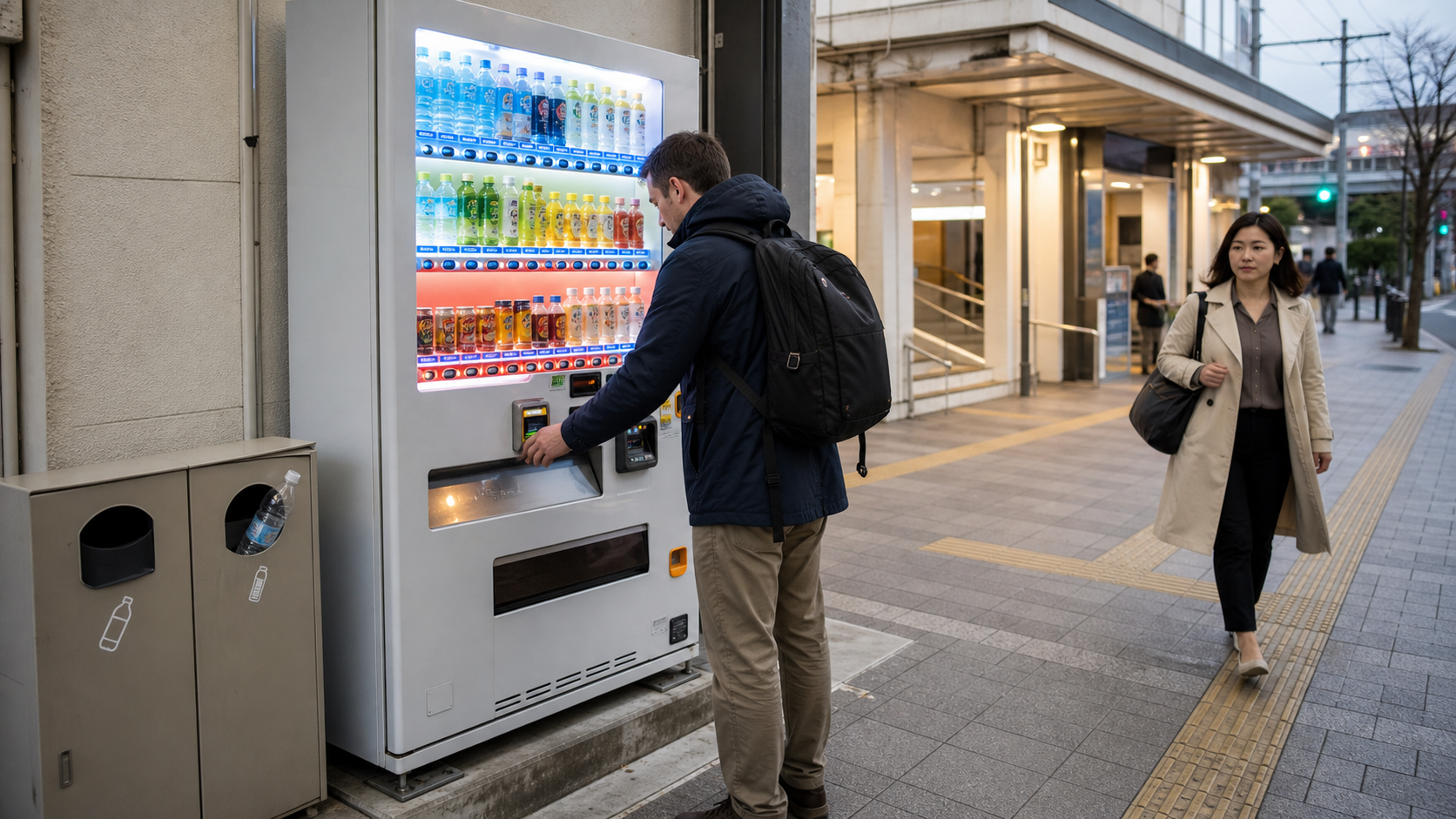
Japan’s vending machines are easy to use, but they are more interesting when viewed as small pieces of infrastructure rather than as a collection of “only in Japan” curiosities. A drink machine connects product temperature, payment technology, replenishment work, electricity use and container recycling in one compact street-side system. This guide explains how to buy confidently and how to observe the system without inconveniencing the people who maintain or share the space.
1. Convenience is organised work, not magic
Vending is visible in stations, hospitals, offices, roadside rest areas and residential neighbourhoods because it allows sales in a small footprint and outside staffed shop hours. Yet the machine is not “unmanned” in any absolute sense. Operators choose the range, refill stock, rotate dated products, collect money and empty nearby beverage-container boxes; technicians service payment, cooling and heating equipment; property owners supply and regulate the location.
The famous image of a machine on every quiet corner can hide these labour and land-use decisions. Machines are removed as demand, operating cost and retail patterns change. Treat them as one layer of Japanese convenience culture, alongside convenience stores, station kiosks and staffed shops—not as proof that every place in Japan works identically.
2. How to buy a drink in six steps
- Check the product, price, volume and HOT/COLD indication before paying.
- Confirm which coins, notes, cards or mobile wallets this particular machine accepts.
- Insert cash or activate the cashless reader. On many machines, the available selection buttons then light up.
- Press the button directly below or beside the chosen sample. On a touchscreen, review the final item and price before confirming.
- Take the product from the delivery compartment and collect change immediately.
- Move away from the front so the next person can use it; drink only where doing so is appropriate.
Do not insert several coins before deciding whether the machine accepts the payment or product you want. If a selection does not illuminate, it may be sold out, unavailable for the inserted amount, or temporarily disabled.
3. Read temperature, package and ingredients—not just colour
| Display clue | What it usually means | What to verify |
|---|---|---|
| Blue / COLD / つめた〜い | Chilled product | Colour design is not perfectly universal; look for text or temperature icon |
| Red / HOT / あったか〜い | Heated canned or bottled drink | Container may be hot; open carefully and do not give it to a child unchecked |
| PET bottle, can or cup | Different package and drinking method | Some cans are not resealable; cup machines may need preparation time |
| Sold-out light / 売切 | That selection cannot be purchased | Choose another product before adding more money |
The front sample is an advertisement or display, not the full food label. After purchase, check the actual package for ingredients, allergens, caffeine, sweeteners, alcohol and use-by or best-before information. A coffee-looking drink may contain milk; soup can contain wheat, soy, fish or meat; “zero” may refer to one nutrient rather than every dietary concern. If a serious allergy is involved, buy from a staffed shop where questions and package inspection are easier.
4. Cashless is common, but never assume one standard
Acceptance varies by owner and model. Some drink machines take coins and ¥1,000 notes only; some accept transport IC cards, contactless cards or selected QR wallets; others are cashless-only. A logo on your phone does not guarantee that an overseas account or card will work. Check the payment marks on the actual machine.
| Payment | Practical method | If it fails |
|---|---|---|
| Coins/notes | Use clean, undamaged accepted denominations; wait until the amount appears | Try another valid coin/note once, then use a different method or shop |
| Transport IC | Select product/payment as indicated, then hold the card still until completion | Check balance; do not tap repeatedly while processing |
| Contactless/QR | Follow the reader or screen sequence and keep the app/network ready | Overseas wallet eligibility, network or issuer controls may block payment |
Japan issued redesigned banknotes in 2024, and older machines have been updated at different speeds. Never force an unaccepted note. Keep coins or another payment method, and use a convenience store if the machine rejects both notes and cashless payment.
5. Drinks dominate; unusual machines are exceptions
Ordinary beverage machines are the most useful to travellers: water, tea, coffee, juice, soft drinks and seasonal hot choices. Stations may also have ice cream, snacks or platform-specific products; service areas and local facilities sometimes sell food, flowers, farm products or souvenirs. These are commercial choices, not a national promise that hot meals, umbrellas or electronics are always available from a machine.
For refrigerated or frozen food, check the package immediately. Do not buy a damaged, swollen, leaking or unexpectedly warm item. Follow heating and storage instructions, and consume perishable food promptly. A vending machine does not remove allergy, food-safety or dietary-restriction concerns.
6. The box beside a machine is not a public rubbish bin
Operators place boxes beside many drink machines to recover empty beverage containers for recycling. Japan’s Ministry of the Environment has specifically highlighted contamination by food trays, tissues, cigarette ends and other rubbish, which reduces the quality and amount of material recovered.
- Use the box only for the beverage-container types indicated at that location.
- Empty remaining liquid where permitted; do not pour it into the box.
- Do not insert food packaging, umbrellas, batteries, cups from another category or general travel waste.
- If the box is full or absent, carry the container to an appropriate facility rather than balancing it on top.
The opening may face downward or look small by design to discourage unrelated rubbish. Do not force an object through it.
7. A machine’s surroundings are still shared public space
Stand close enough to operate the machine without blocking a pavement, station flow, tactile paving, bicycle route, doorway or emergency equipment. Sort money before reaching the front during busy periods. In a station, follow local eating-and-drinking rules; on commuter trains, opening a hot soup or strongly scented drink can inconvenience others.
Photographing an unusual machine is generally less sensitive than photographing a person, but the location still matters. Do not set up a tripod in a narrow passage, include recognisable bystanders without care, lean on private property, or open service panels. If an operator is restocking, give them working space and ask before taking close-up photographs of the worker.
8. Alcohol and tobacco machines are not ordinary souvenirs
People under 20 may not drink alcohol or smoke in Japan. Alcohol and tobacco vending has been reduced and is subject to age-control measures; a visitor should not expect every foreign ID, card or account to work with an age-verification system. Never purchase on behalf of someone under 20 or borrow another person’s verification credential.
Drinking in public is not governed by one simple nationwide tourist rule. Property rules, local ordinances, event restrictions and nuisance concerns still apply. Do not treat the presence of an alcohol machine as permission to drink immediately beside it, on a station platform or in a residential entrance.
During an earthquake, move away from vending machines, walls, signs and glass that could fall or break. A machine described locally as disaster-support equipment may release goods only under an operator or authority’s emergency procedure; it is not free stock during an ordinary outage.
9. What to do if money or a product is stuck
| Problem | Safe response |
|---|---|
| Cash inserted, no purchase | Press the return lever/button once and check both coin return and note slot |
| Payment completed, no product | Wait briefly, check the delivery compartment, then record machine number/location and contact details |
| Wrong or damaged product | Keep the item and payment evidence; contact the operator shown on the machine |
| Machine appears damaged or unsafe | Do not shake, kick, tilt or reach inside; move away and report it |
Many machines display an operator telephone number and an identifying code. Photograph that panel, the payment time, price and location without exposing card details. A nearby shop may not own the machine and is not automatically responsible for refunds.
10. A 20-minute observation exercise
There is no need to cross Tokyo for a gimmick machine. Compare three machines already on your route: one inside a station or building, one on a commercial street and one near a residential or rural setting. Note product mix, hot/cold balance, payment options, accessibility height, lighting, shelter, recycling provision and whether the machine obstructs or supports pedestrian flow.
This small comparison reveals more about climate, commuting, land ownership, maintenance and local demand than collecting photographs of “weird Japan.” Buy only what you will use, leave the area cleaner than you found it, and let convenience remain convenient for the next person.
Official references: Ministry of the Environment: beverage-container recycling boxes; National Tax Agency: alcohol vending and under-20 prevention; Ministry of Finance: tobacco vending age verification; Government of Japan public information.